
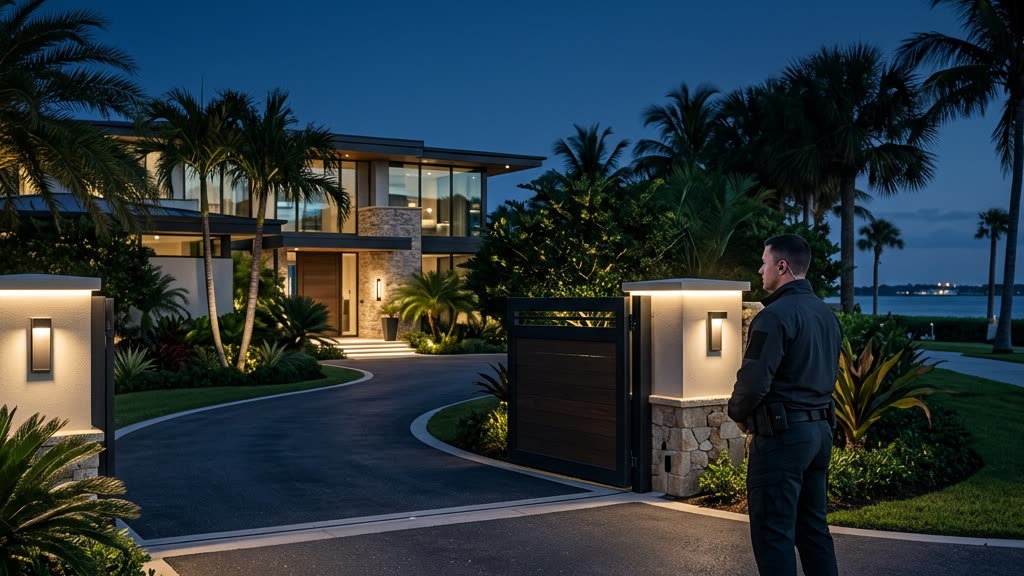
Most people picture executive protection as a large man in a dark suit standing behind a celebrity. That image sells movie tickets. It has very little to do with how executive protection services actually work for a private family. In more than two decades running protective operations and assessing estates for high-net-worth households, the best work I have done was almost always invisible. No confrontation, no headline, no story to tell afterward. A risk was identified early, a schedule was adjusted quietly, and the family went about its week never knowing how close a bad situation came to forming.
That is the frame I want to set before anything else. Real protection is not about the presence of muscle at the door. It is about the absence of the moment where muscle would ever be needed. This guide walks through what executive protection genuinely is, when it makes sense for a family rather than a public figure, and how the three real components, people, technology, and planning, fit together into something that protects a household without turning a home into a bunker.
What Executive Protection Actually Is
Executive protection is a discipline of risk management, not a display of force. The goal is to reduce the probability and the consequences of harm to a person or a family across the places they live, travel, and appear. When it is done well, the protective specialist spends far more time thinking, observing, and planning than reacting. The physical skills matter, but they sit at the very end of a long chain of decisions that should have already prevented the confrontation.
For a private family, the threat model looks different from the one you see around a head of state. Families rarely face organized political violence. What they face instead tends to be opportunistic and financially motivated: burglary crews that study wealth signals, fixated individuals who latch onto a person or a business, extortion attempts that begin online, and the ordinary chaos of a stalker, a disgruntled former employee, or a contentious divorce that turns volatile. Law enforcement has documented, again and again, that the people who target affluent households usually do their homework first. The protective response has to begin at the same place theirs does: with information and pattern, not with a weapon.
I make this distinction early because the word “bodyguard” pushes families toward the wrong purchase. They hire a person to stand near them and feel protected, when what actually keeps them safe is an integrated program. A single agent with no advance work, no residential security, and no communication plan is a comfort object. A modest, well-designed program with fewer visible people is far more effective.
When Executive Protection Services Make Sense for a Family
Not every affluent family needs a protective program, and I will tell a prospective client that plainly. Over-securing a household creates its own problems: it isolates children, strains a marriage, and signals importance to exactly the people you would rather not interest. The honest question is not “can we afford protection,” it is “does our risk profile justify it, and at what level.”
Signals that it is time to assess
A few patterns tend to move a family from “probably fine” to “worth a professional look.” Visible wealth is one: a public property record, a recognizable estate, a lifestyle documented on social media by children or staff who do not think about who is watching. A public or semi-public profile is another, whether that comes from business leadership, media, philanthropy, or simply being known in a community. Litigation and personnel disputes matter more than people expect, because grievance is one of the most reliable predictors of fixation. Major life transitions, a liquidity event, a divorce, an inheritance, a relocation, all reshuffle who has access and who feels wronged. And travel, especially international travel or travel to unfamiliar regions, changes the equation entirely.
None of these alone means you need agents on a rotation. Together, or in an intensified form, they are the moment to bring in someone who does this for a living and let them tell you what the risk actually is. A good assessment often concludes that a family needs better locks, better cameras, and a plan, not a detail. That is a successful outcome, not a lost sale.
The Three Pillars: Agents, Technology, and Planning
Every serious protective program rests on three legs. Weakness in any one of them undermines the other two. Where families go wrong is buying heavily into one leg, usually agents or cameras, and neglecting the rest.
People
Protective specialists are the most visible and most expensive element, and often the least necessary in the quantities people imagine. A capable agent does far more than stand post. They conduct advance work on locations before the family arrives, they read a room and a route, they manage the small logistics that keep a principal from being predictable, and they maintain the calm that lets a family live normally. The best ones are relational, not confrontational. They blend into a restaurant, a school pickup, a board meeting. Selection matters enormously here. Training, judgment, and temperament separate a professional from a large person with a permit, and that difference only reveals itself in the rare, fast moments when it is too late to fix.
Technology
Technology is the force multiplier that lets a smaller human team cover more ground. Good residential systems, layered cameras, access control, alarm monitoring, and lighting, extend a specialist’s awareness across a property they cannot physically stand on at all hours. This is where I spend a lot of a family’s attention, because it delivers durable value long after a temporary detail stands down. I want to be precise about one part of it: on the detection side, our team deploys and tunes GuardDog AI, an enterprise-grade intrusion-detection platform. GuardDog is a third-party product, and we act as its exclusive reseller partner and integrator, which means we install it, connect it to the rest of the estate’s systems, and tune it to the household. You can read more about how that fits an estate on our GuardDog overview, and about the broader residential approach in our guide to luxury home security in Florida. Technology is a tool, not a guardian. It informs people; it does not replace their judgment.
Planning
Planning is the invisible pillar, and it is the one that actually prevents incidents. This is the advance work, the route selection, the communication protocols, the emergency plans, the vetting of household staff and vendors, the quiet coordination with local law enforcement and medical resources before anyone needs them. Federal preparedness guidance from resources like Ready.gov (opens in a new tab) makes the same case for ordinary emergencies that we make for security: the plan you rehearse before the event is worth far more than the reaction you improvise during it. A family that has walked through what happens if a child is separated at an airport, or if a stranger appears at the gate, recovers in seconds instead of minutes. Minutes are where harm happens.
Protection on the Move
The residence is only one of the places a family is exposed. The vehicle and the road are, statistically and practically, where private families face some of their most realistic risk, and they are where most protective programs are weakest. A great deal of what threatens a family in transit has nothing to do with a targeted attack. It is the ordinary crash, the aggressive stranger, the moment of distraction at a stoplight in an unfamiliar city.
Secure movement is a skill set of its own. It starts with unpredictability, varied routes and times, and it extends into how a driver positions the vehicle in traffic, maintains space, and keeps the option to leave. For families who want to understand this in depth, we cover the fundamentals in our field note on secure driving and carjacking prevention, which is written for real households rather than for a motorcade. The behaviors there, keeping a gap to the car ahead, staying off the phone at intersections, trusting the instinct to drive away, protect against everyday danger as much as deliberate targeting.
There is also a quieter, technical exposure that many affluent families never think about: the vehicle itself as a point of theft. Modern keyless entry systems have introduced vulnerabilities that thieves exploit without ever touching the owner, and a stolen high-value vehicle is both a direct loss and a window into where a family lives and travels. We break down how these attacks work, and how to defeat them, in our piece on keyless car theft and relay attacks. Protecting movement, in other words, means protecting the person in the car, the route they take, and the machine they leave in the driveway.
The Estate as a System
A protected home is not a collection of gadgets bolted on over time. It is a system designed in layers, so that a failure at one layer is caught by the next. The outermost layer is the perimeter and the approach: landscaping, lighting, sightlines, and the simple fact of making a property hard to study. Inside that sits access control and detection, the cameras and sensors that notice what should not be there and tell someone in time to matter. Deeper still is the safe interior and the family’s own routine, the habits and rehearsed responses that turn an alarm into an orderly action instead of a panic.
The convergence of the physical and the digital is worth naming here, because it is where estates are increasingly probed. Agencies like the Cybersecurity and Infrastructure Security Agency (opens in a new tab) have long emphasized that connected devices are now part of the physical security picture, and a family’s cameras, network, and smart-home controls are attack surfaces as real as a window. A protective program that secures the doors but ignores the router is only half a program. In South Florida in particular, where visible wealth and seasonal residency create predictable patterns, this systems view is what separates a genuinely secure estate from one that merely looks secure. We work through these considerations regularly with families in communities like Boca Raton, where the estate, the vehicles, and the family’s public rhythm all have to be considered together.
Protecting the Family, Not Just the Principal
The final point is the one that most distinguishes family executive protection from corporate work. A company protects an individual. A family has to protect everyone: the spouse who runs the household, the children who post their locations without a second thought, the staff whose access and discretion are part of the security envelope. The weakest link in a wealthy family’s security is rarely the principal, who is usually the most aware. It is more often a teenager’s social media, a nanny’s ex-partner, or a contractor with a key and a grievance.
Good protection extends outward to cover this. It includes quiet guidance on digital hygiene and privacy, because a family’s exposure now begins online long before anyone shows up at a gate. Resources from the Federal Bureau of Investigation (opens in a new tab) on financial crime and extortion make clear how often physical threats to families start as digital reconnaissance. It includes vetting the people who move through the household, and it includes teaching the family itself, without frightening them, how to notice and report the early signals that something is off. The veteran-owned team I work with at SDVOSB.services approaches this the way I have always preferred: assess honestly, build only what the risk justifies, and keep the family living its life rather than performing security.
Building the Right Program
If you take one thing from this guide, let it be the order of operations. Do not start by hiring agents. Start with an honest, professional assessment of your actual risk, conducted by someone with no incentive to oversell. That assessment should produce a program scaled to your life, which for most families means strong residential systems, a movement plan, digital and staff hygiene, and a small, carefully selected human element that scales up only for elevated periods like travel or a public event. Discretion should be a design goal, not an afterthought. The best program is the one your neighbors never notice and your children barely feel.
Frequently Asked Questions
Do we need full-time bodyguards, or is that overkill for a family?
For most private families, full-time agents are more than the risk requires and can even raise your profile. The far more common answer is a strong residential and technology foundation, a movement plan, and human specialists brought in for specific elevated periods such as travel, litigation, or a public appearance. A proper assessment tells you which level fits.
How is executive protection different from just installing a good alarm system?
An alarm tells you something already happened. Executive protection is designed to keep it from happening at all, through planning, advance work, and human judgment, with technology as one supporting layer. The alarm is a component. The program is the strategy that decides where the alarm goes and what happens the moment it triggers.
Will protection make our family feel like we live in a fortress?
It should not, and if it does, it is being done poorly. The entire craft is about protecting a family while preserving a normal life. Well-designed security is layered into the property and the routine so that it works quietly in the background. The measure of good protection is how little you notice it day to day.
Where should a family that has never done this start?
Start with a private, no-pressure risk assessment before you buy anything. Understanding your real exposure, your property, your travel, your public profile, and your household, is what lets you invest in the right things rather than the most visible ones. Everything else follows from that honest first look.
Protection for a family is not a product you buy once. It is a considered program that grows and contracts with your life, built by people who would rather prevent a problem than respond to one. If your circumstances have changed, or you simply want a clear-eyed read on where you actually stand, request a private consultation or call us directly at (239) 710-1772. The first conversation is about understanding your risk, not selling you a detail, and often the most valuable outcome is the reassurance that you need less than you feared.