
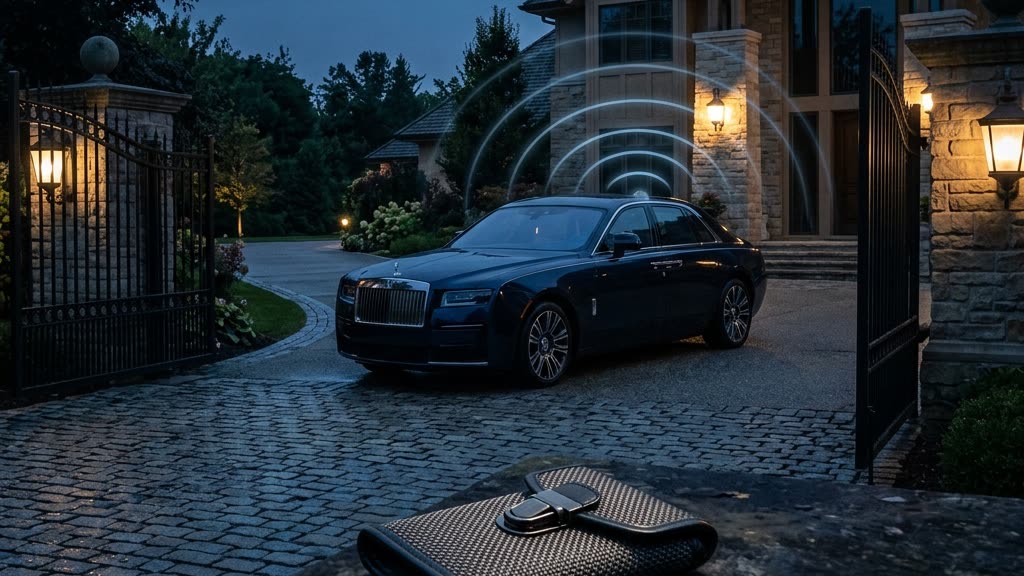
The signal that unlocks your car does not care whether you are standing beside it or asleep upstairs. That is the uncomfortable premise behind keyless car theft prevention, and it is why a six-figure vehicle can disappear from a gated driveway in under a minute with no broken glass and no alarm. I spent years in the Army working electronic warfare in Afghanistan, intercepting, jamming, and spoofing radio signals as part of a counter-IED team. When I look at a modern key fob today, I do not see a convenience. I see a small radio transmitter that a patient thief can listen to, copy, or relay. The reassuring part is that the same physics that make these attacks possible also make them preventable, often with quiet habits and modest hardware that cost almost nothing measured against the cars they protect.
Keyless entry was designed for a world where nobody expected the person in the driveway to be carrying a bag full of software-defined radios. That world is gone. So let me walk you through exactly how these thefts happen, in plain language, and then how you close each door.
How Keyless Entry Actually Works
A modern smart key is in a constant, low-power conversation with your vehicle. The car periodically broadcasts a short interrogation signal. When your fob is close enough to hear it, the fob answers with an encrypted response, and the car unlocks or allows a push-button start. You never press anything. That seamless handshake is the feature, and it is also the vulnerability.
The weakness is not usually the encryption itself. The weakness is that the car has no reliable way to confirm the fob is genuinely nearby. It only knows that a valid-sounding answer arrived. If a thief can make the car believe the key is close when it is actually locked in a drawer in your kitchen, the car opens. Everything below is a variation on that single deception: convincing the vehicle that the key is present when it is not.
Relay Attacks: Stealing the Signal, Not the Key
The most common method is the relay attack, and it is elegant in a way I grudgingly respect from my signals days. It takes two people and two radio devices. One thief stands near your house, close to where your keys sit inside, often just behind the front door or on an entry table. That person’s device captures the faint signal your fob is broadcasting and amplifies it. A second thief stands at the car with a companion device that rebroadcasts that boosted signal to the vehicle. The car hears what sounds like a key right next to it and unlocks. The engine starts. They drive away.
Nothing is decrypted. Nothing is cracked. The thieves simply extended the range of a legitimate conversation, the way a repeater extends a radio net across terrain. Law enforcement and auto insurers have documented this pattern extensively across high-value residential neighborhoods, and it works precisely because most people leave keys near the front of the house, which is the worst possible spot.
Rolling-Code and RollJam Attacks
Older and cheaper fobs, and many aftermarket garage and gate remotes, rely on rolling codes. Each press generates a new one-time code so a recorded signal cannot simply be replayed. It is a sound idea, but researchers demonstrated a defeat years ago, often called RollJam. The attacker jams your fob while simultaneously recording the code you just sent. Your first press appears to fail, so you press again. The device records the second code too, then releases the first one to open the gate or door, quietly keeping the second, still-valid code in reserve for later.
You never notice, because the mechanism worked on your second try. The thief now holds a good code for a return visit. This is why I treat any remote that controls entry to your property, gate, garage, side pedestrian door, as part of the same threat surface as the car itself.
Key Cloning and the OBD Port
The third avenue is more physical. Once a thief is inside the vehicle, whether through a relay attack or a smashed window, the onboard diagnostic port under the dashboard becomes the prize. With an inexpensive programming tool sold openly online, a criminal can pair a blank fob to your car in the time it takes to send a text. Now they own a working key, and they can come back on a calm night to take the car with no forced entry at all. This is why a single successful break-in should always trigger a dealer or locksmith review of which keys are authorized to your vehicle, not just a new window.
Faraday Habits: The Cheapest Fix You Own
If you do one thing after reading this, do this one. A faraday pouch or box is a signal-blocking container lined with conductive mesh. Drop your key fob inside and its broadcast stops reaching the outside world, which defeats the relay attack at its source. There is nothing to boost if there is nothing to hear.
I recommend building the habit around a fixed location. Keep a faraday box on a shelf away from exterior walls and windows, ideally toward the center of the house, and make dropping the keys in it as automatic as taking off your shoes. Test it: put the fob inside, close it, and try to unlock the car while standing next to it. If the car does not respond, the shielding works. Replace cheap pouches when the mesh wears, because a worn seam leaks signal.
A few reinforcing habits matter too. Some vehicles let you disable the fob’s passive broadcast when it sits still, often called a motion or sleep mode, so a key resting overnight goes quiet on its own. Check your owner’s manual or ask your dealer. And when you travel, the same discipline applies at hotels and valet stands, where a fob handed over or left in a jacket pocket is far from your control. I cover this in more depth in our notes on travel security for wealthy families, because a car parked at an airport for a week is a patient target.
Garage and Driveway Countermeasures
Faraday habits stop the signal. The next layer stops the vehicle from being easy to take even if a thief gets a code.
Bring the Car Inside, and Harden the Garage
A car inside a closed garage is dramatically harder to steal than one sitting in the open, so use the garage for the vehicle rather than for storage. Treat the garage door opener as a security device: replace old rolling-code remotes with current models, and if your system supports it, enable a keypad PIN and disable any remote you no longer use. A connected smart-garage controller can alert you the moment the door opens unexpectedly, which turns a silent 2 a.m. theft into a live notification.
Light the Approach and Watch It
Thieves running a relay attack need to loiter near the house with a device, sometimes for a minute or two. Motion-triggered lighting and well-placed cameras make that loitering costly. I favor cameras with local recording over cloud-only consumer units, for reasons I have written about in why cloud cameras like Ring and Nest are the weak link. For estate driveways here in the region, including the long private approaches common around Naples, the goal is simple: no dark corner within reach of a parked vehicle, and no blind spot at the front entry where keys typically live.
Add Physical and Electronic Deadlocks
Old-fashioned deterrents still work because they are visible and slow the thief down. A quality steering wheel lock, a wheel clamp for a car that sits for long stretches, or a lockable driveway bollard all shift the risk calculation. On the electronic side, ask your dealer or a reputable installer about an aftermarket immobilizer, sometimes called a ghost immobilizer, that requires a hidden PIN sequence entered on existing buttons before the engine will drive. Even a cloned fob is useless without that sequence, and because these devices do not broadcast, there is no signal to intercept.
Fold It Into a Layered Posture
A single countermeasure is a speed bump. The vehicle is safest when its protection is one thread in a coordinated plan, the same principle that governs a well-run luxury home security program. The driveway, the entry doors, the network, and the household routine all reinforce one another. Connected garage controllers and vehicle apps live on your home network, which is why our team pays attention to what runs on it. As the exclusive reseller partner for GuardDog AI, an enterprise intrusion-detection platform we deploy and tune, we watch that network layer for the anomalous behavior that often precedes a physical event, then coordinate the response.
For households with drivers, multiple vehicles, or staff who handle keys, the coordination question gets larger, and it belongs inside a documented plan rather than in someone’s memory. That is the work we describe in our approach to a family office security program and, for principals with a higher profile, our framework for executive protection for families. The car is often the first place a determined adversary probes, precisely because owners underestimate how exposed a key fob really is.
Frequently Asked Questions
Does a faraday pouch really stop relay theft?
Yes, when it is intact and used consistently. A faraday pouch blocks the fob’s radio signal, so an attacker standing outside your home has nothing to capture or amplify. The relay attack depends entirely on hearing that signal, so removing it defeats the method at the source. Test the pouch periodically and replace it when the lining wears.
Is keyless entry worth disabling entirely?
For some owners, yes. Many vehicles let you turn off passive entry so the car only responds to a deliberate button press, and some let the fob sleep when it is still. Neither is a cure on its own, but both shrink the window an attacker can exploit. Weigh convenience against exposure, especially if the car parks outdoors.
Are luxury and newer cars more at risk?
They draw more organized attention because resale and parts values are high, and the FBI (opens in a new tab) has tracked sophisticated theft rings that specialize in high-value vehicles. That said, the underlying vulnerability is the keyless system, not the badge. Any car with passive entry deserves the same habits and layered protection.
What should I do the moment I suspect a key was cloned?
Treat it seriously. Contact your dealer or a qualified locksmith to see which keys are authorized to the vehicle and have unknown ones revoked, then review your camera footage and report the incident. You can also file with the FTC (opens in a new tab) if account or identity data may be involved, and check safety and recall guidance through the NHTSA (opens in a new tab).
Keyless convenience was never meant to withstand a skilled adversary with a radio, and pretending otherwise is how good cars end up gone by morning. A faraday habit, a hardened garage, a watched approach, and a plan that treats the vehicle as part of the whole property will put you well ahead of the people testing driveways tonight. If you would like our veteran-owned team to assess your specific exposure and design that layered plan, request a private consultation or call us directly at (239) 710-1772.