
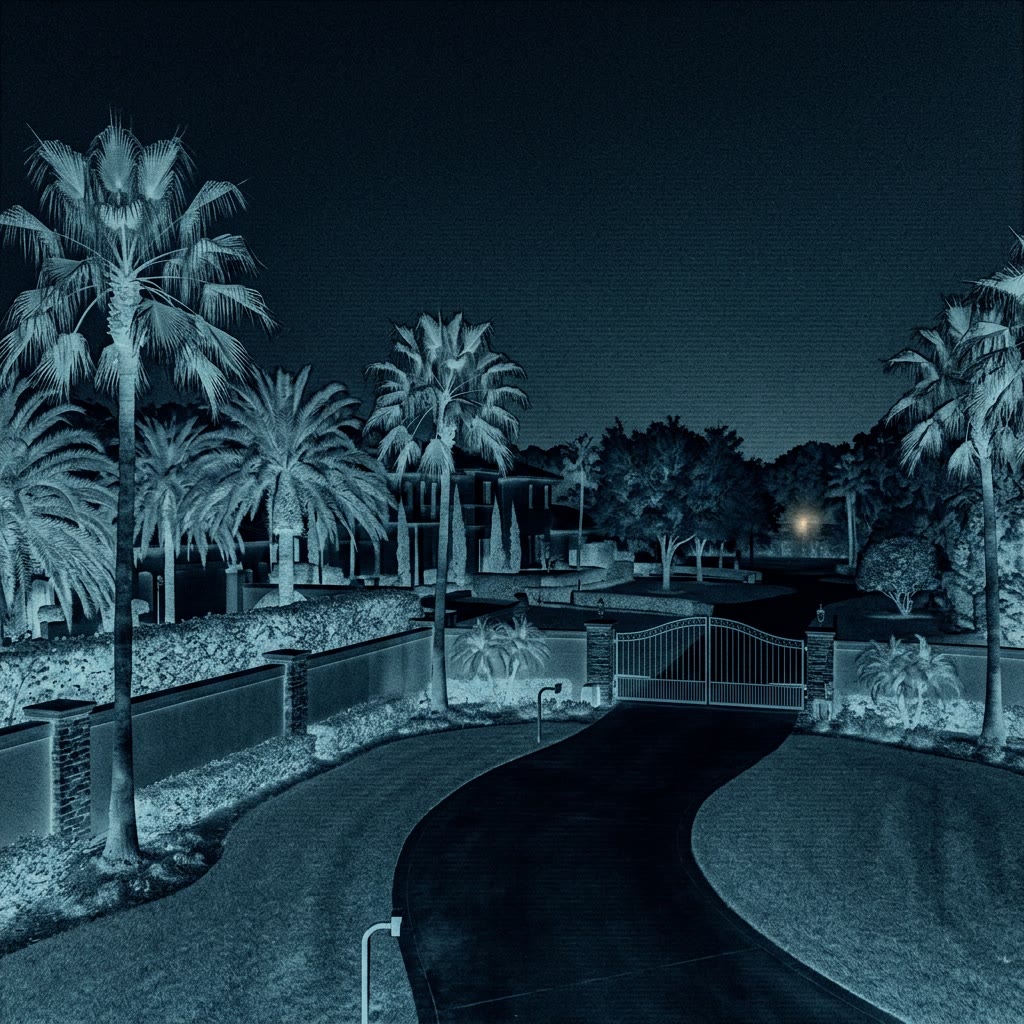
In the Army, I spent years on the electromagnetic spectrum, first as an Electronic Warfare Officer and then on Counter-IED work, where the entire job was understanding how a wireless signal can be listened to, jammed, or spoofed. When I walk into a luxury home in Naples or Palm Beach today and see a rack of consumer cloud cameras protecting an eight-figure property, I see the same vulnerabilities I once exploited professionally, just pointed at a family instead of a convoy.
The uncomfortable truth is that a Ring doorbell and a Nest cam are excellent consumer products and poor estate-security tools. They are built for a townhouse, priced for a mass market, and engineered around a business model that assumes your video lives in someone else’s data center. On a connected estate, that combination turns your cameras from your strongest asset into the single easiest thing for a competent adversary to defeat. Let me show you how it actually happens, and what genuinely hardens a modern home network.
The wireless layer is undefended by design
Here is the part almost no one selling you cameras will explain. The Wi-Fi standard your cameras run on has a structural flaw that has existed for over two decades. The “management frames” that tell a device to connect or disconnect from your router were, for years, sent completely unauthenticated. Your camera has no way to verify that a “disconnect now” instruction genuinely came from your router versus from a $60 device sitting in a car across the street.
This is a deauthentication attack, and it is not exotic. The hardware can be built in under half an hour from parts anyone can order online. The attacker doesn’t need your password, doesn’t need to touch your equipment, and doesn’t need any real skill. They simply flood the air with spoofed “disconnect” commands, and your wireless camera drops offline. No footage reaches the cloud because there is no connection to carry it. Security researchers have found that the overwhelming majority of wireless networks in the field have no protection against this at all [verify].
We have already moved from theory to street crime. Over the past two years, law enforcement across the country has documented burglars and “porch pirates” using cheap Wi-Fi jammers to knock cameras offline before they act. The FBI (opens in a new tab) and CISA (opens in a new tab) both now treat wireless jamming and IoT compromise as mainstream threats, not edge cases. If your entire camera system depends on an uninterrupted wireless link to a distant server, you have built your security on the one layer that an outsider can disrupt from the curb.
Jamming versus spoofing, and why it matters
There is a real distinction I want you to understand, because the fix depends on it. A deauthentication attack forges those disconnect commands, and there is a genuine defense against it: a security feature called Protected Management Frames (802.11w), which is mandatory in the WPA3 standard. When it’s active, your devices cryptographically verify management frames and simply ignore the forged ones. The problem is that most consumer cameras and their bundled base stations either don’t support it well or don’t enforce it, so the protection is off even when your router could offer it.
A jamming attack is cruder and, honestly, harder to stop. It floods the radio channel itself with noise. No cryptography helps here, because the physics of the airwave is being overwhelmed. This is exactly why, in my professional assessments, I treat any wireless-only camera as a device that a motivated adversary can silence at will. The only real answer is architectural, not a firmware update.
The cloud dependency is a second front
Set the radio aside for a moment. Even with a perfect wireless link, consumer cloud cameras create a second category of exposure that has nothing to do with your property line.
When your Ring or Nest records, that footage travels to and lives on a corporate server. You are now trusting that company’s security, its employees, its data-retention policies, and its willingness to hand footage to third parties. This isn’t hypothetical hand-wringing; there is a well-documented history of consumer camera vendors experiencing account takeovers, insider access to customer video, and law-enforcement data sharing that owners never explicitly agreed to. For a high-net-worth family, video of your interior layout, your routines, your children, and your safe room is not data you want sitting in a shared cloud you don’t control.
There’s also a quieter failure mode. Cloud cameras phone home constantly, and many “smart” features route through servers overseas or through third-party analytics providers. Every one of those connections is an outbound path that a compromised device can abuse, and an inbound path an attacker can probe. I’ve walked estates where a single cheap camera, months out of date on firmware, was the most-attacked device on the entire network, precisely because it was internet-exposed and forgotten. This is the same pattern I described in what a $2M burglary ring teaches us about estate security: the target is rarely the obvious front door. It’s the overlooked, over-trusted device three steps removed from it.
What actually hardens a connected estate
Now the useful part. Genuine hardening isn’t a product you buy; it’s an architecture you impose. Here is the approach I install and stand behind, in the order that matters.
1. Segment the network so a camera can’t see anything worth taking
The most important thing you can do costs almost nothing and stops the majority of lateral attacks: put your cameras and IoT devices on their own isolated network segment (a VLAN), walled off from the network your phones, laptops, and family files live on. If a camera is ever compromised, the attacker lands in an empty room. They can’t pivot to your banking, your email, or your other devices, because there is no route from the camera’s segment to yours. Both CISA (opens in a new tab) and the NIST (opens in a new tab) cybersecurity framework treat segmentation as foundational, not advanced. In practice, most homes run everything flat on one network, which is why one weak device compromises the whole house.
2. Record locally, so a jammer defeats nothing
This is the architectural answer to the jamming problem. When cameras are hardwired and recording to an on-site, encrypted network video recorder, cutting the Wi-Fi accomplishes nothing. The footage is already written to a drive inside your walls. Jam the air all you want; the record keeps rolling. Wired cameras also can’t be deauthenticated, because they were never on the radio in the first place. For a serious estate, wired-and-local is not a luxury upgrade; it’s the baseline that makes the system actually adversary-resistant.
3. Enforce WPA3 and Protected Management Frames everywhere possible
For the wireless devices that remain, insist on WPA3 with Protected Management Frames enforced. This closes the deauthentication door for anything modern enough to support it, and it quietly disqualifies the cheapest, least secure gear during selection, which is a feature, not a limitation.
4. Add spectrum awareness
Because jamming is a physical-layer attack, the mature defense is to detect it. A properly designed system monitors its own radio environment and treats a sudden flood of interference, or a camera going dark, as an alarm condition in itself, not a glitch to be ignored. In signals work we called this recognizing that the absence of a signal is itself intelligence. An estate system should escalate a silent camera immediately, over a channel the jammer can’t touch, such as a cellular backup.
5. Maintain it like the critical infrastructure it is
Change every default credential. Keep firmware current. Retire devices the manufacturer has stopped patching. Ready.gov (opens in a new tab) and CISA both publish plain-language guidance on exactly this hygiene, and it holds up. A hardened network that goes un-maintained for two years is no longer hardened.
You can see how all of this fits into a complete defensive posture on our luxury home security in Florida pillar, and how we tailor it to specific communities like Naples and Palm Beach, where the threat profile and the property values both run high.
FAQ
Are Ring and Nest cameras insecure? Not for an apartment. For a high-value estate, yes, in the sense that matters: they depend on a wireless link an outsider can disrupt and a cloud you don’t control. They are the right tool for the wrong job when the stakes are your family’s privacy and safety.
Can a Wi-Fi jammer really disable my cameras? If your cameras are wireless, yes, and it’s increasingly common in real burglaries. A cheap jammer floods the radio channel, and no password or app setting stops the physics. The durable fix is wired cameras recording locally, so the footage survives even when the air is jammed.
Is local recording really more secure than the cloud? For a private estate, yes. Encrypted on-site recording means your interior video never leaves your property, removing an entire category of third-party breach, insider access, and data-sharing risk. The cloud is convenient; local is defensible.
What’s the single most effective thing I can do first? Segment your network. Isolating cameras and IoT devices from your personal devices is low-cost, high-impact, and neutralizes the most common attack path, where one weak device becomes the key to the whole house.
A quiet word to close
Most of the estates I assess were sold “premium” cameras by someone who never thought about the electromagnetic spectrum, the cloud supply chain, or what a competent adversary actually does at 2 a.m. That gap is exactly what my team was trained to see and to close.
If you’d like a discreet, no-pressure review of how your current system would hold up against a real attacker, request a private consultation or call us directly at (239) 710-1772. We’ll tell you what’s solid, what isn’t, and what a genuinely hardened estate looks like, in plain language.
Written by Onur Oncer, Chief Technology Officer and U.S. Army combat veteran (former Electronic Warfare Officer, Counter-IED). Google AI certified and a published scientist, Onur writes about home cyber and AI from first-hand signals and electronic-security experience.