
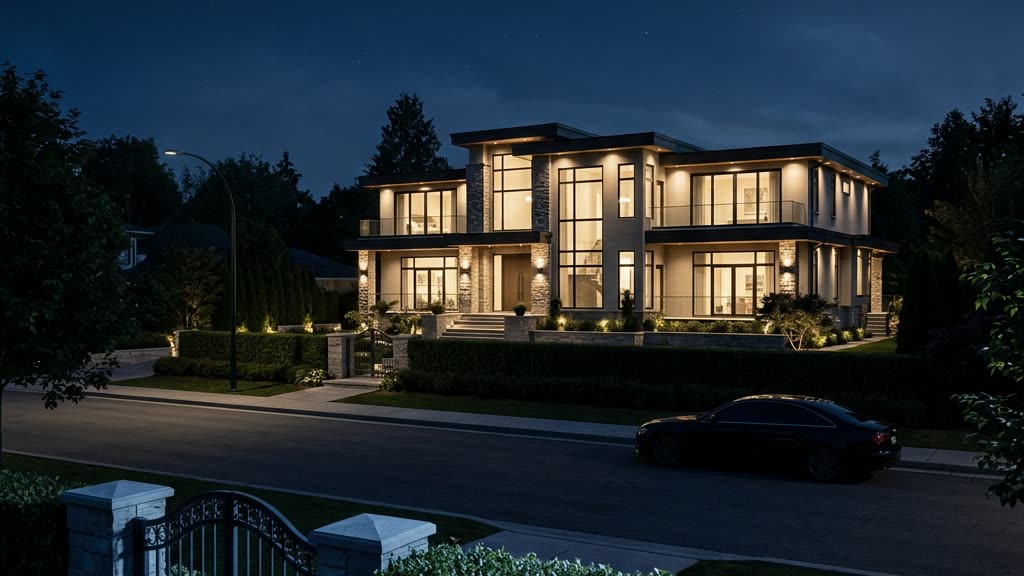
Every estate assessment I run begins the same way. I park down the street and study the property the way a professional crew would: not as a home, as a target file. I spent years leading a security company in Brazil, and I have since assessed estates and run protective operations for high-net-worth families across the United States. That experience taught me something the popular image of burglary gets wrong. The crews that hit luxury homes are not opportunists rattling door handles. They are patient, organized, and deliberate, and understanding how burglars choose houses is the foundation of every defense worth building. Professional crews select targets the way an underwriter prices risk: reward weighed against exposure, opportunity weighed against consequence. Understand that selection process and you can take your home off the list before a crew ever commits to it.
Burglary at This Level Is a Business, Not a Crime of Opportunity
The first adjustment is mental: stop thinking of burglary as a random event. At the top of the market it is a planned operation with a division of labor. One person selects targets, another runs surveillance, another defeats the security layer, and someone else moves the goods. Law enforcement has documented organized theft groups that travel between states and countries specifically to work affluent neighborhoods, and the FBI (opens in a new tab) has publicly warned about crews that systematically targeted the homes of professional athletes and executives, timing entries to travel schedules that guaranteed an empty house.
The margins are excellent, and most luxury homes are defended by systems designed for convenience rather than resistance. I broke down one instructive case in what a $2M burglary ring teaches us about estate security, and the lesson repeats across every ring I have studied: professionals do not gamble. They commit to a house only after the file on it is complete.
The Target File: Three Questions Every Crew Answers First
When I reverse-engineer how burglars choose houses, the selection always reduces to three questions. What is inside? What will entry and escape cost? When will the house be empty?
Reward: what the property signals
A crew rarely knows exactly what it will find, so it reads signals. Architecture and landscaping that suggest serious money. Watches and art visible through the glass-heavy rear elevations that dominate modern luxury construction. Old listing photos that never left the internet, showing the closet build-out and the location of the primary suite. The estimate does not need to be precise. It only needs to justify the planning effort.
Exposure: what entry and escape will cost
Here is where most homeowners misread their own defenses. A crew does not ask whether you have security. It assumes you do. It asks how much time and risk that security actually imposes: how visible the approach is from the street, whether detection begins at the property line or only at the glass, and how long a response will realistically take. In assessments I walk the route a crew would take and time it. The results are sobering: on many estates, a capable team can reach the primary suite within minutes.
Predictability: the calendar is the real prize
Professionals overwhelmingly prefer an empty house. Confrontation adds charges, noise, and variables no planner wants. So the decisive intelligence is not what you own. It is when you leave. School runs, standing reservations, charity galas announced months in advance, and above all travel. In seasonal markets like Naples, where a meaningful share of estates sit dark for months at a time, the calendar work is nearly done for them. A crew that knows your rhythm does not need luck. It needs a window, and a predictable household hands it one on schedule.
Pattern-of-Life Surveillance: How a Crew Studies You
Pattern-of-life is a term of art from protective operations: the map of a person’s routines and habits. Executive protection teams build it to defend a principal. Burglary crews build it to defeat one. The workup typically runs on three tracks at once.
The physical workup
Expect nothing dramatic. A sedan that idles down the street twice in a week. A jogger with an unusual interest in sight lines. A knock at the door with a clipboard and a vague pitch about solar or landscaping, whose real purpose is to see who answers, hear whether a dog responds, and glimpse the alarm panel. Other crews simply watch: when the lights cycle, when staff arrive, when the gate opens, which nights the house goes dark early. None of it looks like crime while it happens, which is why I teach households and estate staff to log and report exactly these encounters.
The digital workup
Much of the file now assembles itself without anyone driving past the house. Geotagged posts, a teenager’s story from the airport lounge, the gala program with your name on the host committee: each item timestamps your absence or forecasts it. Property records, aerial mapping, and archived listings supply the floor plan and the approach. I wrote a dedicated brief on social media OPSEC for wealthy families because in cases investigators have described publicly, crews built entire target packages from open sources before ever visiting the street.
The insider angle
The third track is people. Cleaning services, contractors, delivery drivers, and party staff all see the inside of your life, and most are honest. But a crew only needs one conversation, one photographed keypad, one remark about the family leaving for the summer. The answer is not suspicion. It is process: vetting, access control, and compartmentalization of travel plans, the same way any well-run organization protects sensitive information.
What Makes a Luxury Home Attractive
The homes that land on a crew’s shortlist share a recognizable profile.
Predictable absence. Seasonal occupancy, publicized travel, and rigid routines are the single biggest factor. An empty house with a known return date is a professional’s ideal working environment.
Wealth on display with weak depth behind it. Visible valuables guarded by a consumer alarm, a few cloud cameras, and hope. I have written before about why cloud cameras like Ring and Nest are the weak link: they record crimes for later rather than interrupting them, and they depend on connections a crew can cut.
Wireless dependence. Law enforcement around the country has reported burglaries in which inexpensive jammers silenced Wi-Fi cameras and sensors before entry. If your entire detection layer rides on wireless signals, read what homeowners must know about Wi-Fi jammer burglaries.
Privacy that serves the intruder. Walls, hedges, and long setbacks feel protective, but concealment is neutral. It hides a crew from the neighbors just as effectively as it hides you from the road.
What Takes a House Off the List
The encouraging news: crews deselect targets constantly, and for consistent reasons.
Detection that starts at the property line. If the first sensor a crew trips is on the glass, you have surrendered the entire approach. Layered exterior detection, tuned to ignore wildlife and weather, changes the math because it takes away the one thing a professional cannot buy back: time. This is the layer where our veteran-owned team deploys GuardDog AI, an enterprise intrusion-detection platform we integrate and tune for estates as its exclusive reseller partner.
Redundancy that survives tampering. Hardwired detection, local recording, and multiple communication paths that keep working when the wireless spectrum goes quiet.
A lived-in, unpredictable house. Staggered lighting, varied schedules, vehicles that move, staff presence during absences. Predictability invites planning. Variance defeats it.
Evidence of a program, not just equipment. Crews recognize the difference. Monitored response, maintained sight lines, deliberate lighting, and staff who politely challenge strangers all signal that this file will be expensive to complete. Insurers study the same distinction, and the Insurance Information Institute (opens in a new tab) publishes useful material on how home security affects loss exposure.
The through-line: professionals want certainty. Every layer that adds doubt pushes them toward an easier street, and there is always an easier street.
Reading Your Own Estate the Way a Crew Would
You can run a useful first audit in an afternoon. Stand across the street and note everything you can learn without stepping onto the property. Search your address and family names and see what listings, permits, and posts reveal. Walk the approach a crew would take at night and count the seconds before anything detects you. Confirm whether your cameras and sensors survive a cut internet connection; guidance from CISA (opens in a new tab) on securing home networks is a sound place to start.
Most estates I assess were assembled piecemeal: an alarm from one vendor, cameras from another, a gate from the builder, none of it designed as a system. For the full framework we use, from perimeter to safe room, see our guide to luxury home security in Florida. It maps each layer of a complete program to the selection logic described here.
Frequently Asked Questions
Do professional crews really surveil a home before breaking in?
Yes. Investigators consistently describe advance surveillance in cases involving organized crews, ranging from repeated drive-bys to weeks of digital monitoring. Seeing no surveillance means little, because much of the workup happens off-site.
Are gated communities safe from professional burglary crews?
Safer against opportunists, not against professionals. Crews tailgate vehicles, pose as vendors, and exploit the complacency gates create. Treat the community gate as one layer among many, never as your perimeter.
How do crews know when a house is empty?
Social media, predictable seasonal schedules, pretext knocks and calls, observation of lighting and vehicle patterns, and occasionally information leaked through service providers. Controlling information about your absences matters as much as locks.
What is the single most effective change a homeowner can make?
Move detection off the glass and out to the property line, with power and communications that survive tampering. Early, reliable detection collapses the intruder’s timeline, and time is the one resource a crew cannot recover.
Once you understand how burglars choose houses, the goal becomes straightforward: make your estate the file that never gets completed. If you would like a professional read on how your property scores against this selection logic, we conduct discreet assessments across Southwest Florida and beyond. You can request a private consultation or call (239) 710-1772. A brief conversation will tell you whether a full assessment is worth your time.