
In 2011 I deployed to Afghanistan as an Electronic Warfare Officer attached to a counter-IED team. The job came down to a single discipline: control of the electromagnetic spectrum. We kept our own signals alive and denied the enemy theirs, because whoever owns the spectrum owns the fight. That background is why the rise of the Wi-Fi jammer burglary caught my attention early, and why I take it more seriously than much of the residential security industry does.
The pattern is simple and, from a technical standpoint, depressingly effective. A burglary crew arrives with a small transmitter, floods the radio frequencies your wireless cameras and sensors depend on, and moves through your property while your security system says nothing at all. Law enforcement agencies across the country have documented these cases and issued public warnings about them. The devices involved are illegal, inexpensive, and easy to obtain. If your home’s security depends entirely on Wi-Fi, you should assume a capable crew can switch it off from the street.
Here is how the attack works, and what a properly engineered defense looks like.
What a Wi-Fi Jammer Actually Does
The word “jamming” gets used loosely, so let me be precise. Two techniques are in play, and crews use both.
Brute-force RF jamming
A true jammer is a transmitter that floods a slice of spectrum with noise. Your camera and your router are trying to hold a quiet conversation on the 2.4 GHz or 5 GHz bands, and the jammer is an air horn in the same room. The receiver cannot separate the legitimate signal from the noise, so the link drops. It is the crude version of military electronic attack, shrunk to pocket size. It requires no skill, no password, and no knowledge of your network. Proximity and transmit power are the whole game.
Deauthentication attacks
The second technique is quieter. Older Wi-Fi management protocols let a device send disconnect commands that the network accepts without verifying the sender. An attacker with cheap hardware can forge a stream of these deauthentication frames and push every camera off your network while barely transmitting at all. Newer standards support protected management frames that resist this, but a meaningful share of consumer camera systems either lack the feature or ship with it disabled. The National Institute of Standards and Technology (opens in a new tab) has published wireless security guidance for years, and the recurring theme is blunt: consumer wireless was engineered for convenience, not for contact with a motivated adversary.
Either way, the camera does not fail loudly. It simply goes silent, and most platforms treat that silence as a routine connectivity hiccup rather than an attack in progress.
Why Wireless Cameras Fail Quietly
Wireless cameras carry two structural weaknesses that jamming exploits perfectly.
First, most of them record to the cloud. If the radio link is down, nothing reaches the server, which means the attack erases the evidence of itself. There is no corrupted file, no flagged gap in the timeline, just an absence. I covered this in why cloud cameras like Ring and Nest are the weak link, and jamming is the sharpest version of the problem.
Second, offline alerts are slow and easy to ignore. Consumer platforms are built around the reality that home Wi-Fi drops constantly for innocent reasons. When a camera disappears, the system waits, retries, and eventually sends a low-priority notification that looks just like the one from the last router reboot. By the time anyone treats it as suspicious, the crew is gone.
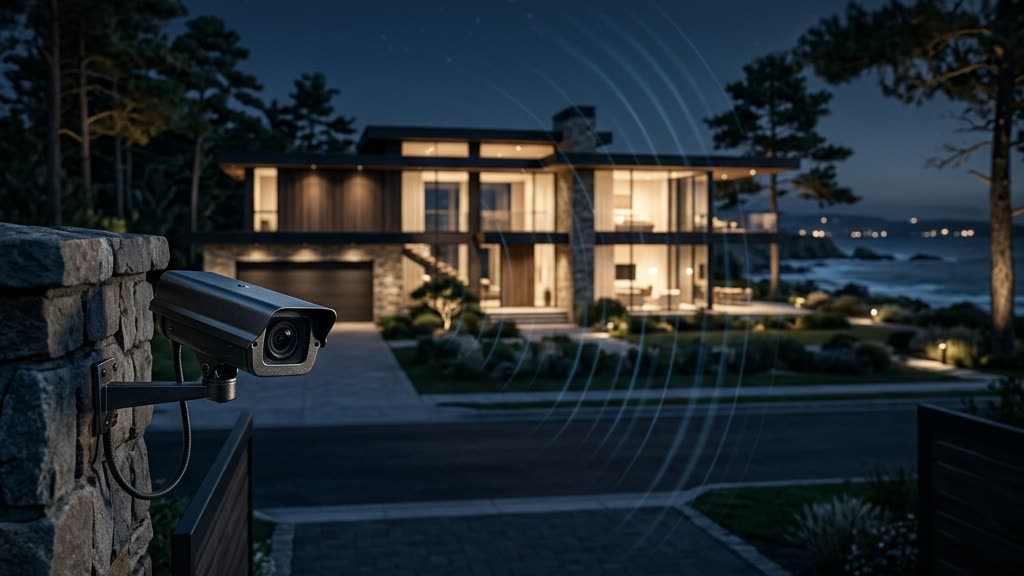
In electronic warfare we call this a denied environment: a bubble in which your sensors transmit into nothing. That is exactly what a jammer builds around your home.
How Crews Use Jammers Against High-Value Homes
A wifi jammer burglary is almost never a crime of opportunity. Jamming shows up at the end of a process that begins weeks earlier with target selection and surveillance. I have written about how burglary crews choose luxury homes, and the short version is that they favor properties with predictable occupancy, valuable and portable contents, and security that can be defeated remotely. Wireless-only camera systems check that last box.
The reconnaissance is usually digital before it is physical. Crews study listing photos, aerial imagery, and the family’s own posts. A visible doorbell camera and a few Wi-Fi cameras under the eaves tell a trained eye everything about the system’s architecture. Public social activity tells them when the house will be empty, which is why I push clients so hard on social media discipline for wealthy families. Some households face elevated risk by profession alone, a large part of why athletes and executives get targeted at home.
The geography of premium neighborhoods works in the crew’s favor too. Along canal-front streets like those in Port Royal, homes sit behind deep landscaping with generous setbacks, and a jammer’s effective radius easily covers the distance from the street or the water to the house. Privacy, the very feature owners pay for, shortens the attacker’s problem.
The Legal Reality, and Why It Will Not Protect You
Federal law prohibits the marketing, sale, and operation of signal jammers in the United States, with no homeowner or hobbyist exception, and the penalties are real. The FBI (opens in a new tab) and local agencies have pursued cases where jammers were recovered from burglary crews, and prosecutors treat the device as evidence of planning.
None of that helps you at two in the morning. The people pointing a jammer at your home have already accepted felony exposure for the burglary itself. An additional communications violation does not change their math. Your countermeasures have to work on physics, not statute.
Countermeasures That Hold Up Under Attack
The good news: defeating jamming is a solved engineering problem. It simply requires designing for an adversary instead of for convenience.
Put critical cameras on wire
A camera connected by Ethernet cable, powered over that same cable, and recording to an on-site network video recorder has no radio link to jam. Power over Ethernet cameras are the backbone of every serious system we design. The footage lands on hardware inside your home, so it survives both jamming and internet outages, and the cable itself runs protected inside walls and conduit. For perimeter coverage of an estate, this is not a luxury. It is the baseline.
Give the system more than one path out
Monitoring and alerting need a route to the outside world that does not depend on your Wi-Fi or your internet provider. Cellular communicators provide that second path, and dual-path configurations that combine broadband with cellular are the professional standard. Be honest about the limits, though: cellular bands can also be jammed by more sophisticated hardware. The answer is redundancy, plus a system that treats loss of communication as an alarm condition rather than a shrug.
Watch the spectrum, not just the video
Here is the mindset shift I carried home from electronic warfare: the jamming itself is a signal. A deauthentication flood or a wall of RF noise is loud and distinctive if anything is listening for it. Modern network defense tools can flag those events in real time and treat them as intrusion indicators. This is one reason our team deploys GuardDog AI, an enterprise intrusion detection platform that we integrate and tune for residential estates as its exclusive reseller partner. We did not build it; we chose it because it watches the network layer that camera platforms ignore. You can read about how we deploy GuardDog on estate networks, and CISA (opens in a new tab) offers solid baseline guidance on network security that any household can apply.
Keep layers that never touch the radio
Finally, assume the wireless layer fails and design so that the failure does not matter. Hardwired intrusion sensors on doors and glass. Physical hardening at entry points that buys time. Monitored response with humans in the loop. Layered defense is the core of our approach to luxury home security in Florida: no single sensor, link, or vendor should ever be a single point of failure.
Questions Worth Asking About Your Current System
You do not need to be an engineer to audit your own exposure. Ask four questions. Would my cameras keep recording if the Wi-Fi vanished right now? Would anyone be alerted within seconds, not minutes, if every wireless device dropped at once? Does my alarm have a communication path that does not share fate with my router? Is anything on my property watching for interference itself, rather than just watching video? If the honest answer to more than one of those is no, your system was designed for last decade’s burglar.
Frequently Asked Questions
Are Wi-Fi jammers illegal in the United States?
Yes. Federal law prohibits selling, marketing, or operating them, with no consumer exceptions. That deters honest people and does very little to deter burglary crews, which is why technical countermeasures matter far more than the statute.
Would I know if my cameras had been jammed?
Probably not in the moment. Most consumer platforms treat a jammed camera as an ordinary offline event and notify you slowly, if at all. Without dedicated monitoring for RF interference or deauthentication activity, a jamming attack usually reads as a Wi-Fi glitch.
Are cellular security systems immune to jamming?
No. Cellular is far more resilient than consumer Wi-Fi and raises the difficulty for the attacker considerably, but cellular-capable jammers exist. Treat cellular as one strong layer in a redundant design, and make sure that loss of signal itself triggers a supervisory alarm.
Do I need to replace every wireless device in my home?
No. Wireless has legitimate roles, interior convenience cameras among them. The rule is that anything mission-critical, meaning perimeter cameras, primary recording, and alarm communication, must either be wired or be monitored closely enough that its loss is treated as an event, never as silence.
The wifi jammer burglary is no longer exotic. The tools are cheap, the technique is documented, and crews targeting high-value homes have absorbed both. The defense is neither complicated nor experimental, it is simply deliberate: wire what matters, add redundant paths, and listen to the spectrum the way an adversary uses it. If you would like a discreet assessment of how your current system would hold up, our veteran-owned team is glad to walk the property with you. You can request a private consultation or reach us directly at (239) 710-1772.