
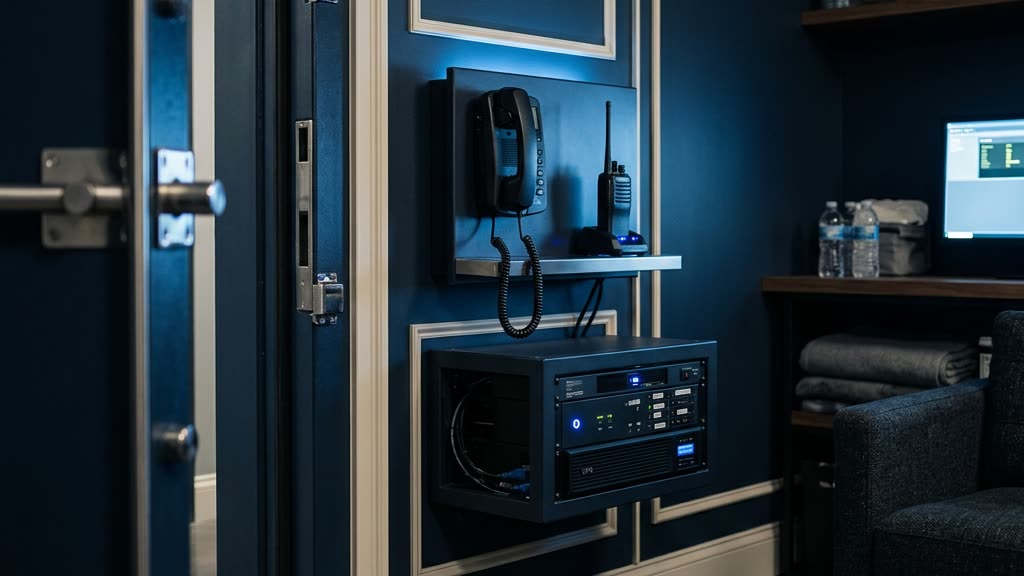
A safe room fails quietly. Not with a breached door or a defeated wall, but with a family sitting in the dark holding a phone that shows no bars, unable to reach anyone who can help. In two decades of assessing estates and running protective operations for high-net-worth families, I have found that safe room communications is the most overlooked element of an otherwise excellent refuge. Owners invest in ballistic panels, reinforced frames, and biometric locks, then route the room’s only lifeline through the same cellular signal and the same electrical panel that an intruder, a storm, or a simple utility fault can take offline in seconds.
A refuge is not a hiding place. It is a position from which you buy time and summon a response. If you cannot call for help and cannot keep your systems powered while you wait, the room has done half its job. The other half, the half that decides how the night ends, is communications and power. Below is how I think about both, and how we build them so they hold when everything around them does not.
Why the room is only as strong as its lifeline
The purpose of retreating to a safe room is to create distance between your family and a threat, then to shorten the time until trained responders arrive. Every minute in the room is a minute you are managing with information: where the intruder is, whether police are en route, whether a family member is still outside the door. All of that depends on a reliable channel to the outside world.
The failure I see most often is a single point of dependency. One carrier. One power source. One device. An adversary who has done even modest homework, or a hurricane that has done none at all, only has to remove that single thing. The discipline of good safe room communications is the discipline of redundancy: no single failure, whether accidental or deliberate, should leave the room silent. This is the same layered thinking that runs through serious luxury home security in Florida, where grid loss and storm season are not hypotheticals but seasonal certainties.
The three-layer communications stack
I design safe room communications in three independent layers. Each uses a different physical path to the outside world, so an attack or outage that defeats one does not touch the others. Think of it as cellular, wireline, and radio, with each layer capable of raising an alarm on its own.
Layer one: cellular, hardened
Cellular is the primary channel for most families because it is familiar and mobile. It is also the most fragile. Signal inside a hardened room is frequently poor, because the same dense construction that stops a round also attenuates radio frequency. Determined intruders can also degrade cellular coverage, and storms routinely knock down local towers.
We harden this layer in a few ways. A properly installed cellular signal booster with an external antenna brings usable signal into a room that would otherwise be a dead zone. Where the risk profile justifies it, we provision devices on more than one carrier, because coverage and outages differ between networks. A dedicated phone that lives in the room, kept charged and tested, removes the very human failure of the family sprinting to refuge and leaving the one device that works on the kitchen counter.
Layer two: a wireline path that does not depend on the house grid
The traditional copper landline is fading, but the principle behind it is sound: a physical wire to the outside that carries its own power and does not care whether your Wi-Fi is up. Where copper is still available, a hardwired handset in the room is worth keeping. Where it is not, a well-configured internet-based line can serve, provided the router, modem, and network gear are all on battery backup inside the protected envelope. The distinction that matters is not the technology on the label. It is whether the line stays alive when the main panel goes dark.
This is also where the security of the network itself becomes part of the conversation. A communications path is only trustworthy if the equipment carrying it has not been quietly compromised. As the exclusive reseller partner for GuardDog AI, our team deploys, integrates, and tunes that third-party intrusion-detection platform on estate networks, watching for the kind of quiet device-level compromise that could sit undetected on the very gear your alerting depends on. Protecting the pipe is part of protecting the message.
Layer three: two-way radio and satellite
The third layer answers the hardest question: what do you do when both the cellular and the wireline paths are gone at once. Two-way radios give you communication that depends on no carrier and no utility, either between family members and a security team on the property or, on a licensed setup, to a monitoring point. For estates in remote settings or coastal areas where storms routinely sever conventional service, a satellite messenger or phone adds a channel that reaches out even when the local infrastructure is entirely down.
None of these layers is exotic. What makes them effective is that they are independent, tested on a schedule, and kept inside the room rather than assumed to be somewhere in the house. For a fuller treatment of how these choices sit inside the overall room, our complete guide to safe room design walks through the structural decisions that surround the communications plan.
Alerting from inside the room
Communication is two directions. You need to reach out, and the people who protect you need to know, instantly, that you have gone to refuge. A hardwired panic capability inside the room, tied into a professionally monitored alarm system, sends that signal the moment you trigger it. I favor a physical, fixed control that a frightened person can find in the dark by feel, not only an app that requires an unlocked phone and steady hands.
The monitoring relationship behind that button matters as much as the button itself. A signal that reaches a central station, is verified quickly, and is escalated to law enforcement with the right address and access notes is worth far more than a loud siren that annoys the neighborhood and informs no one. When we design this, we make sure the responding agency has what it needs to act without delay, and that the family understands what happens on the other end of the alarm. General home-invasion and reporting guidance from the FBI (opens in a new tab) is a useful reference for families who want to understand how these events are documented and handled.
Independent power: keeping the refuge alive
Every element I have described assumes the room still has power. In Florida, that assumption is fragile for months at a time. Independent power is not a luxury bolt-on. It is the foundation the communications stack stands on.
Battery backup as the first line
An uninterruptible power supply, sized correctly, keeps your communications gear, monitoring panel, lighting, and network equipment running through the gap between a grid failure and any longer-term source coming online. This is the layer that guarantees your call does not drop mid-sentence when the lights go out. I specify battery capacity based on how long the room realistically needs to operate on its own, not on the smallest unit that fits the budget.
Generators, solar, and fuel that will actually be there
For sustained events, a standby generator with an automatic transfer switch carries the load without anyone stepping outside. The failure point here is almost always fuel: a generator with an empty tank is a heavy paperweight. We plan fuel type, storage, and runtime deliberately, and where it fits the property, we add solar with battery storage as a quiet, refueling-free supplement. The goal is a room that can sustain itself for the duration of a credible event, whether that event is a coordinated intrusion or a week without municipal power.
The federal preparedness guidance at Ready.gov (opens in a new tab) offers a sensible baseline for family communication plans and emergency supplies, and the resilience material published by CISA (opens in a new tab) is a good primer on why redundancy across independent systems is the professional standard. Both reinforce the same point I make to every client: plan for the loss of the thing you rely on most.
Bringing it together before the walls go up
The most cost-effective time to solve safe room communications and power is before construction, not after. Conduit routing, a dedicated electrical subpanel, antenna placement, and battery and generator siting are trivial to design in early and expensive to retrofit later. This is precisely why I encourage owners to bring a security practitioner into the room while the drawings are still on the table, a process we describe in designing security with your architect.
It is also where avoidable errors get locked in. Many of the problems I am called to fix later were set in motion by a single early decision, and several of the most common appear in our field note on the seven safe room mistakes that undermine otherwise capable rooms. Communications and power sit near the top of that list, because they are the systems owners most often assume will simply work.
Frequently Asked Questions
Do I still need a landline if I have strong cellular coverage?
You need a second independent path, and a wireline connection is one of the cleanest ways to provide it. Cellular can be degraded by construction, by weather, and by deliberate interference. A hardwired line, or a battery-backed internet line, gives you a channel that fails for different reasons than your phone, which is exactly the point of redundancy.
How long should the room stay powered on its own?
Long enough to outlast the credible event you are planning for. For a home intrusion, that is measured in the time until responders arrive and clear the scene. For a regional storm, it can be days. I size battery backup for the near-term certainty and add generator or solar capacity for the sustained case, so the room never depends on a single source.
Can an intruder simply cut my communications?
They can defeat one path if you only have one, which is why we never build on a single path. When cellular, a wireline connection, and radio or satellite each stand on their own, and the panic alerting is hardwired to a monitored station, an adversary would have to defeat several independent systems at once. That is a far harder problem, and it buys you the time refuge is meant to provide.
Is this only for large estates?
No. The principles scale to any home with a dedicated refuge. The specifics of capacity and equipment change, but the logic of redundant communications and independent power is the same whether the room protects a coastal estate or a primary residence in the city.
Safe room communications and power are the systems your family will reach for on the worst night of their lives, and they deserve the same rigor as the walls around them. Our veteran-owned team assesses each property on its own terms, then designs redundancy that holds under real pressure. To review your refuge and its lifelines with a practitioner, request a private consultation or call us directly at (239) 710-1772.