
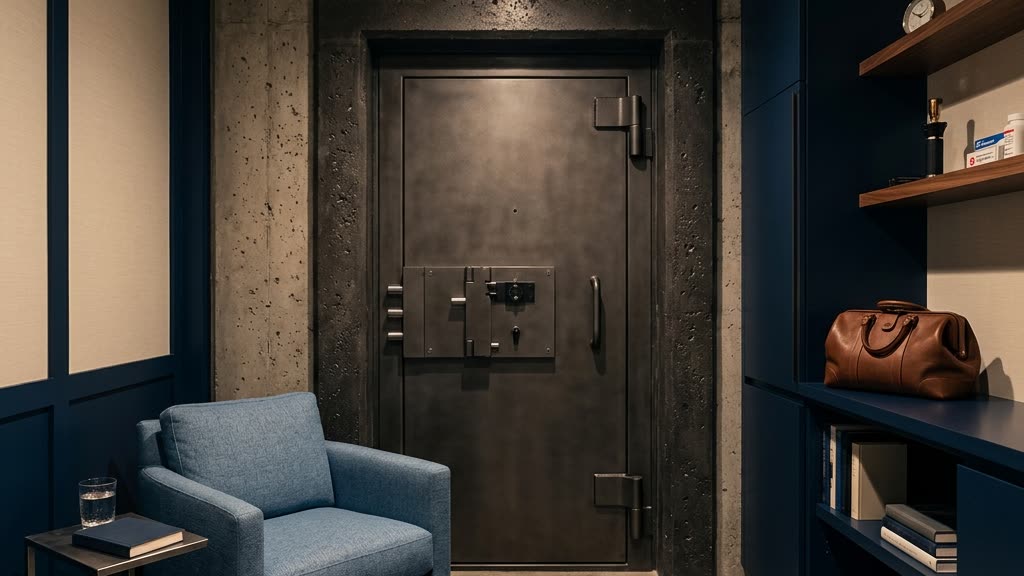
When a family on the Gulf coast asks me to build a room that will protect them, the conversation almost always begins with one threat and quietly grows to two. In Florida, the storm shelter safe room is the rare piece of home security that earns its cost twice. It stands ready for the hurricane that arrives on a forecast, and for the intruder who does not. I have spent much of my career assessing estates and running protective operations for high-net-worth families, and I have come to view the dual-purpose refuge as one of the most rational hardening investments a Florida homeowner can make. Built correctly, a single hardened space answers the two emergencies most likely to force a family to shelter in place.
The instinct to treat these as separate problems is understandable, and it is expensive. Homeowners commission a hurricane room from a shelter contractor, then bolt on a panic room concept later, or the reverse. The result is often two compromises instead of one strong design. The threats overlap more than most people expect. A storm strips a neighborhood of power, cameras, and police response for days, and that same window is when opportunistic crime rises. A well-planned refuge treats wind, water, and human intrusion as one continuous problem in survivability.
Why Florida Estates Need a Dual-Purpose Refuge
Florida concentrates hazards that most of the country experiences separately. The peninsula takes the brunt of Atlantic hurricane season, and the storm surge and wind fields that come with it can isolate a home long before and after landfall. Widely reported storms in recent years have left affluent coastal communities without power, cell service, or drivable roads for extended periods. During that isolation, the ordinary safeguards a wealthy family relies on, meaning private patrols, monitored alarms, and a responsive sheriff’s office, all degrade at once.
That is precisely the environment in which a determined intruder operates with the least friction. Law enforcement has long documented that burglary and property crime spike in the disorder that follows a major disaster, when homes stand dark and help is slow. For a high-net-worth household, the calculus is straightforward. The same days you most need protection from the storm are the days your protection from people is thinnest. A refuge that only solves one of those problems leaves the family exposed during the exact hours both threats converge.
This is the logic behind the broader approach I take to luxury home security in Florida. Layered defenses matter, but a family also needs a final, defensible place to go when the outer layers are overwhelmed by nature or by a person. The storm shelter safe room is that place.
What FEMA-Informed Construction Actually Means
The phrase “safe room” gets used loosely by builders who mean a reinforced closet. I use it in the technical sense, drawing on the design criteria that federal guidance has established for near-absolute life protection in extreme wind events. The public references maintained through Ready.gov (opens in a new tab) and FEMA’s shelter publications describe what a genuine safe room requires, and those standards are the right floor for any Florida estate, not the ceiling.
Structure and Anchoring
A true storm refuge is engineered to resist the wind pressures and windborne debris of a design-level hurricane. In practice that means reinforced concrete or filled masonry walls, a roof system rated for the same loads, and connections that tie the room into a foundation capable of resisting uplift. The failure point in most weak rooms is not the wall itself, it is the anchoring. Wind does not politely push on a structure. It tries to lift it, twist it, and pull the roof away. A refuge that is not mechanically fastened to a proper foundation is a decorative box.
The same mass that stops a two-by-four traveling at highway speed also frustrates the tools an intruder brings. Reinforced concrete does double duty here, which is one reason the dual-purpose design is so efficient. You are not paying twice for two kinds of hardness. You are buying one continuous shell that resists both debris and forced entry.
The Door Is the Whole Story
I tell every client the same thing. Your refuge is only as strong as its weakest opening, and that is almost always the door. A wind-rated, debris-rated door with a multi-point locking system and a reinforced frame is non-negotiable. Ordinary interior doors, even heavy ones, are not certified for either threat. The frame and its anchoring into the surrounding wall matter as much as the door slab. For the full treatment of how these pieces fit together, I walk owners through our complete safe room design guide, because the details that seem minor on a drawing are the ones that decide outcomes under load.
Designing for Two Threats at the Same Time
A refuge that works for both scenarios has to accommodate two very different timelines. Understanding each one changes the design.
The Storm Scenario
In a hurricane you have warning. The family gathers, provisions the room, and shelters for a period measured in hours, sometimes longer if the home is damaged and evacuation is impossible afterward. The priorities are debris protection, ventilation, and enough supplies to remain in place comfortably. Occupancy is planned. The stress is environmental, not adversarial.
The Intrusion Scenario
An intrusion offers little or no warning. The family moves fast, often at night, and the room must lock instantly and communicate with the outside world immediately. Here the priorities shift to rapid access, a door that cannot be defeated quickly, and a reliable line to summon help. The refuge does not need to defeat an intruder. It needs to hold long enough for response to arrive, and to make the cost of entry higher than any intruder is willing to pay.
Designing for both means the room must be quick to enter under duress and calm to occupy for hours, hardened against debris and against tools, and connected in a way that survives both a regional power loss and a deliberate attempt to cut it. Those are not contradictory requirements. They are complementary, and the discipline is in refusing to optimize for one at the expense of the other.
Life Support: Power, Air, and Communications
A refuge that traps a family without air, light, or a way to call for help is not a refuge. It is a very strong problem. This is the domain where I see the most expensive rooms fail, because the structural work is visible and the life-support work is not.
Ventilation has to function with the door sealed. Power has to survive the grid going down, which in a Florida storm is a certainty, not a risk, so battery backup and a path to generator support both belong in the plan. Communications cannot depend on a single carrier’s cell tower staying up. I generally specify redundant paths, meaning a hardwired line where feasible, cellular, and a satellite option for the worst case, so the family is never one failed tower away from silence. Because these systems are the difference between shelter and entrapment, I treat them as their own engineering exercise, which I detail in our field notes on safe room communications and power.
Detection belongs in this layer too. Knowing what is happening outside the door changes every decision a sheltering family makes. For estate clients we deploy and tune GuardDog AI, a third-party enterprise intrusion-detection platform that our veteran-owned team integrates as its exclusive reseller partner, so the household has eyes on the property even when the family is behind a sealed door. You can read more about how we deploy GuardDog as part of a layered defense.
Where the Refuge Belongs in the House
Placement is a quiet decision that shapes everything. The room should sit on an interior wall, away from windows and exterior openings, ideally on the ground floor to avoid the uplift forces that are strongest higher up and to keep access simple in an emergency. In multi-story estates I look for a location reachable from the primary bedroom without crossing the whole house, because in an intrusion the family will move toward it half-awake and under stress.
Discretion matters at this level of the market. A refuge does not need to announce itself. The best ones read as a normal part of the home, a study, a closet, a wine room, while doing structural work no one sees. For families in communities like Boca Raton, where privacy is part of the value of the property, an unobtrusive refuge protects the household without advertising that it exists.
Common Mistakes I See in Estate Safe Rooms
The errors repeat. Owners spend heavily on wall thickness and neglect the door. They forget ventilation. They route communications through a single point of failure. They place the room somewhere the family cannot reach quickly at night. They treat the storm case and the security case as separate projects and end up with a room that half-serves both. Each of these is avoidable with disciplined planning, and each one shows up after the fact, when it is expensive and disruptive to correct. I have catalogued the ones I encounter most often in our field notes on the seven safe room mistakes, because the cheapest fix is the one you make on paper before the concrete is poured.
Frequently Asked Questions
Can one room really serve as both a storm shelter and a security refuge?
Yes, and in Florida it should. The reinforced construction that resists windborne debris also resists forced entry, and the life-support systems a storm demands are the same ones an intrusion requires. Designing for both from the start is more effective and less costly than adapting a single-purpose room later.
How much space does a family need?
Enough to shelter the household comfortably for the longer of the two scenarios, which is usually the storm. The room has to hold everyone plus supplies, ventilation equipment, and communications gear without feeling like a closet. I size refuges around planned occupancy and expected duration rather than a fixed square footage, because a room that is too small will not be used.
Will a safe room lower my insurance or add value?
Insurance treatment varies by carrier and policy, and I do not make promises on premiums. Homeowners can review general guidance through resources like the Insurance Information Institute (opens in a new tab) and confirm specifics with their own agent. What I can say plainly is that a properly built refuge is a durable asset that a serious buyer in a coastal market understands and values.
How do I prepare the room before a storm?
Provision it ahead of the season, not the day a system is named. Florida’s own preparedness resources at FloridaDisaster.org (opens in a new tab) offer solid checklists for water, medication, documents, and power. Keep supplies current, test the communications and ventilation on a schedule, and make sure every member of the household knows how to reach and secure the room without instruction.
A refuge is one of the few investments that you hope never to prove out, and one you will be grateful for on the day you do. If you are weighing how a storm shelter safe room fits into the protection of your home and family, our veteran-owned team is glad to assess your property and design around your specific risks. To begin a discreet conversation, request a private consultation or call us directly at (239) 710-1772.