
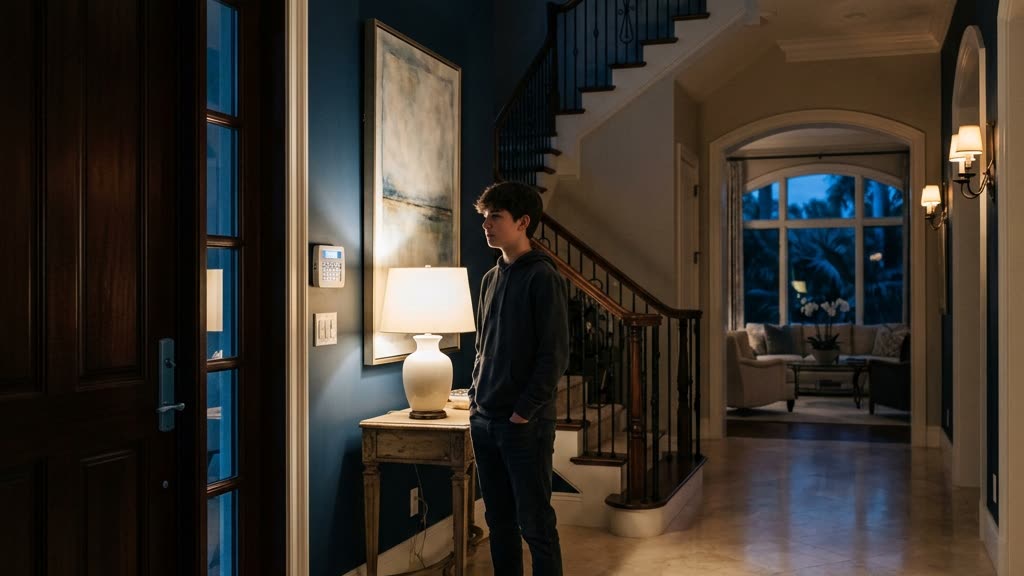
There is a specific afternoon every family with a large home eventually reaches: the one where the adults are an hour away and the teenagers are holding the house on their own for the first time. I have assessed a great many estates, and I can tell you that the quality of that afternoon is decided long before it arrives. Teen home alone safety is not a lecture you deliver on the way out the door. It is a system you build, rehearse, and then trust, so that a capable young person can run a secure house without an adult narrating every step.
Most of the families I work with have invested seriously in perimeter, cameras, and access control. What they often have not done is translate that infrastructure into something a sixteen-year-old will actually use when a friend shows up unannounced or a smoke alarm chirps at nine at night. The gap is rarely the equipment. It is the habits, the rules, and the small number of decisions we ask a teenager to make under mild pressure. Close that gap and you get something better than constant supervision. You get a young adult who can be trusted with the keys, literally and figuratively.
The Shift From Supervision To Trust
When a child becomes a teenager, the security conversation has to change with them. Supervision assumes an adult is present to catch mistakes. Trust assumes the teenager will make good decisions because they understand why the decisions matter. The families who navigate this well treat their teenagers as junior operators of the household, not as risks to be managed around.
That framing does real work. A teenager who understands that the alarm protects their younger siblings, the dogs, and the family’s privacy will arm the panel. A teenager who thinks the alarm is an adult’s paranoia will disarm it and leave it off. The difference is not maturity. It is whether anyone bothered to explain the reasoning and then handed over genuine responsibility. This is the same principle I apply when I help households build a broader plan, and it is worth reading alongside a proper family security plan guide so the teenage years fit inside a longer arc.
Arming Discipline: The System Only Works If They Use It
The most expensive alarm system in Palm Beach County is worthless if it spends the afternoon disarmed. Arming discipline is the single habit that determines whether everything else you have installed matters. And teenagers, left to their own defaults, will choose convenience every time. Our job is to make the secure choice the convenient one.
Make The Panel A Non-Event
If arming the house is a fifteen-second ritual with a long code and a confusing menu, it will not happen. I push families toward user-specific codes for each teenager, a clearly labeled panel or app, and a single obvious action for the two states they actually need: leaving, and settling in for the evening. When the interaction is simple, compliance stops being a battle. A teenager who has their own code also learns that the system remembers who did what, which quietly reinforces ownership.
Partial Arming For Daytime
The reason many teenagers refuse to arm the house is that full arming feels like being locked in a vault while the sun is up. The answer is partial or “stay” arming: perimeter doors and windows monitored, interior motion relaxed, so they can move through the kitchen and the yard without triggering anything. This gives you a genuinely protected shell during daylight hours without asking a young person to live inside a tripwire. Teach them to escalate to full arming at night or whenever they feel uneasy, and you have handed them a dial rather than a switch.
Visitor Rules That Hold Under Pressure
Almost every avoidable incident with a teenager home alone traces back to the front door or the gate. Someone was let in who should not have been, or a delivery became a conversation, or a friend of a friend arrived and no one wanted to be the one to say no. Visitor rules exist to take that social pressure off the teenager’s shoulders. The rule decides, not the sixteen-year-old standing awkwardly at the threshold.
The Front Gate Is A Decision Point
On a gated property, the gate is your best friend precisely because it creates distance and time. The rule I recommend is simple and absolute: the gate stays closed, and only pre-approved people come through it when parents are away. Everyone else is handled through the intercom or camera, and the default answer to an unexpected visitor is a polite “I can’t let you in right now.” No teenager should feel they owe an explanation to a stranger. Law enforcement has documented that offenders sometimes probe a property with a pretext at the door, and a young person who has been told the standing rule will not be talked out of it.
Deliveries And Service Windows
Deliveries and service calls are where good rules quietly fail. A teenager sees a familiar uniform and opens up out of habit. Set the rule that no service person and no delivery driver comes inside while parents are away, full stop. Packages are left at the gate or the door. If a service visit is genuinely scheduled, an adult confirms it in advance and, ideally, is present or on a live call. The federal consumer-protection guidance at the FTC (opens in a new tab) is a useful primer on the impersonation and social-engineering tactics that target households, and the same awareness applies at the front door as it does in an inbox.
Emergency Triggers: What Counts, And What They Do
Teenagers freeze not because they are incapable but because no one told them what the plan was. The antidote is a short, memorized list of triggers and the single action each one demands. When the situation is already defined, the teenager does not have to invent a response in the moment. They execute.
Write The Triggers Down
I ask families to name the handful of events that change the posture of the house: someone at the door who will not leave, a person seen on the property who does not belong, a fire or smoke alarm, a medical problem, a strange smell, a power loss that takes the cameras down. For each one, there is a written action. Not a paragraph. A line. Where the safe room is, where the exits are, who to call first, and when to simply leave the house and go to a neighbor. The national preparedness resources at Ready.gov (opens in a new tab) give families a clean template for building this out, and it is worth doing at the kitchen table together rather than handing a teenager a document.
One Phrase, One Action
The most reliable tool I give families is a code word. A single phrase that a teenager can text or say on a call that means “come now, do not ask questions.” It removes the paralysis of having to explain or justify a bad feeling. Pair it with a rehearsed instinct: if something is genuinely wrong, the goal is not to defend the house. It is to get people out and get help moving. Estates are large, and I would always rather a teenager be standing safely at a neighbor’s gate than heroically checking a noise in a wing they cannot see the end of.
Respecting Autonomy Without Losing The Perimeter
Here is the balance that matters most, and the one families get wrong in both directions. Surveil a teenager too heavily and they will route around every control you install, because no one likes living inside a microscope. Give them no structure at all and you have handed a serious responsibility to someone with no framework for it. The estates that run well find the middle: cameras cover the perimeter and the approaches, not the private interior spaces where a young person has a reasonable expectation of privacy. The teenager knows exactly what is monitored and why, because you told them.
Autonomy, framed correctly, is a security asset. A teenager who feels respected becomes a genuine partner in protecting the household. They report the odd car parked outside. They notice the gate left open. They speak up when a friend’s plus-one seems off. That kind of engaged awareness is worth more than any additional sensor, and it is the same collaborative instinct that makes a household resilient when the concern is at the other end of the age range, as I discuss in my notes on securing an aging parent’s estate.
Layering Technology Behind The Human Habits
Once the habits and rules are solid, technology should make them easier, not replace them. A well-trained protection dog, for instance, changes the whole calculus at the door and gives a teenager both an early alert and real confidence, which is why I treat dogs as part of estate security rather than as pets that happen to bark. On the detection side, our veteran-owned team deploys and tunes GuardDog AI, a third-party enterprise intrusion-detection platform for which we serve as the exclusive reseller partner. It watches the network the cameras and sensors run on, so a teenager alone in the house is backed by monitoring that does not depend on them noticing anything at all. All of this sits inside the broader approach I lay out for luxury home security across Florida, because a teenager home alone is not a separate problem. It is one chapter in how a serious estate protects the people inside it.
Frequently Asked Questions
At what age can a teenager safely be home alone on a large property?
There is no single number, because maturity and the property both matter. A capable fourteen-year-old in a well-secured, gated home with rehearsed rules may be more ready than an older teenager in a home with no plan. Judge readiness by whether they can arm the system, follow the visitor rules under mild pressure, and execute the emergency triggers from memory. If they can do those three things calmly, they are ready.
Should I track my teenager’s phone location when they are home alone?
Location sharing within a family is reasonable when it is mutual and openly discussed, not covert. Covert monitoring almost always backfires, because a teenager who discovers it stops trusting the entire security relationship. Frame it as a two-way safety tool the whole family uses, agree on it together, and it becomes a genuine asset rather than a source of resentment.
What is the single most important habit to teach first?
Arming discipline. Everything else depends on the house actually being armed. If a teenager reliably sets the alarm to “stay” during the day and full arming at night, and never opens the door to an unexpected visitor, you have covered the large majority of realistic risk before you add anything else.
How do I prepare a teenager for a real emergency without frightening them?
Rehearse calmly and treat it as competence, not fear. Walk the exits, name the safe room, practice the code word, and make the whole thing feel like learning to drive: a serious skill they are being trusted with. Confidence, not anxiety, is what carries a young person through a genuine emergency.
Building teen home alone safety into an estate is less about hardware and more about handing a capable young person a clear, rehearsed framework and then trusting them to run it. If you would like a candid assessment of how your property and your family’s routines hold up when the teenagers are on their own, I would welcome the conversation. You can request a private consultation or reach our team directly at (239) 710-1772.