
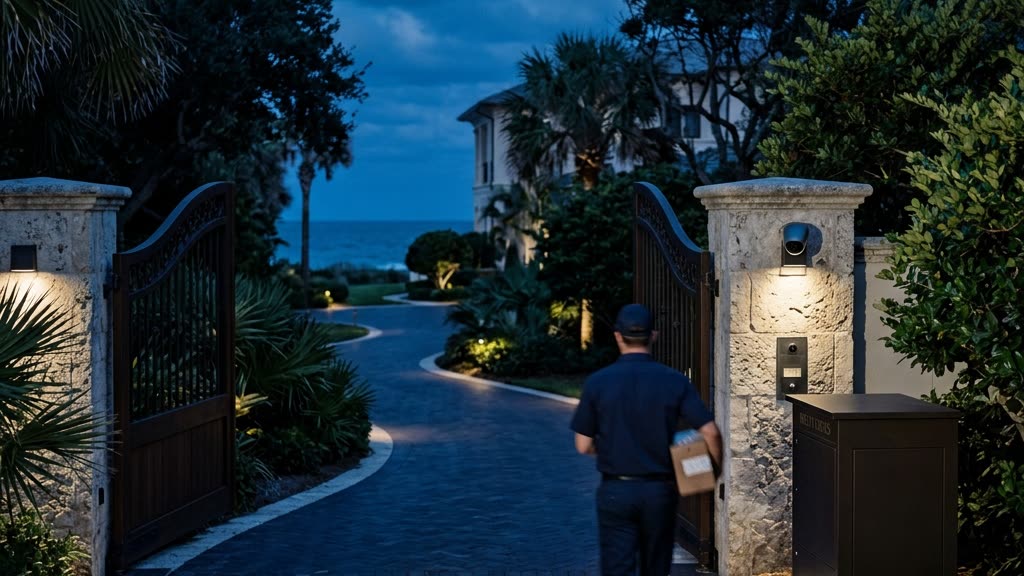
Every estate I assess has the same blind spot, and it arrives several times a day wearing a familiar uniform and carrying a cardboard box. Package delivery security is the quietest weakness in most high-net-worth households, because deliveries feel routine, benign, and beneath concern. They are none of those things. A delivery is a scheduled, repeating event in which a stranger approaches your threshold, your gate opens on cue, and your household lowers its guard by reflex. Over years of running protective operations for families here in Florida and abroad, I have learned that the people who study a residence rarely begin with the alarm panel. They begin with the delivery rhythm, because it quietly tells them who comes, when, and how close a stranger can get before anyone thinks to ask a question.
This is not an argument for refusing packages. It is an argument for treating the delivery stream as what it actually is: a recurring, semi-trusted channel that runs straight through your perimeter. Handled with a little structure, it stays a convenience. Handled carelessly, it becomes the easiest way for someone to learn your patterns, test your gate, or walk up to your door with a plausible reason to be there.
A Delivery Is a Reconnaissance Channel
Before anyone attempts a theft or a forced approach, they gather information, and deliveries hand it over for free. The frequency of drop-offs suggests the size of the household and its spending. Boxes left in view advertise what you have just bought. A driver who is buzzed through without a word teaches a watcher that the gate opens for a uniform. None of this requires sophistication. It requires patience and a place to stand.
I ask families to think about the signal they broadcast without meaning to. Idle packages on a front step near a public road are a billboard. A gate that opens for any vehicle with a magnetic decal is a training exercise for the wrong audience. The purpose of good package delivery security is to close these small information leaks so that the residence gives away as little as possible about its people, its habits, and its valuables. That principle runs through everything I recommend, and it is the same instinct behind serious luxury home security in Florida: reduce what a stranger can learn, and you reduce what a stranger can plan.
Gate Deliveries: The Perimeter Decision That Sets the Tone
The gate is where package delivery security is won or lost, because it is the one moment you control completely. Once a vehicle is inside the wall, your options narrow and your margin disappears. My strong preference for gated estates is simple: routine deliveries do not come through the inner gate at all.
Establish a Delivery Zone Outside the Inner Perimeter
Create a defined place where couriers drop parcels without being admitted to the grounds: a secure parcel enclosure, a lockbox large enough for the volume you actually receive, or a service vestibule near the entrance. This single change accomplishes several things at once. It keeps unknown vehicles and unknown people outside the space where your family moves. It removes the daily habit of opening the gate for strangers. And it gives you a controlled, observed point where every parcel passes through, rather than a scatter of drop points across the property.
For larger estates with staff, the delivery zone also clarifies responsibility. Someone owns the parcels, logs them, and brings them in. That clarity matters, and it connects to a broader discipline I write about in how households manage staff digital access boundaries: the same care you apply to who holds a code or a credential should apply to who receives, opens, and moves what arrives at your door.
Verify the Appointment, Not the Uniform
A gate should open for an expected event, not for a costume. When a delivery genuinely requires access to the grounds, a furniture crew, an appliance installation, a catering team, the appointment should be known in advance, tied to a company and a name, and confirmed by a call to a number your household already has, never a number handed to you at the gate. The uniform proves nothing. The appointment, verified independently, proves a great deal.
Porch Strategy: Remove the Reward, Control the Approach
Even with a strong gate posture, most homes still receive parcels at or near the door. The porch is where two problems meet: opportunistic theft, which law enforcement has documented rising in step with online ordering, and the more serious risk of a stranger using a package as a reason to reach your threshold.
Remove the Reward
A parcel visible from the street or drive is an invitation. The fix is boring and effective: parcels should land where they cannot be seen and cannot be reached without entering an observed, defensible space. A recessed alcove, a parcel locker, or a side service door out of public sightlines turns an easy grab into an effort that a casual thief will not make. The Federal Trade Commission and other consumer-protection authorities have long noted that most porch theft is opportunistic, which is exactly why removing the easy opportunity does most of the work. You can read the government’s general guidance on scams and consumer protection at the FTC (opens in a new tab).
Design the Approach So It Is Observed
The second job of a porch is to make anyone who approaches it feel seen, because being observed is the single most reliable deterrent I know. Lighting that removes shadow, clear sightlines from inside the house, and a camera positioned to capture faces rather than the tops of heads all change the psychology of the approach. I want a person walking up to a door to sense, immediately, that they are on record and that someone is aware. That sense does more than any lock.
A word of caution on the cameras themselves. Many families rely on consumer cloud doorbell cameras, and those devices are networked, which means they are also a potential entry point. I have written before about why cloud cameras like Ring and Nest are the weak link, and the delivery use case is a good illustration: a camera watching your porch is only an asset if the network it sits on is itself protected.
Impersonation: The Uniform Is the Oldest Key in the World
The risk I take most seriously in this domain is impersonation. A delivery uniform is close to a universal passport. It explains why a stranger is at your gate, why they are carrying something, and why they want you to open the door. It lowers suspicion precisely when suspicion is warranted. Law enforcement agencies, including the FBI, have documented criminals using delivery and utility disguises to gain access to homes and to commit fraud, and the tactic endures because it works on our reflexes rather than our judgment. General guidance on these schemes lives on the FBI (opens in a new tab) site.
Why the Disguise Works
We are trained by ordinary life to trust the uniform. It arrives dozens of times a month attached to a harmless outcome, so the brain files it under safe. An impersonator borrows all of that accumulated trust in an instant. The vest, the handheld scanner, the branded cap, none of it is hard to acquire, and none of it is verified by the person opening the door. The disguise is not defeating your security system. It is defeating your assumptions.
The Verification Habit That Defeats It
The counter is a household habit, practiced until it is automatic: no uniform grants access on its own. A real delivery does not require you to open a door to a person. Parcels can be left. Signatures are rarely mandatory and can be arranged in advance. So the rule becomes clean and easy to teach: packages are received, people are verified. If someone in a uniform needs you to open the door, that is the moment to slow down, confirm the appointment through a channel you already trust, and keep the barrier between you and the stranger until you are certain.
This matters most when the household is not at full strength. A teenager home alone should never feel obligated to open a door for a uniform, which is one of the plainest rules in any plan for teens who are home alone. Give young family members permission, in advance, to leave a door closed and a parcel on the step. Certainty is worth more than a few minutes of a courier’s time.
Make It a Written Protocol, Not a Reflex
Everything above fails if it lives only in one person’s head. The families who handle deliveries well have turned these decisions into a short, shared protocol that everyone in the residence knows: where parcels go, who retrieves them, how an access-requiring delivery is verified, and what to do when something feels wrong. Writing it down converts good instincts into consistent behavior, and it ensures a new nanny, a weekend guest, or a visiting relative follows the same standard as the principal. I treat this as one component of a complete family security plan, because a delivery protocol that contradicts the rest of your household’s habits will not hold.
On the Gulf Coast, where I assess a number of waterfront estates, the geography adds its own wrinkle. Homes on Marco Island often combine long private approaches with periods when the family is away, which makes the delivery zone and the written protocol even more valuable: the property should behave the same way whether the principals are in residence or not.
Technology Supports the Protocol, It Does Not Replace It
I am wary of families who buy devices and believe they have bought security. Cameras, sensors, and smart locks are useful only inside a discipline that tells people what to do. That said, the right technology, correctly integrated, extends your reach. Well-placed cameras give you observed approaches. A monitored parcel enclosure gives you a controlled hand-off. And because so much of this now rides on your home network, the network itself deserves protection. As the exclusive reseller partner for the GuardDog AI intrusion-detection platform, our veteran-owned team deploys and tunes that third-party system to watch the network layer your cameras and connected devices depend on. You can see how we approach that work on our GuardDog page. The technology earns its place by serving the protocol, never by standing in for it.
Frequently Asked Questions
Should I stop having packages delivered to my home entirely?
No. That is rarely practical and usually unnecessary. The goal is to control where and how parcels arrive, not to eliminate them. A secure delivery zone outside your inner perimeter, parcels kept out of public view, and a firm rule that no uniform earns entry will address the great majority of the risk while keeping the convenience intact.
How do I verify a delivery that genuinely needs access to the grounds?
Confirm the appointment before the vehicle arrives, tie it to a specific company and name, and verify through a phone number you already possess, not one the driver or a text message provides. Delivery scams often begin with a message urging you to click a link or call a number, and the FTC and other authorities have documented that pattern for years. If a delivery requires access and you cannot independently confirm it, keep the gate closed until you can.
What should household staff or my children do when they are unsure about a delivery?
Default to caution, with permission granted in advance. Parcels can be left on a step or in the enclosure without anyone opening a door. Staff should log what arrives and bring it in through the controlled point, and younger family members should know that leaving a door closed is always the right call. Certainty is the standard, not politeness.
Are smart doorbell cameras enough on their own?
They help, but they are not a strategy. A camera records an event; it does not decide who gets close to your door, and as a networked device it can introduce its own exposure. Treat cameras as one supporting layer inside a written protocol and a protected home network, not as the answer by themselves.
Package delivery security rewards structure over gadgets and habit over reaction, and every measure here is something a thoughtful household can put in place without turning the home into a fortress. If you would like a discreet assessment of how deliveries move through your property and where the quiet gaps are, I invite you to request a private consultation or call our team directly at (239) 710-1772. We will look at your gate, your approach, and your household’s routine, and give you a plan that fits the way your family actually lives.