
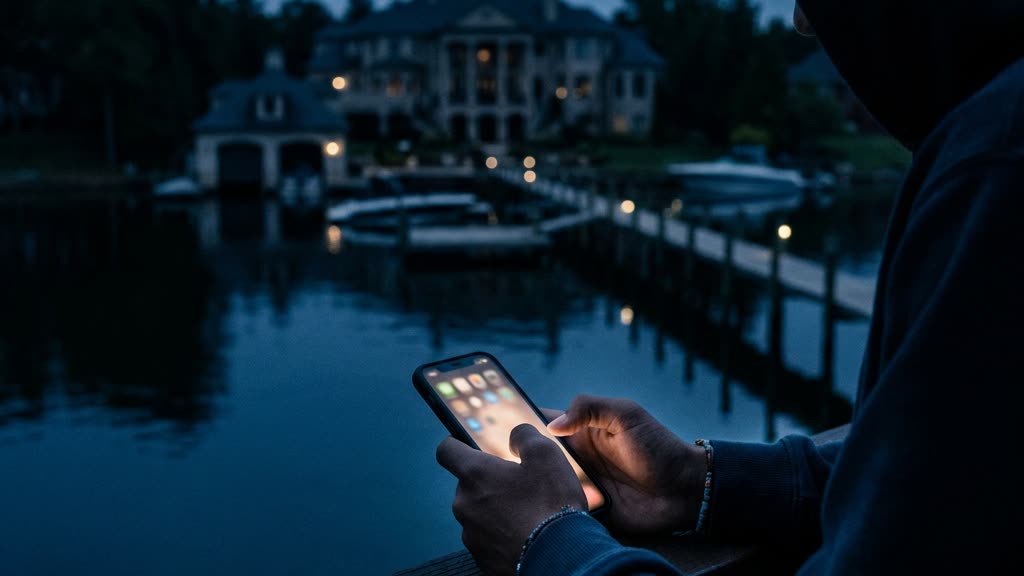
Most of the families I work with have spent real money on the perimeter. Cameras at the gate, hardened doors, a monitored alarm, sometimes a safe room. Then a fourteen-year-old posts a poolside video with the boat in the frame, tags the location, and the whole investment springs a leak. This is why kids social media safety is not a side conversation for a high-net-worth household. It is part of the physical security plan, because the information your children broadcast every day is precisely the kind of intelligence a motivated adversary needs to plan against you.
I spent my Army years as an Electronic Warfare Officer, and later on a counter-IED team in Afghanistan. The work taught me something that applies directly to your home: you rarely need to breach a target to defeat it. You need to observe it long enough to understand its pattern. Emissions, movement, habits, timing. In the field we called it pattern of life. A phone in a teenager’s pocket, a gaming headset, a public profile: these are emitters, and they are broadcasting your family’s pattern of life to anyone patient enough to watch. Good kids social media safety is, at its core, controlling those emissions.
Why a Teenager’s Feed Is a Reconnaissance Tool
Burglary and extortion rings that target affluent homes almost never start with the house. They start with the people. Law enforcement has documented organized crews that build target packages from open sources before they ever move: who lives there, what they own, and, most valuable of all, when the home is empty. A child’s public account is a generous source for all three.
Think about what a single week of normal teenage posting reveals. School logo on a hoodie. The car in the driveway. The interior of the house in the background of a dance video. A countdown to a family trip. A “we’re finally in Aspen” story. None of it feels like a security disclosure to a fifteen-year-old. Assembled by someone doing reconnaissance, it is a briefing. In electronic warfare we assume the adversary is collecting continuously and correlating later. Your family should assume the same about anything posted publicly.
The uncomfortable truth is that the more recognizable and successful a family is, the more valuable that briefing becomes. Discretion is a security control. Kids, by nature and by platform design, are rewarded for the opposite.
The Three Leaks That Matter Most
You do not need to police every app or read every message. You need to close the three channels that convert a teenager’s normal online life into actionable intelligence against your household.
Location Leaks
Location is the crown jewel, because it answers the attacker’s most important question: is the target home or not. It leaks in more ways than most parents realize.
The obvious one is the tagged post, the check-in, the “live location” shared with a friend group that is larger and leakier than your child thinks. Less obvious is metadata. Photos can carry embedded location data, and some platforms and messaging apps preserve it. Backgrounds betray location too: a recognizable dock, a street sign, a neighbor’s roofline, the marina where the boat is kept.
The most dangerous pattern is the real-time travelogue. Posting from the airport, then the resort, then the ski lift, tells the world the house is empty right now and for a known number of days. I coach families to treat the vacation post the way I would treat radio discipline on a patrol: nothing that reveals position until you are back inside the wire. Post the trip after you are home. The photos are just as good a week later, and the risk drops to near zero. This same logic is why we build package delivery protocols for estates, so an empty house is never advertised by a pile of boxes at the gate either.
Friend Lists
A friend list, or a follower list, is a target map. It shows who is in the child’s circle, and it shows the seams. Attackers do not always come through the front of an account. They come through a weak connection: the account with no privacy settings, the follower who accepts everyone, the “mutual” who is actually a stranger running a well-built fake profile.
Two behaviors create most of the exposure. The first is the follower-count game, where teenagers accept or add people they do not know because reach feels like status. The second is the sympathetic stranger, an account that mirrors the child’s interests, an athlete, a gamer, a fan of the same artist, and works its way inside over weeks. The FBI has repeatedly warned about adults using exactly this approach to build trust with minors online. You can read general guidance from the FBI (opens in a new tab) on how these schemes operate. The defense is not paranoia. It is a simple standard: you do not connect with people you have not met in real life, and a private account is not a punishment, it is normal operating procedure.
Gaming Chats
The channel parents watch least is the one I watch most: the game. Voice chat on a console, party channels, Discord servers, and in-game messaging are largely unmonitored, often anonymous, and social in a way that lowers a kid’s guard. Your child may keep a locked-down profile and still spend two hours a night talking to strangers with a headset on.
This is where two threats live. One is grooming and sextortion, which federal agencies including the FBI have flagged as a fast-growing danger to teenagers, boys very much included. An attacker builds rapport in a game, moves the conversation to a private app, and manipulates the child into sending an image, then extorts them. The second, quieter threat is intelligence collection. A friendly voice in a squad chat asking casual questions, where do you live, what does your dad do, are you around this weekend, is doing reconnaissance whether the child realizes it or not. In my counter-IED work, the most effective collection never looked like an interrogation. It looked like conversation. Teach your kids that the same is true online.
Rules Teens Will Actually Accept
Here is where most family policies fail. They are written like a lockdown, the teenager experiences them as an accusation, and within a month the rules are quietly ignored. The goal is not maximum restriction. It is a standard your kids will actually hold when you are not watching.
Trade Autonomy for Discipline
Frame it as operational discipline, not distrust. Older kids respond to being treated as capable. I tell them the same thing I told young soldiers: smart people control what they emit, not because someone is weak, but because the professional does not hand the other side free information. That framing lands far better than “because I said so,” and it gives them a reason that survives once their friends are in the room.
A Short List That Survives Contact
Keep it to a handful of rules a teenager can remember and defend to a friend.
- Private accounts only, and connections limited to people met in real life.
- No live location, and no posting from a trip until the family is home.
- Turn off location tagging and strip location from photos before they go out.
- Strangers in game chat stay in game chat. No moving to private apps, no personal questions answered.
- One non-negotiable: if anyone online asks for an image, threatens them, or makes them uncomfortable, they come to you immediately and without judgment. That last line matters most. Sextortion thrives on a child’s fear of getting in trouble. Remove that fear and you remove the leverage.
Agree on these together, revisit them once or twice a year, and model them yourself. The Federal Trade Commission (opens in a new tab) publishes plain-language resources on protecting kids’ privacy that are worth reading alongside your own house rules. Writing this down formally, rather than leaving it as a lecture, is one piece of a broader family security plan that everyone in the household actually understands.
Where This Fits in the Household Perimeter
Digital discipline for kids is one layer of a larger picture. The same principle applies to the adults and the people who work in your home. Anyone with access to your network or your routine is a potential leak, which is why we help families set clear digital access boundaries for household staff alongside the rules for the children.
There is also a technical layer that families often overlook. Every console, phone, and smart device in the house connects through your home network, and that network is a target in its own right. As the exclusive reseller and integrator for GuardDog AI, our veteran-owned team deploys and tunes that enterprise intrusion-detection platform to watch for the compromised device and the unusual outbound connection, the kind of threat a consumer router will never flag. Guidance from CISA (opens in a new tab) reinforces the same point: the home network is now part of the attack surface for any household worth targeting.
For families in Naples and the surrounding communities, all of this connects back to the broader approach we take to luxury home security across Florida. The gate, the cameras, the network, and the family’s own information discipline are one system. A weakness in any of them weakens the rest.
Frequently Asked Questions
At what age should I start setting these rules?
Before the first account exists. It is far easier to start with private-by-default habits than to claw back a public presence a child has spent years building. If your kids are already active online, do not overhaul everything at once. Fix location leaks first, because that is the highest-consequence channel, then work through friend lists and game chat over the following weeks.
Won’t monitoring my kids destroy their trust?
Surveillance can. A shared standard does not. The families who succeed treat this as a household norm that applies to the adults too, not as spying on the children. When the rule is “nobody in this family posts our location in real time,” a teenager experiences it as belonging to a serious household, not as being watched. Transparency about what you are protecting against does more for trust than secrecy ever will.
My teenager pushed back hard. What actually works?
Give them the reasoning and a role. Kids who understand that they are personally the softest part of the family’s security tend to take it seriously, especially when you frame it as competence rather than fear. Let them help write the rules. Ownership beats enforcement every time, and a rule they helped set is one they will defend to their friends.
What if something has already happened online?
If your child is being extorted, pressured, or contacted by an adult who is grooming them, treat it as the emergency it is. Preserve the messages rather than deleting them, do not pay or negotiate, and report it. You can file with the FBI’s internet crime center through IC3 (opens in a new tab). Then focus on your child, not on blame. The faster a kid feels safe telling you, the faster you can shut the threat down.
Your children are the most capable and the most exposed part of your home’s security posture. Getting kids social media safety right is quiet, ongoing work, and it pays off precisely because you never see the incident that did not happen. If you would like a discreet, whole-household assessment that ties your family’s digital habits to your physical security, request a private consultation or call our team directly at (239) 710-1772. We will treat your family’s information the way we would treat our own.