
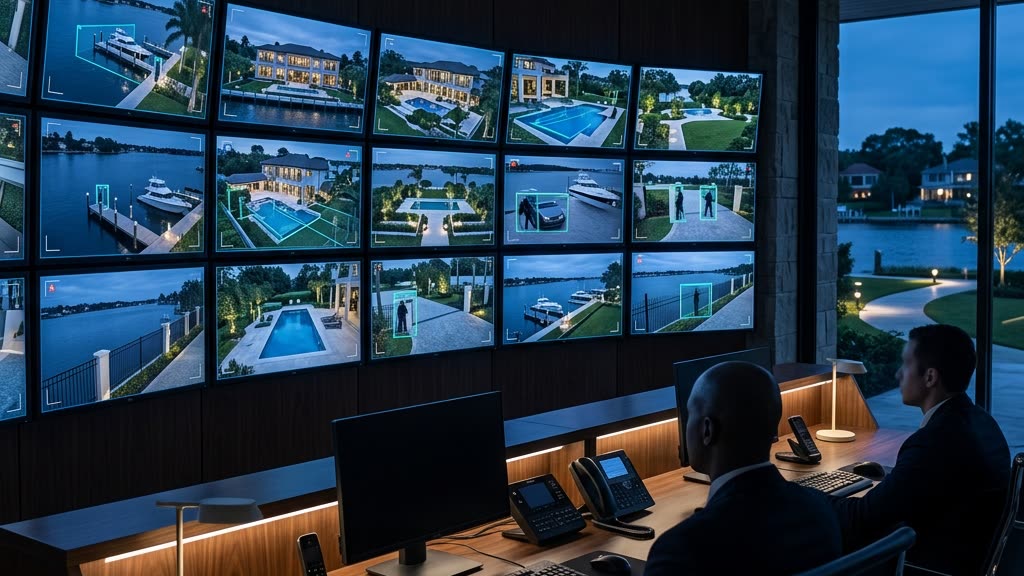
I have spent most of my career on the operational side of security: running protective operations, assessing estates, and building security infrastructure for institutions that could not afford to get it wrong. So when clients ask me about AI home security, I answer as a practitioner, not as a salesman. Artificial intelligence has genuinely changed what a residential security system can do. It has also produced a wave of marketing language that makes it difficult for a homeowner to tell the difference between a real capability and a relabeled motion sensor. This guide is my attempt to draw that line clearly.
The diligence is worth it. The people who target significant homes are rarely opportunists anymore. Organized crews study properties, learn schedules, and defeat systems they have seen a hundred times before. The FBI (opens in a new tab) treats these groups as organized criminal enterprises for a reason, and a family with meaningful assets should evaluate security technology with the same seriousness. What follows is how I break down AI home security for my own clients: what it changes, what it does not, and how to separate substance from sales copy.
What AI Actually Changes: Three Capabilities That Matter
When I evaluate any technology for a client’s estate, I strip away the branding and ask a single question: what does this change operationally? For AI in residential security, the honest answer is three things. It changes the quality of detection, the depth of analysis, and the speed and credibility of response. Everything else is packaging.
Detection: From “Something Moved” to “Someone Is at the Fence Line”
Traditional motion detection is arithmetic. A sensor or camera watches for pixel changes and fires when enough of the frame moves. In Florida, that means palm fronds, rain bands, herons, and headlight sweep all generate the same alert as a person crossing your lawn. The predictable result is that homeowners and staff learn to ignore the system, which is worse than having no system at all.
AI-driven detection classifies before it alerts. A properly configured system distinguishes a person from a vehicle from an animal, and then goes further: direction of travel, time of day, whether someone is walking the sidewalk or lingering at the gate, whether a figure is approaching the seawall from the water side. The alert becomes a statement, not a guess. This is the single most consequential upgrade available to a residential system today, and it is why I wrote a dedicated comparison of AI video analytics versus motion detection for readers who want the technical detail.
Analytics: Seeing the Pattern Before the Event
Detection tells you what is happening now. Analytics tells you what has been happening over time, and that distinction matters because sophisticated burglaries begin with surveillance. Law enforcement has documented crews conducting days of pre-operational reconnaissance on high-value homes: repeated vehicle passes, walk-bys, photographs of camera positions and gate hardware. A human reviewing footage will almost never catch this. A well-tuned analytic layer can, flagging the same vehicle appearing multiple times in a week or a person testing a pedestrian gate in the early morning hours.
I saw this pattern play out in the casework behind one of the more instructive investigations in recent memory, which I unpacked in what a burglary ring teaches us about estate security. The short version: the homes that were hit had cameras. What they lacked was anything watching the pattern.
Response: Verified Alerts Get Taken Seriously
The third change is the one homeowners feel most directly. The overwhelming majority of traditional alarm activations turn out to be false, and many jurisdictions have responded by deprioritizing unverified alarms or imposing fines on repeat offenders. An unverified signal from a keypad is, from a dispatcher’s perspective, statistical noise.
AI verification changes the category of the call. An alert that arrives with a classified human intruder, a video clip, and a confirmed point of entry is treated differently by responding officers, by monitoring centers, and by your own protective team if you retain one. Response is where seconds compound, and verification is what buys those seconds. I covered the mechanics and the practical results in ending false alarms with AI verification, which I consider required reading before anyone signs a monitoring contract.
Separating Substance From Marketing
“AI-powered” now appears on doorbells, floodlights, and consumer cameras that perform none of the functions described above. After years of vendor evaluations, I use a short set of questions that reliably sorts real capability from labeling.
Four Questions I Ask Every Vendor
Where does the inference run? Systems that process video on the property, at the edge, keep working when the internet fails, respond faster, and keep footage under your control. Systems that ship everything to a vendor’s cloud inherit that vendor’s outages, breach history, and data practices. This is not a theoretical concern, and it is the core of my field note on why cloud cameras are the weak link.
Can detection be tuned to this property? A waterfront estate, a golf-course lot, and a gated compound present completely different environments. If the vendor cannot adjust detection zones, sensitivity, and classification rules per camera and per property, you are buying a generic product, not a system.
What happens between the alert and the action? An alert that ends as a phone notification while the family is asleep or abroad has accomplished nothing. There must be a defined human layer: a monitoring center, a protective team, a documented escalation path with named decision points.
Who owns the false alert problem after installation? Real systems are commissioned, observed, and re-tuned over the first weeks. If the vendor’s involvement ends at installation, so does the system’s accuracy.
Red Flags Worth Walking Away From
Be skeptical of “AI” used as an adjective with no specifics behind it, of subscriptions whose only function is storing clips, of systems with no commissioning period, and of any provider who cannot explain what happens during a power or internet outage. In my experience, a vendor’s willingness to answer these questions precisely is itself a diagnostic.
Where AI Fits in a Layered Estate Program
Here is the caution I give every client, because it is where enthusiasm gets ahead of judgment: AI is a force multiplier, not a program. A sound estate program layers deterrence, detection, delay, and response. Artificial intelligence dramatically strengthens detection and sharpens response. It contributes nothing to delay: gates, glazing, lighting design, safe rooms, and hardened entry points still do that work, and no algorithm replaces a well-drilled family plan or a capable human responder. I have laid out that full framework in our guide to luxury home security in Florida, which is the right starting point if you are building or rebuilding a program from the ground up.
On the detection layer specifically, it is worth understanding what enterprise-grade tooling looks like, because it is a different species from consumer gear. One example we work with closely is GuardDog AI, a third-party enterprise intrusion-detection platform built for environments where the network itself is an attack surface. The veteran-owned team at SDVOSB.services serves as its exclusive reseller partner, and our role is deployment, integration, and tuning: making an enterprise platform behave correctly inside a private residence. I raise it not as a pitch but as a benchmark. Once you have seen what purpose-built detection looks like, the gap between it and a consumer camera subscription becomes obvious.
Geography shapes the program too. On the Gulf Coast, waterfront approaches, seasonal occupancy, and storm-related outages all change how detection and response must be designed, which is why our Fort Myers work looks different from a program built for a gated golf community inland. AI home security that has not been tuned for its actual environment is a demonstration, not a defense.
Privacy, Data, and Governance
A subject most vendors avoid: an intelligent camera system is also a surveillance system pointed at your own household. Staff, guests, and family members, including minors, live inside its field of view. Before deployment, I insist clients settle governance questions in writing. Who can view live feeds. Who can export clips. How long footage is retained. Whether recordings leave the property at all.
Two public resources are genuinely useful here. NIST (opens in a new tab) publishes widely used guidance on managing risk in AI systems, and CISA (opens in a new tab) offers practical direction on securing connected devices, which is exactly what every camera and sensor on your property is. The operating principle I give clients is simple: treat every camera as a computer, because that is what it is, and hold it to the same standard you would hold any device that stores your family’s private life.
Frequently Asked Questions
Does AI home security replace a monitored alarm or a protective team?
No. AI upgrades the detection and verification layers of a program. Someone still has to respond, whether that is a monitoring center, law enforcement, or a protective detail. The value of AI is that responders arrive informed and treat the alert as credible.
Should the AI processing run on my property or in the cloud?
For significant homes, I favor edge processing: analysis performed on the property. It responds faster, continues working through internet outages, and keeps footage under your control. Hybrid designs can work when the cloud component is limited to secondary functions, but a system that goes blind when the connection drops is a liability.
Will AI eliminate false alarms entirely?
No system will, and any vendor claiming perfection should concern you. What a properly tuned system does is reduce nuisance alerts to the point where every notification deserves attention, and attach verification to real events so that response is fast and prioritized.
How do I know whether a product’s AI claims are real?
Ask the four vendor questions above, then insist on a demonstration at your own property, at night, in weather. Real capability survives contact with palm fronds and rain. Marketing does not.
If you are weighing an upgrade to your estate’s detection and response posture, or you simply want a candid second opinion on a proposal already in front of you, I am glad to walk through it with you. You can request a private consultation or reach our team directly at (239) 710-1772, and the conversation stays confidential either way.