
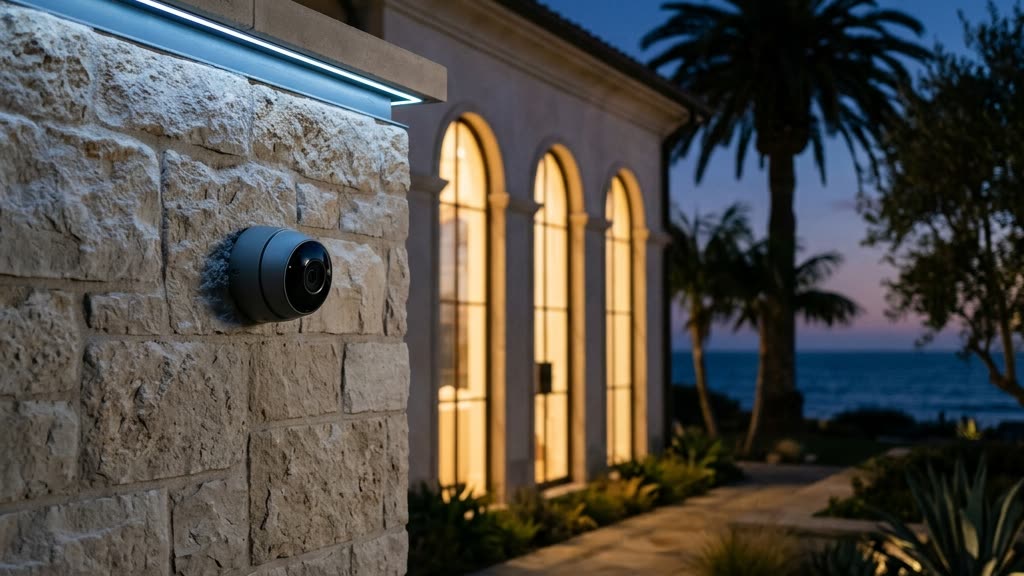
In Afghanistan in 2011, my job as an Electronic Warfare Officer on a counter-IED team came down to a single discipline: pulling a meaningful signal out of an environment saturated with noise, then deciding what to do about it before the window closed. Get it right and everyone goes home. Get it wrong in either direction, a missed threat or a false alarm that burns attention and trust, and you pay for it. That experience shapes how I evaluate facial recognition home security for the estates we protect today. The technology is genuinely powerful. A camera that knows the difference between your housekeeper arriving early and a stranger who has now walked your fence line twice is a fundamentally better instrument than one that reports “motion detected.” But recognition carries tradeoffs that rarely come up on the sales call: privacy, consent, storage, and some uncomfortable failure modes. This is my honest accounting of both sides, including the situations where I tell clients not to deploy it at all.
What Facial Recognition Actually Does in a Home System
Strip away the marketing and the mechanics are straightforward. When a camera detects a face, the software converts it into a mathematical representation, often called a faceprint or embedding. That representation is compared against a database of enrolled faces: family, household staff, regular vendors, trusted friends. A match above a confidence threshold produces a known-person event. No match produces an unknown-person event.
That distinction, known versus unknown, is the entire value proposition for residential use. This is not the airport-style problem of naming a stranger by searching millions of records. A well-designed home deployment answers a much narrower question: is this one of the people who belongs here? Narrower questions get more reliable answers.
For the broader context on how recognition fits alongside behavioral analytics and automated response, my complete guide to AI home security covers the full stack. Here I want to stay on this single capability, because it raises the hardest questions.
The Case for Known-Person Alerts
The strongest argument for facial recognition home security is not what it catches. It is what it lets you safely ignore. The estates we work with generate an enormous volume of camera events: landscapers, pool service, deliveries, housekeepers, catering staff. On a conventional system every one of those is an anonymous motion alert, and the predictable result is that the homeowner stops looking. Alert fatigue is not a comfort problem. It is the mechanism by which a real intrusion gets ignored.
Recognition changes the math. When the system can quietly log “housekeeper, main gate, expected window” and reserve the loud alert for “unknown adult, service entrance, no scheduled arrivals,” the signal-to-noise ratio improves dramatically. In electronic warfare we called this deconfliction: filtering the friendly emitters so the operator’s attention lands on the anomaly. The same principle applies at your gate.
It also transforms what a monitoring team can do. A human operator who receives “unknown person” plus context acts faster and with more confidence than one staring at a raw clip. I have written about why that human layer matters in professional monitoring versus self-monitoring, and recognition makes that layer sharper. On larger properties it pairs naturally with aerial coverage: a perimeter recognition event can cue the automated response I described in security drones for estates.
The Tradeoffs Nobody Puts in the Brochure
Accuracy Is Conditional, Not Absolute
Recognition algorithms have improved enormously, and the best modern systems are impressive under good conditions. But performance is conditional. The National Institute of Standards and Technology (opens in a new tab) has run extensive public testing of face recognition algorithms for years, and the consistent lesson is that accuracy varies meaningfully across vendors, lighting conditions, camera angles, and demographics. A system that performs beautifully on a well-lit frontal view can degrade badly on a low, rain-streaked camera at dusk. If your integrator cannot tell you which algorithm is under the hood and how it has been evaluated, that is a red flag. Marketing does not survive contact with a Florida thunderstorm.
Design matters as much as the algorithm. Camera height, focal length, infrared illumination, and placement relative to sun angles determine whether the software ever receives a usable face. We treat recognition cameras as precision sensors with specific siting requirements, not as commodity boxes to scatter around the property.
Consent Is a Household Policy, Not a Checkbox
Here is the conversation most vendors skip. Enrolling your housekeeper’s face into a biometric database is not a trivial act, legally or ethically. Several states now regulate the collection of biometric identifiers, and the Federal Trade Commission (opens in a new tab) has made clear that it views biometric information as sensitive data deserving heightened protection.
Beyond the law, there is the household itself. Staff who discover they were enrolled without being told rarely react well, and a trusted employee who feels surveilled is a relationship you have damaged for marginal benefit. Our practice is simple: written acknowledgment for employed staff, a clear retention policy, and a genuine option to decline where the role allows it. Guests are a separate category: we generally advise against enrolling them at all, in favor of gate credentials or scheduled arrival windows.
Storage: Where Your Family’s Faces Live
A faceprint database is a high-value target, and where it lives matters more than most buyers realize. Consumer cloud cameras typically ship every frame, and often the biometric templates themselves, to servers you do not control, under terms you did not negotiate. I have covered the structural problems with that model in why cloud cameras are the weak link, and recognition raises the stakes: a breach exposes not just footage but a mathematical key to your family’s identity.
Our strong preference is edge or on-premises processing, where faceprints are computed and stored locally, encrypted at rest, with defined retention limits and no third-party training rights. Whatever architecture you choose, the network those cameras ride on has to be hardened and monitored. CISA (opens in a new tab) publishes solid baseline guidance on securing connected devices, and it applies to a camera network as much as to any business system.
When We Recommend Against It
Facial recognition home security is a tool, not a default, and there are households where I advise clients to skip it entirely.
The first is the high-entertainment household. If your property hosts frequent events with rotating guest lists, recognition produces a flood of unknown-person events that either get ignored or push you toward enrolling people you should not enroll. Credentialed entry and staffed gate protocols solve that problem more gracefully.
The second is the household where staff consent is not realistically obtainable. If key employees are uncomfortable and their roles do not allow an opt-out, the trust cost exceeds the security benefit. There are other ways to verify arrivals.
The third is the client who wants covert recognition of a specific person: an ex-spouse, a neighbor, a litigation adversary. We decline that work. It is legally hazardous, and it is not security, it is targeted surveillance.
Finally, some public-figure households conclude, correctly in my view, that a compromised biometric database is a worse outcome than the problem recognition solves. For those clients we design around the capability: license plate recognition at the gate, behavioral analytics on the perimeter, and human verification in the loop deliver most of the benefit with a much smaller sensitive-data footprint.
How We Deploy It When It Does Make Sense
When recognition earns its place in a design, we treat it with the same discipline we apply to every layer of luxury home security in Florida: one sensor in a system, never a standalone gadget.
That means edge processing wherever the site allows it, retention measured in days rather than years, and enrollment limited to people with a durable relationship to the household. It means cameras sited as precision instruments with dedicated views of choke points. It means the camera network is segmented away from the family’s personal devices and watched continuously. On that network layer we deploy GuardDog AI, an enterprise intrusion-detection platform we partner with as its exclusive reseller, so that an attempt to reach the cameras or the recognition server is itself a detected event. My electronic warfare instincts die hard: I assume a capable adversary goes after the sensor before he goes after the door.
And it means a human stays in the loop. Recognition should change the priority of an alert, not replace judgment about it. For the properties we serve across Southwest Florida, including the gated communities and waterfront estates in Naples, that combination of careful enrollment, local storage, hardened networks, and professional response is what separates a capability from a liability.
Frequently Asked Questions
Is facial recognition legal for home security in Florida?
Private residential use is generally permitted, but the details matter: employment relationships, audio recording, and biometric data handling each carry their own legal considerations, and the law is evolving quickly. We review the specifics of every deployment and recommend clients confirm staff-facing policies with their own counsel.
Does facial recognition work at night or in bad weather?
It can, with the right hardware and siting: proper infrared illumination, correct camera height, and protected sight lines. Performance degrades with rain, glare, and poor angles, which is why we design recognition points deliberately.
Do I have to tell my staff they are enrolled?
In our deployments, yes. Beyond the legal exposure in a growing number of jurisdictions, undisclosed enrollment damages the trust your household runs on. We use written acknowledgment for staff and generally advise against enrolling social guests at all.
What happens to the face data if we remove the system?
That depends entirely on the architecture you chose, which is why we prefer local storage with contractual deletion terms. With consumer cloud systems, deletion is a promise you are trusting a vendor to keep. Ask that question before you buy, not after.
Recognition done well is quiet, consented, locally stored, and woven into a layered defense. Done carelessly, it is a sensitive database bolted to someone else’s cloud. If you are weighing it for your own property, our veteran-owned team is glad to walk through the tradeoffs against your household’s actual patterns: request a private consultation or call (239) 710-1772, and we will give you a straight answer, including “don’t” when that is the right one.