
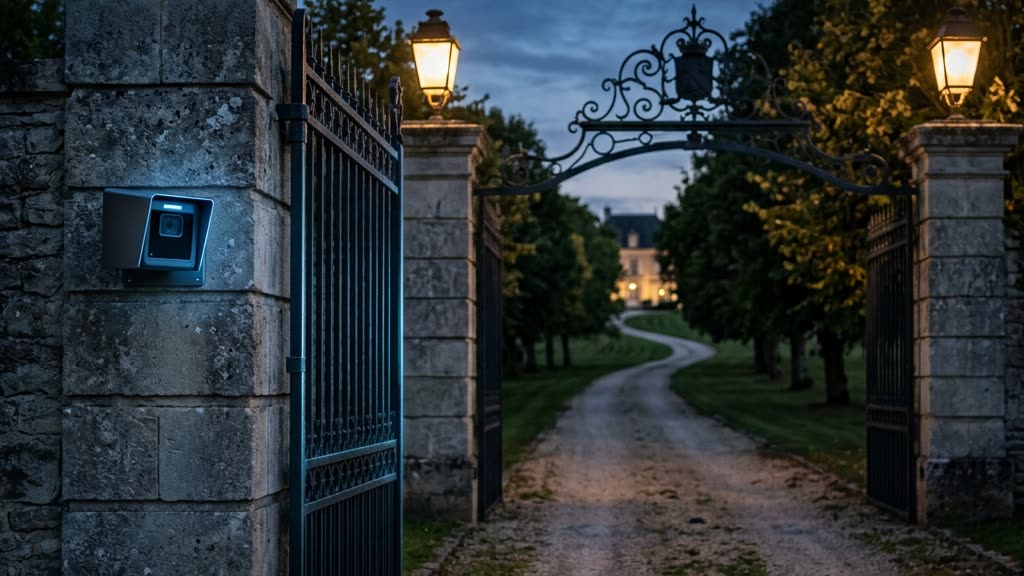
Most targeted residential crimes announce themselves in advance. Before anyone touches a gate or tests a door, someone drives the street. They drive it slowly, at odd hours, more than once, and in my experience assessing estates for high-net-worth families the pattern is remarkably consistent: the vehicle appears in recorded footage days or weeks before the incident, and nobody noticed because nobody was looking for it. That is the specific problem an lpr camera home deployment solves. License plate recognition turns the road in front of your property from background noise into a searchable record, one that can tell you, quietly and automatically, that the same unfamiliar sedan has now passed your gate four times this week.
The hardware is the easy part. What follows is the judgment: what LPR does well at a residence, how to tie it into gate operations without creating a new vulnerability, and where the privacy lines sit.
Vehicles Are the First Tell
Nearly every serious residential incident I have reviewed had a vehicle phase. Organized crews establish pattern of life before they commit: when the household leaves, when staff arrive, when the property goes quiet. Law enforcement, including the FBI (opens in a new tab), has documented the role of pre-operational surveillance in organized residential burglary, and the sophisticated transnational crews that have worked affluent American neighborhoods in recent years are disciplined about it. We broke down that behavior in what a multimillion-dollar burglary ring teaches us about estate security.
Here is the operational gap. Your existing cameras almost certainly recorded those pass-bys. The footage existed. It was simply never reviewed, because no human can hold every plate that crossed a driveway over three weeks in memory, and nobody sits watching a quiet street feed. LPR closes that gap mechanically: every plate is read, timestamped, and compared against every prior read. The pattern a person cannot see becomes an alert.
What a Residential LPR Camera Actually Is
Purpose-built optics, not a software checkbox
Many vendors now advertise plate reading as a software feature on ordinary surveillance cameras. Understand the difference. A general camera exposes for a whole scene. Reading a reflective plate on a moving vehicle at night demands the opposite: very fast shutter speeds, infrared tuned for retroreflective plate material, and a narrow field of view aimed precisely where plates present themselves. Software LPR on a wide-angle camera reads plates in daylight at parking-lot speeds and quietly fails after dark, which is exactly when you need it most. A purpose-built LPR camera, mounted correctly, reads reliably day and night at normal road speeds.
Placement decides performance
LPR is a chokepoint tool. You are not blanketing the property; you are covering the few lines a vehicle must cross: the gate approach, the driveway throat, the street frontage, the service entrance. Mounting height and angle matter because the lens needs a near-straight look at the plate, and each direction of travel generally needs its own camera. On tight urban frontage, like many of the properties we assess in Miami, one well-placed camera covering the approach lane will outperform four mediocre ones scattered across the facade.
Flagging Returning Vehicles: Where the Value Lives
The plate read itself is a commodity. The value is the logic layered on top of it, and that logic is the first thing I examine when a client shows me a system someone already sold them.
A properly configured deployment maintains three categories. A known list: household vehicles, staff, regular vendors, expected guests. A watch list: a former employee, an opposing litigant, a stalker, an ex-partner subject to a protective order. And everything else, which is where the interesting work happens. The system should alert on unknown-repeat behavior: the same unfamiliar plate seen multiple times inside a short window, especially at unusual hours or dwelling at low speed. When a watch-listed plate hits your street line, you want minutes of warning and a protocol, not a doorbell clip to hand detectives afterward.
Tuning is everything. An LPR feed that pings the family for every delivery van gets muted within a month, and a muted system protects no one. On estates where we run the full detection stack, plate alerts flow into the same monitoring picture as the perimeter sensors. GuardDog AI, the enterprise intrusion-detection platform we deploy and tune as its exclusive reseller partner, correlates those signals, so a flagged vehicle on the frontage followed by a fence-line anomaly presents as one developing event rather than two ignorable pings.
Gate Integration Without Creating a New Vulnerability
The convenience case is obvious: the gate recognizes your plate and opens before you reach it. Done thoughtfully, that is a real quality-of-life improvement for a household and its staff. Done carelessly, it converts a public identifier into a key.
Remember what a plate is: a string of characters bolted to the outside of a vehicle, visible to anyone, photographable by anyone, and reproducible. Treat a plate as a convenience factor, never as a sole credential. In practice:
- Family vehicles open the gate on a plate read paired with a second signal, such as a vehicle transmitter or a phone that is genuinely present.
- Vendors get time-windowed permissions: the landscape crew’s truck works on its scheduled day during business hours, and the permission expires on its own.
- Unknown vehicles get logged and get a human decision through the intercom, every time.
- The gate fails secure, keeps a manual override, and logs every actuation with the plate read that triggered it.
One more point from the field: tailgating remains the most common gate defeat, and LPR does not physically stop a second vehicle slipping through. What it does is record that vehicle’s plate with a timestamp, which transforms the follow-up investigation. Knowing you cannot prevent everything, you engineer to know everything.
Privacy Boundaries: Capture Narrowly, Hold Briefly, Guard Well
An LPR system at a residence collects data about people who will never set foot on your property. Handling that responsibly is a legal question, a neighbor-relations question, and frankly a character question. The families I work with value discretion, and their systems should reflect it.
Aim at your approach, not the neighborhood
Configure capture zones around your own frontage and entrances. Do not aim into a neighbor’s driveway, and do not build a de facto traffic database of the street. If the property sits on a shared private road or inside an HOA, put agreements in writing before installation. Recording laws vary by state, and audio is treated very differently from video in many jurisdictions, so keep audio capture off at the street line and have counsel review the configuration. That is inexpensive diligence compared to the alternative.
Retention and access discipline
Hold plate data long enough to surface repeat-visit patterns and no longer: a window measured in weeks serves the security purpose. Keep a short, named list of who may query the system, and log those queries. These are the same data-minimization principles the FTC (opens in a new tab) presses on businesses, and they apply just as cleanly to a household. Store the data encrypted and access-controlled, consistent with NIST (opens in a new tab) guidance on protecting stored information, and be deliberate about where it lives. Consumer cloud cameras ship everything to third-party servers under consumer terms of service; we covered that exposure in why cloud cameras are the weak link. Plate data deserves local or tightly controlled private storage.
A final boundary worth naming: a plate connects to a registered identity only through law enforcement channels, and it should stay that way. A private system’s job is to say this vehicle has returned, not to resolve who owns it. That restraint is one reason LPR sits more comfortably in a residential program than biometric tools do; we examined those heavier questions in our piece on facial recognition tradeoffs in home security.
Where LPR Fits in the Layered Program
LPR is an early-warning layer, not a security system. It extends your awareness beyond the fence line to the street, which buys the most valuable commodity in protective work: time. Behind it you still need detection on the perimeter, a hardened envelope, and a response plan that names who does what when an alert fires. It also sits naturally alongside the other machine-speed layers we have written about, from the analytics in our complete guide to AI home security to security drones for estates on larger acreage, all within the framework we laid out for luxury home security in Florida. When our veteran-owned team assesses an estate, vehicle-approach coverage is among the first gaps we look for, because it is the layer that tells you trouble is forming rather than arriving.
Frequently Asked Questions
Do LPR cameras actually work at night and in bad weather?
Purpose-built units do. They pair infrared illumination with fast shutter speeds designed for retroreflective plate material, so darkness is their normal operating condition. Heavy rain shortens effective range, which good placement and lens selection largely offset. Software plate-reading added to ordinary cameras is where night performance falls apart.
Can my gate open automatically for recognized plates?
Yes, and for family and staff it is a genuine convenience. Just treat the plate as one factor, paired with a transmitter or verified phone presence, because plates are visible to anyone and can be duplicated. Vendor plates should work only inside scheduled windows.
Is it legal to record plates on a public street?
In most U.S. jurisdictions, a camera on your own property viewing the public way is lawful, but data-handling and audio rules vary by state. Keep audio off, keep retention short, restrict who can search the records, and have counsel confirm the setup for your jurisdiction.
How long should we keep plate data?
Long enough to reveal repeat-visit patterns, which in practice means weeks rather than months or years. Longer retention adds legal exposure and privacy risk without adding security value.
Vehicles telegraph intent before people do, and a well-placed, well-governed lpr camera home installation is one of the quietest, highest-leverage upgrades available to a private residence. If you would like an experienced set of eyes on your approach coverage, your gate logic, and your data practices, request a private consultation or call (239) 710-1772. We will tell you plainly what is worth installing and what is not.