
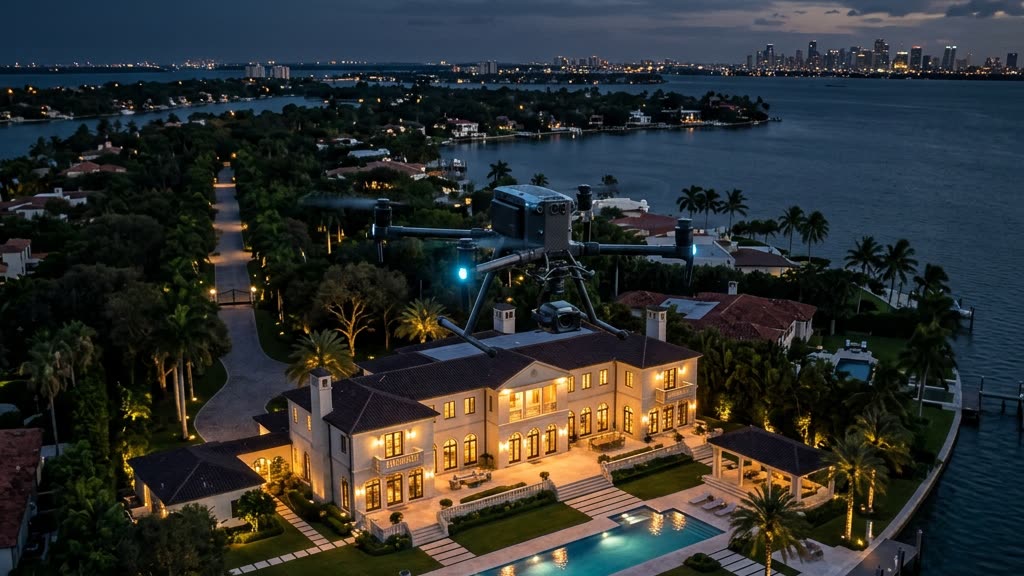
Security drone home security has moved from trade-show novelty to a serious line item in estate protection planning, and it comes up on nearly every large-property assessment I run. The question is rarely whether the technology works. It does, within limits that matter. The real question is whether a drone program solves a problem your property actually has. I have spent my career running protective operations, first as CEO of a security firm in Brazil, later supporting security infrastructure for institutions in Washington, and that experience has made me suspicious of any tool that arrives with its own marketing budget. Drones deserve a clear-eyed evaluation: what they genuinely do well, what federal aviation rules allow, and the point at which acreage turns them from an expensive gadget into a legitimate force multiplier.
What a Security Drone Actually Does for an Estate
Every large property fights the same enemy: distance. A perimeter sensor can tell you something crossed the fence line at the northeast corner. It cannot tell you what. On a compact lot, a fixed camera answers that question instantly. On ten wooded acres with a guest house, a barn, and a long stretch of shoreline, verification takes time, and time is the entire game in a security event. A drone collapses that verification window from minutes to seconds. That is its core value. Nearly everything else is secondary.
Automated Patrol: The Drone-in-a-Box Model
The systems worth discussing are not hobby quadcopters. They are dock-based platforms: the drone lives in a weatherproof enclosure on the property, launches on a schedule or on command, flies a pre-programmed route with optical and thermal cameras, and returns to its dock to recharge without a human touching it. Two details separate a professional deployment from a demonstration. First, patrol routes should be randomized within limits, because sophisticated theft crews surveil a property before they strike, and a drone that lifts off at the top of every hour is a drone they will simply wait out. The organized burglary rings that the FBI (opens in a new tab) and local task forces have pursued in affluent communities are patient, professional, and observant, a pattern I examined in my note on what a multimillion dollar burglary ring teaches us about estate security. Second, thermal imaging is not optional. Most of the events you care about on a large property happen in darkness or under tree cover, and an optical-only drone is blind exactly when you need it most.
Response Drones: Verification in Seconds
The second mode is the one that earns the investment: alarm-triggered response. A ground sensor trips at the far fence line, and instead of a staff member walking out with a flashlight, the drone launches automatically to those coordinates and puts a stabilized, zoom-capable, thermal eye on the exact spot within seconds. Now your monitoring team is making decisions with real information: a downed palm frond, a lost boater, or three figures moving along the treeline with intent. Some platforms add a spotlight and a loudspeaker, which introduces a deterrence effect fixed infrastructure cannot replicate. An intruder who is suddenly lit from above and addressed by voice tends to reconsider his evening. But none of this matters if nobody competent is watching the feed, which is why I push clients to settle the question of professional monitoring versus self-monitoring before they spend a dollar on aircraft.
The FAA Basics Every Estate Owner Should Understand
Here is the part that surprises owners: the airspace above your estate is not yours. It is federal, regulated airspace, and the rules apply over private property just as they do anywhere else.
Rules That Apply to Your Own Program
In broad strokes, without turning this into a regulatory brief: nearly all drones used for security work must be registered, must broadcast a Remote ID signal, and must be operated under the FAA’s commercial rules by a certificated remote pilot when the flying serves a business purpose, which estate security does. The default rule keeps the aircraft within the visual line of sight of its operator. Fully autonomous patrols beyond visual line of sight, the kind the marketing videos love, require waivers that are granted case by case and remain the exception rather than the rule. Night operations are permitted for certified operations with proper anti-collision lighting, which matters because night is when you want the aircraft up. And much of coastal Florida sits near controlled airspace around regional airports, which means airspace authorization is part of the planning, not an afterthought. A professionally managed program absorbs all of this on your behalf. An enthusiastic do-it-yourself program very often ends up out of compliance without knowing it.
The Drone You Do Not Own
The other half of the conversation is the drone you did not buy: the one loitering over your pool deck on a Saturday. I understand the instinct, and I will save you the trouble: you cannot shoot it, net it, or jam it. Drones are aircraft under federal law, interfering with an aircraft is a federal crime, and signal jamming is a separate federal violation on its own. Counter-drone authority is deliberately restricted to a short list of federal agencies, with the Department of Homeland Security (opens in a new tab) among them. What a private estate can lawfully do is detect, document, and report: drone-detection sensors that log the aircraft and often the operator’s position, landscape and architectural screening that denies a camera anything worth seeing, and a disciplined habit of treating repeated overflights as possible pre-operational surveillance rather than a curiosity.
When Acreage Justifies a Drone Program
I will be direct: most homes do not need one. On a typical residential lot, a properly designed set of fixed cameras and sensors covers every approach for less money, with no pilots, no waivers, and no weather limitations. Even in a premier Naples enclave like Port Royal, where the lots are generous but sightlines are short and neighbors are close, I rarely lead with aircraft. Fixed infrastructure and the waterline are the story there. The calculus changes with acreage, and it does not change gradually. It changes at the moment your property develops blind spots that fixed equipment cannot economically close.
The Questions I Ask Before Recommending One
When I walk an estate, the drone decision usually answers itself through four questions. How long does it take a capable adult to physically reach the farthest point of the perimeter? Are there approaches fixed cameras cannot realistically cover: a long tree line, a service road, a dock and open water, equestrian facilities, outbuildings scattered across the parcel? Is there on-site staff or a monitoring partner who will actually use the aircraft, or would it sit in its dock as an ornament? And does the property already carry the detection layer a drone depends on? When the walk to the fence line is long, the blind spots are plural, and the detection layer is mature, a drone earns its place. When any of those are missing, the money belongs elsewhere first.
Florida Realities: Weather, Salt, and Storm Season
One more dose of honesty for our climate. A drone is a fair-weather asset. Sustained wind, heavy rain, and lightning ground it, and salt air is unkind to airframes and docks on waterfront estates. During storm season you should assume the aircraft is unavailable precisely when your property is most stressed, which is why hurricane planning of the kind the state lays out through the Florida Division of Emergency Management (opens in a new tab) has to rest on hardened fixed infrastructure and human procedures, with the drone as a bonus on the calm days before and after the event.
A Drone Is a Layer, Not a System
The most expensive mistake I see in this category is buying the aircraft first. A security drone home security program stands or falls on its detection layer, because the drone has to be told where to look. That intelligence comes from the unglamorous ground game: perimeter sensors, entry detection, driveway and waterline coverage, the instrumentation I covered in the sensors that matter beyond cameras. It also increasingly comes from AI-driven analytics that can separate a raccoon from a reconnaissance run, a subject we treat fully in our complete guide to AI home security. On estates where our veteran-owned team at SDVOSB.services deploys GuardDog AI, an enterprise intrusion-detection platform we integrate and tune as its exclusive reseller partner, that detection layer is what decides when the aircraft flies at all. The drone is the response arm. The system is the architecture around it, the same layered approach we map out in our guide to luxury home security in Florida: deter at the boundary, detect early, verify fast, respond with information.
Frequently Asked Questions
Do I need an FAA license to fly a security drone on my own property?
If the flying serves a business purpose, and protecting a residence with paid equipment or staff qualifies, the operation falls under the FAA’s commercial rules and requires a certificated remote pilot. Owning the land does not exempt you from airspace regulation. Professionally managed programs handle certification, registration, Remote ID, and any required waivers as part of the service.
Can a drone replace my cameras or security staff?
No, and be wary of anyone who says otherwise. Drones carry battery limits, weather limits, and regulatory limits. They excel at rapid verification and deterrence across distance. Fixed sensors provide the always-on detection that tells the drone where to go, and people make the decisions that matter.
What can I legally do about an unknown drone over my estate?
Detect, document, and report. Note dates, times, and flight behavior, capture video if you can, and report persistent overflights to local law enforcement. Do not attempt to disable or jam it: drones are aircraft under federal law and interference carries federal consequences. Treat a repeat visitor as possible hostile surveillance and tighten your screening accordingly.
How many acres justify a drone program?
There is no magic number, and I distrust vendors who quote one. The honest measure is time and blind spots: how long verification takes on foot or by fixed camera, and how many approaches your current system cannot see. Long verification times and multiple uncovered approaches argue for aircraft. A compact, well-instrumented property rarely justifies a security drone home security program at all.
If you are weighing a drone program for a large property, or wondering whether your current system would even know when to launch one, that conversation is worth having before the purchase, not after. Request a private consultation or call (239) 710-1772, and we will walk your ground, look honestly at the distances and the blind spots, and tell you whether your estate is one where a drone earns its keep.