
I get asked some version of this in nearly every estate assessment I run: can’t we just buy the same cameras that get advertised everywhere and skip the professional side entirely? It is a fair question, and an honest one. The distance between diy vs professional home security has narrowed in ways that would have surprised me ten years ago. Consumer kits are genuinely capable now. They install in an afternoon, the apps are polished, and for a great many homes they are the right answer.
But “a great many homes” is not the same as “an estate.” My work is with high-net-worth families, and at that scale the question changes shape. The failures I see are rarely dramatic. They are quiet. A camera that was never pointed at the one approach that mattered. A cloud feed that dropped for hours and nobody noticed. An alarm that pinged a phone sitting on silent in another time zone. This piece is my attempt to be candid about where do-it-yourself security earns its keep and where it stops being enough.
Where DIY Genuinely Works
I want to start here, because the honest answer is that DIY is not a lesser choice for every property. It is often the correct one.
Deterrence on a contained footprint
Most residential burglary is opportunistic. The offender wants an easy entry and a fast exit, and visible deterrence pushes them toward a softer target. Law enforcement has long documented that a meaningful share of burglars avoid homes with obvious alarm signage and cameras. On a contained lot, a doorbell camera, a couple of well-placed exterior units, and door and window sensors cover the realistic threat model. The public crime and prevention material the FBI (opens in a new tab) publishes shows that pattern clearly.
Awareness and convenience
DIY systems are excellent at the everyday layer. Did a package arrive. Did the housekeeper come at the scheduled time. Did a teenager get home. That kind of ambient awareness is real value, and consumer platforms deliver it well. For a primary residence of ordinary size, an engaged and attentive owner can run a competent DIY setup for years without incident. I say that plainly because the goal here is not to talk anyone out of a tool that works.
Where DIY Quietly Fails at Estate Scale
The trouble is that an estate is not a bigger house. It is a different problem. More approaches, more structures, more people moving through, and a threat profile that includes targeted actors rather than only opportunists.
Coverage becomes a design problem, not a shopping list
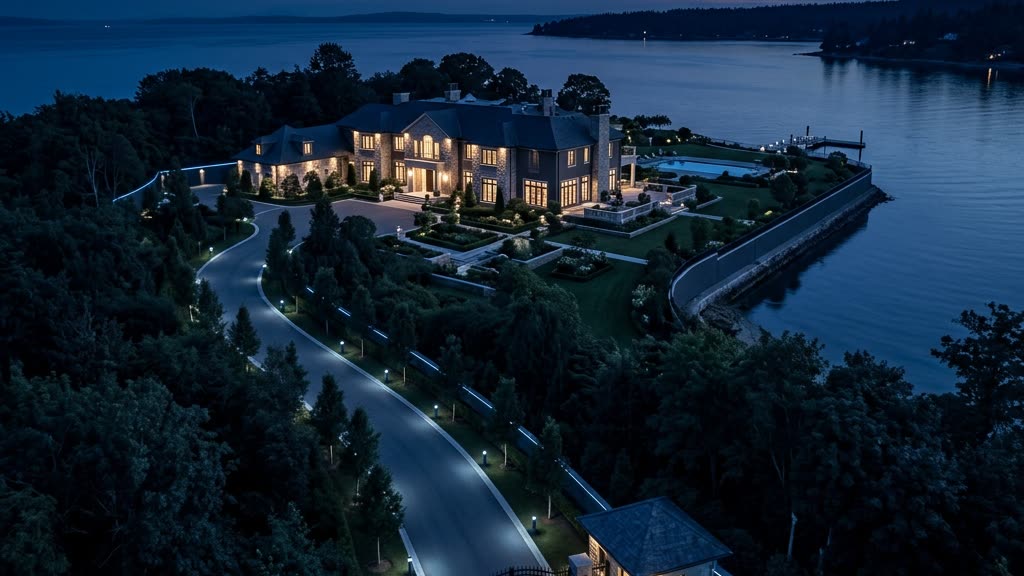
On a small lot you can point cameras at the doors and be mostly done. On a property with a gatehouse, a pool house, a boat dock, guest quarters, and a long tree-lined drive, coverage is an engineering exercise. Sight lines cross. Landscape lighting fights the sensors. Foliage grows and blinds a lens by August that was clear in March. I walk these properties and find the same thing repeatedly: capable cameras bought in good faith, mounted where they were easy to mount rather than where the risk actually lived.
The cloud-camera weak link
Nearly every consumer platform routes video through the manufacturer’s cloud. That is convenient, and it is also a single point of failure and a target. If the internet drops, or the vendor has an outage, or the account is compromised, your eyes go dark. Connected cameras and other smart-home devices are a known attack surface, and agencies like CISA (opens in a new tab) publish clear guidance on why default passwords and unpatched firmware are such a liability. I have written separately about why cloud cameras like Ring and Nest are the weak link, and at estate scale that fragility stops being theoretical.
Monitoring and response, the part nobody buys
Here is the failure I see most. The cameras work. The recording works. And when something happens at three in the morning, the entire response plan is a notification to a phone. Self-monitoring depends on a person being awake, holding the phone, seeing the alert, interpreting it correctly, and knowing exactly who to call. That chain breaks constantly. Professional monitoring exists because response is a discipline, not an app feature. It is verified alarms, a working relationship with local dispatch, and an escalation path that does not depend on whether you happened to feel your phone buzz.
Integration across systems
Estates accumulate systems. Access control at the gate, cameras, alarm sensors, sometimes a safe room, sometimes on-site personnel. DIY products are built to be islands. They do not talk to each other, and they are not meant to. The value a professional brings is not one better camera. It is a single coherent posture where the gate, the perimeter, the interior, and the response all behave as one system. This is also where a properly deployed enterprise platform matters. GuardDog AI, the intrusion-detection platform our veteran-owned team deploys and tunes as its exclusive reseller partner, watches the network layer that consumer kits leave completely unguarded. It is not a camera. It is the thing that notices when a device on your network starts behaving in a way it never should.
The Cost Conversation, Honestly
DIY looks cheaper, and at the register it is. The real comparison is not the box price. It is the total cost of the outcome you actually want, including the coverage design, the monitoring, the maintenance, and the failures you are trying to prevent. A single successful intrusion at estate scale, with the loss and the disruption and the insurance consequences that follow, dwarfs any install budget. I lay out how to think about this without hand-waving in a dedicated luxury home security cost guide, and the Insurance Information Institute at III (opens in a new tab) is a sober resource on how these losses and the coverage around them actually work.
How to Decide for Your Property
The decision is rarely all-or-nothing. Here is the framework I give families.
Match the solution to the threat model
An in-town condo and a waterfront compound are not the same risk. Be honest about who might target you, from where, and why. If your name is public, your risk profile is not the neighborhood average, and your system should not be either.
Interview before you install
Most regret I encounter traces back to a salesperson who sold a package rather than assessing a property. Before you sign anything, know what to ask. I keep a running list of the questions to ask a security installer that separates a genuine professional from an order-taker, and a companion piece on choosing a security company that covers licensing, references, and the warning signs. Those two conversations are worth more than any product comparison.
Think in layers, not products
The strongest posture I build is usually hybrid. Let capable DIY devices handle the everyday awareness layer. Let a professional design the coverage, own the monitoring and response, and integrate the whole thing. For families across the state, this layered approach is the core of how I think about luxury home security in Florida, and for clients in and around Naples it is how we reconcile the desire for discretion with the need for genuine protection.
A Hybrid Standard, Not a Binary
If you take one thing from this, let it be that diy vs professional home security is a false choice at the top of the market. The right answer borrows from both. Use consumer technology where it is strong, which is convenience and ambient awareness. Bring in professional design, monitoring, and integration where DIY quietly fails, which is coverage, resilience, and response. The families who sleep well are not the ones who spent the most. They are the ones whose systems were designed as a whole, and whose response plan does not depend on a phone being face-up on a nightstand.
Frequently Asked Questions
Is a DIY system ever enough for a high-value home?
For a smaller primary residence with an attentive owner, a well-chosen DIY setup can be genuinely competent for everyday awareness and basic deterrence. The gap opens as the property grows, the threat profile sharpens, or nobody is reliably positioned to act on an alert in the middle of the night. At that point the missing pieces are coverage design, resilient monitoring, and a real response path.
What is the single biggest weakness of consumer security systems?
Response. The hardware is often fine. What fails is the assumption that a notification to a phone equals a response. Professional monitoring closes that gap with verified alarms and an established relationship with dispatch, which is the part you cannot buy in a box.
Can I keep my existing cameras and add professional coverage?
Frequently, yes. A good assessment starts with what you already own and builds around it. The goal is one coherent system, not a rip-and-replace, and capable consumer devices often keep a place in the everyday awareness layer.
Does professional monitoring really matter if I always have my phone?
Self-monitoring works right up until the one moment it does not: the phone on silent, the dead battery, the trip abroad, the deep sleep. Response is a discipline that should not rest on a single person being awake and attentive. That is precisely the reliability professional monitoring is built to provide.
If you are weighing these trade-offs for your own property, the most useful next step is a candid conversation about your specific footprint and risk, not a product pitch. You can request a private consultation or reach our team directly at (239) 710-1772, and we will tell you plainly where DIY will serve you well and where it will not.