
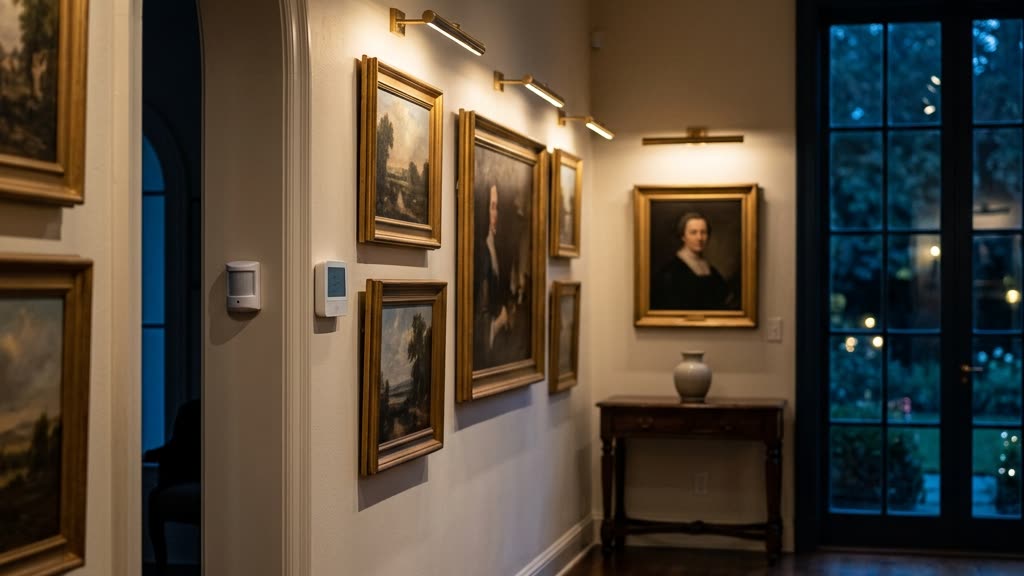
A private art collection is one of the few asset classes that has to be seen to be enjoyed and hidden to be protected. That tension sits at the center of every conversation I have with families about art security at home. A painting earns its place on the wall, in good light, in a room where people gather. Treat it purely as a vault item and you have lost the reason you acquired it in the first place. My work is about resolving that contradiction: letting a family live with their collection while making it genuinely difficult, and genuinely risky, for anyone else to touch it.
Over years of assessing estates and directing protective operations for high-net-worth families, I have found that the danger to a collection rarely arrives the way owners expect. The dramatic overnight heist is real but rare. Far more common are the quiet failures: a humidity swing that blisters a canvas over a season, a contractor who photographs a study on his phone, a loan that leaves the house in a plain crate with no one watching the loading dock. Good art security at home accounts for all of it, not just the masked figure in the night.
A Collection Is Not One Risk, It Is Several
The first thing I tell a new client is that “the art” is not a single thing to secure. It is a set of objects moving through different states, each with its own exposure. A piece on display faces one set of threats. The same piece in storage faces another. In transit it is at its most vulnerable of all. And behind all three sits the environmental layer, the slow damage that never trips an alarm but can quietly erase value.
That framing matters because most residential systems are built for one scenario: someone breaking in. A serious collection needs a program that treats display, storage, transit, and environment as four distinct problems that happen to share a house. This is the same layered thinking behind any sound luxury home security strategy, applied to objects that are irreplaceable rather than merely expensive.
Display Security: Protecting Work That Has to Be Seen
Mounting and Sightlines
Most of what protects a displayed piece is invisible and mechanical. Security hangers, cleats, and anti-theft mounts make a frame far harder to lift off a wall quickly, and speed is what a thief depends on. For higher-value works I favor concealed fasteners that require a tool the intruder will not be carrying. Placement matters as much as hardware. A painting hung in direct sightline of an exterior glass door is an advertisement. The same painting on an interior wall, out of view from the street and the entry, is simply less tempting.
Detection at the Object Level
Beyond the mount, the piece itself should be part of the alarm. Discreet contact sensors, weight-shift pads behind the frame, and motion detection tuned to a specific wall let the system know the moment a work is disturbed, not just when a door opens. The goal is to detect the theft in progress, when a response still means something, rather than discovering it hours later on a recording. I am candid with clients that cameras alone are a forensic tool, not a preventive one. They tell you what happened; they do not stop it. That is one reason I am cautious about leaning on consumer cloud cameras as a primary defense, a point I have written about separately in why cloud cameras like Ring and Nest are the weak link.
Storage Security: The Pieces You Are Not Showing
Most serious collectors show only a fraction of what they own at any given time. The rest lives in storage, and storage is where I see the widest gap between what owners assume and what actually exists. A climate-controlled room is not a secure room. A secure room has controlled access, its own intrusion detection separate from the main house, and a construction standard that resists forced entry rather than merely marking a boundary.
For works on paper, small sculpture, and other portable high-value items, the same discipline that governs jewelry and watch security and safe selection applies directly: rated enclosures, layered access, and a clear record of who can open what and when. If your collection shares space with a wine room or other specialty storage, the protection strategy for a wine cellar and a fine collection overlaps more than people expect, because both depend on stable environment and restricted access working together. The principle underneath all of it is the plain discipline of protecting valuables at home: fewer people with access, better records of that access, and detection that does not depend on someone being awake.
Environmental Sensors: The Threat That Does Not Trip an Alarm
Ask a conservator what destroys more art than theft and the answer is almost always the environment. Humidity that climbs and falls, temperature that cycles, a slow water leak behind a wall, ultraviolet light degrading pigment over years. None of it triggers a burglar alarm, and by the time the damage is visible it is often permanent.
A properly instrumented collection carries its own environmental nervous system: humidity and temperature sensors in every display and storage zone, water detection at floor level near plumbing and exterior walls, and monitoring that alerts before conditions drift out of range rather than after. In Florida this is not optional. Our clients contend with extreme heat load, salt air near the coast, and a hurricane season that can knock out power and climate control for days. For families in Palm Beach and along the coast, I treat storm resilience as part of the collection’s security, not a separate concern. Backup power for climate systems, pre-storm relocation plans for the most sensitive works, and coordination with the guidance from Florida’s emergency management division (opens in a new tab) all belong in the same plan. Fire is its own category. Early-warning smoke detection and a suppression approach chosen with art in mind, not a standard sprinkler head over a Rothko, can be the difference between a manageable event and total loss.
Art in Transit: The Most Exposed Moment
A collection is never more vulnerable than when it moves. Acquisition, a museum loan, restoration, seasonal relocation between residences: every one of these takes a work out of your controlled environment and hands it to a chain of people you do not directly supervise. The FBI (opens in a new tab) runs an Art Crime program and has documented how often losses trace back to these transitions rather than to a forced entry at the home.
My guidance here is simple and firm. Insist on unmarked, purpose-built crates. Vet the fine-art shipper the way you would vet a member of household staff. Keep the itinerary tightly held; the fewer people who know a valuable piece is on a truck, the better. Maintain a documented chain of custody with condition photographs at each handoff. And where the value justifies it, arrange discreet physical escort. The most common failure I see is not a sophisticated interception. It is casual disclosure, a piece talked about at a dinner or posted online, that tells the wrong person exactly what is moving and when.
Coordinating With Your Insurer and Appraiser
Security and insurance are two halves of the same discipline, and they should be built together. A fine-art policy or rider depends on accurate, current valuations and on documentation that proves both ownership and condition. High-resolution images, provenance records, appraisals kept current, and a complete inventory stored somewhere other than the house itself are what turn a claim from a dispute into a formality. The Insurance Information Institute (opens in a new tab) is a useful neutral starting point for understanding how these specialty policies differ from a standard homeowner’s line.
Insurers also reward the measures described above. Documented environmental monitoring, professional-grade intrusion detection, and a clear transit protocol can shape both coverage and premium. I encourage clients to bring their broker into the security assessment early, so the protection plan and the policy reinforce each other rather than sitting in separate drawers.
Bringing Detection and Response Together
The measures I have described only work when they operate as one system rather than a drawer of disconnected gadgets. Object sensors, environmental monitoring, access control, and cameras should report into a single, professionally monitored platform with a defined response for each type of alert. Part of how our veteran-owned team achieves that is by deploying and tuning GuardDog AI, a third-party enterprise intrusion-detection platform we integrate into the wider security picture so that a network intrusion or an anomaly on the property is caught and escalated the same way a physical breach would be. The point is not any single device. It is that a disturbed frame, a humidity spike, and a stranger at the loading dock all reach a person trained to act, at the hour it happens.
That is the standard I hold for every collection I assess. Not the illusion of a fortress, but a quiet, layered program that lets a family enjoy their art while the risk of losing it drops to something they can live with.
Frequently Asked Questions
Should I hide my most valuable pieces or display them?
You can do both, intelligently. Display the works that define the home, but mount and instrument them so a piece cannot be removed quickly or quietly. Rotate the most sensitive or portable items through secure storage rather than leaving everything out permanently. The goal is not to choose between enjoyment and protection but to make the displayed pieces genuinely hard targets.
Do I need environmental sensors if my house already has good climate control?
Yes. Climate control keeps conditions comfortable; sensors tell you the moment control fails. A compressor that quits during a summer storm, a slow leak behind a wall, or a humidity drift in one room are exactly the failures that ruin art, and they happen silently. Monitoring is what turns a potential loss into a routine maintenance call.
What is the most overlooked risk to a collection?
Transit and disclosure. Owners invest heavily in the home and then hand a work to a shipper, a restorer, or a mover with far less scrutiny. Combine that with casual talk about what is moving and when, and you have given away your advantage. Treat every move as the most exposed moment in the collection’s life, because it is.
How does art security fit with the rest of my home’s protection?
It should be one program, not a bolt-on. The same access control, monitoring, and response that protect the residence protect the collection, tuned for objects rather than people. Building it as part of a broader plan is far more effective than adding an art system on top of a home system that was never designed to talk to it.
Protecting a collection well is quiet, specific work, and it looks different in every home. If you would like a considered assessment of how your art is displayed, stored, moved, and insured, I would welcome the conversation. You can request a private consultation or reach our team directly at (239) 710-1772.