
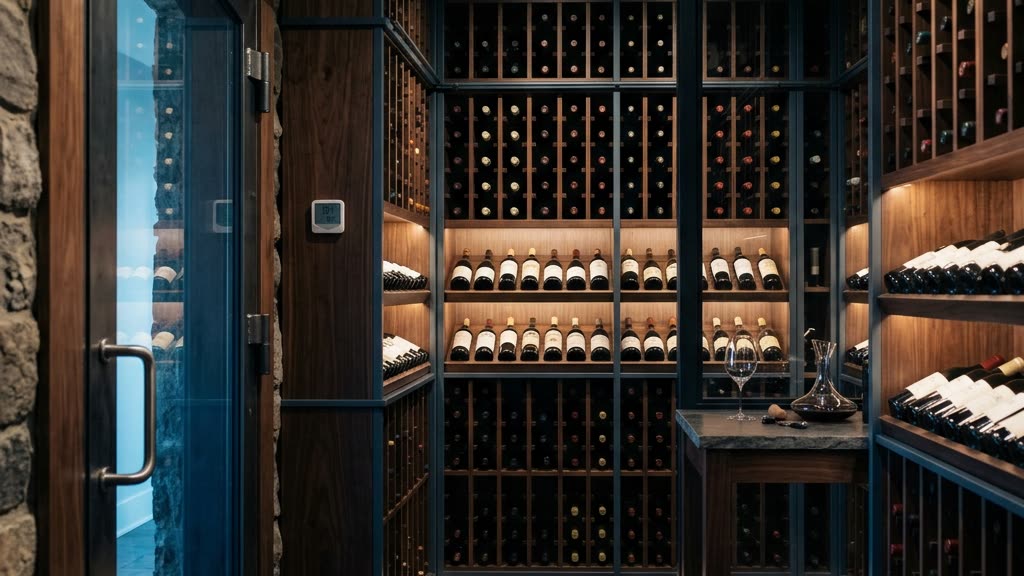
A wine cellar rarely appears at the top of a homeowner’s list of security concerns, and that is precisely what makes wine cellar security worth a serious conversation. When I assess an estate, the owner usually walks me past the safe room, the art wall, and the garage before mentioning the cellar almost in passing, as if a room full of bottles were a hospitality feature rather than an asset. Meanwhile, that room may hold value rivaling every watch, television, and handbag in the house combined, sitting behind a glass door and a climate system that a knowledgeable person can defeat in minutes. In my experience, the quiet holdings are the ones that get taken, because they are the ones nobody thought to defend.
I have spent my career assessing residences and running protective operations for families whose exposure is not obvious from the street. A serious wine collection is one of the cleanest examples of that hidden exposure. It is portable in units, easy to fence, hard to trace, and it degrades the moment its environment is disturbed. Protecting it well means thinking about three things at once: who can reach it, what conditions keep it alive, and whether you can prove what you own. Treat those as one problem, not three, and the cellar stops being the soft spot in the house.
The Quiet High-Value Target
A fine collection has a particular risk profile. Individual bottles carry meaningful value yet fit inside a jacket. Provenance is difficult to establish after the fact, which is convenient for a thief and painful for an owner filing a claim. And the people most likely to know exactly what sits in your cellar are rarely strangers. They are guests who admired a label over dinner, contractors who ran the electrical, and household staff who restock the racks. Law enforcement has repeatedly documented that high-value residential theft frequently involves someone with prior knowledge of the home, and the FBI publishes property-crime resources at fbi.gov (opens in a new tab) that reinforce how often access and insider familiarity drive these losses.
The cellar also tends to sit at the intersection of two failures. It is often outside the primary alarm zone, tucked into a basement or an addition, and it is protected by a climate system that owners are reluctant to interrupt with hardened doors or aggressive sensors for fear of harming the wine. That reluctance is understandable and it is exactly the gap a professional looks for. The goal is not to turn the cellar into a vault that ruins the experience of the room. The goal is to make reaching, removing, and reselling that collection slow, noisy, and traceable.
Access: Who Can Reach the Cellar
Access control is the first and most consequential layer, and it is where most residential cellars fail. A glass door with a decorative handle is not access control. It is a display case.
Layered access, not a single lock
I want to see the cellar treated as a controlled space inside an already controlled home. That means a solid, properly rated door rather than an ornamental one, a real locking mechanism, and an entry log that tells you who opened the room and when. Credentialed access, whether by code, fob, or biometric reader, does two useful things. It removes the shared-key problem, and it creates a record. When a bottle goes missing, the difference between an unsolvable mystery and a short list of names is almost always whether the door kept a log.
Position the cellar inside your alarm topology, not adjacent to it. The room should have its own contact and motion coverage that arms independently, so the space can stay secured even when the rest of the house is active for a party. This is the same layered logic I apply across an estate, and it connects directly to the broader approach I describe in this overview of luxury home security in Florida: concentric rings, each one buying you time and evidence.
The staff and vendor problem
The uncomfortable truth is that the person with legitimate reasons to be near your collection is your largest variable. Cleaners, cellar consultants, caterers, and maintenance crews all pass through. I am not suggesting suspicion of the people who serve your household. I am suggesting structure. Define who is credentialed for the cellar and who is not. Escort vendors who have no reason to be in the room. Keep the entry log reviewable. The families who handle this gracefully treat it as a matter of clear boundaries rather than mistrust, and the boundaries protect the staff as much as the owner, because a documented access trail clears the innocent as quickly as it flags a problem. The same discipline that governs the cellar should govern the safe room and the home safes in your buyer’s guide: controlled, logged, and never dependent on a single shared secret.
Environment: The Threat That Isn’t a Thief
Here is where wine cellar security diverges from every other room in the house. The most common way an owner loses a collection is not theft at all. It is a failed compressor over a holiday weekend, a humidity swing, a power interruption, or a flood no one saw for two days. In Florida, where I do much of my work, heat and moisture are relentless and storm-driven outages are a fact of life. A cellar that loses its climate control in July can cook a collection before anyone notices.
Environmental protection therefore belongs inside your security posture, not in a separate maintenance folder. I want continuous monitoring of temperature and humidity with alerts that reach a real person, not a light blinking on a panel nobody watches. I want water detection on the floor and near any cooling unit. I want the cellar on backup power or at minimum on a monitored circuit, so an outage triggers a notification rather than a silent countdown. Federal preparedness guidance at ready.gov (opens in a new tab) is a sensible starting point for thinking through outage and flood planning, and those same principles apply to any climate-dependent asset in the home. The families who avoid catastrophic loss are the ones whose systems tell them something is wrong while it is still a phone call rather than a claim.
Inventory: You Cannot Protect What You Haven’t Documented
If a collection is stolen or ruined and there is no credible record of what existed, the loss compounds. You cannot recover what you cannot prove, and you cannot value what you never documented. I ask every collector I work with to maintain a current inventory: labels, vintages, provenance where available, purchase records, and dated photographs. Store that record somewhere other than the cellar and somewhere other than a single laptop. The Insurance Information Institute at iii.org (opens in a new tab) offers clear guidance on documenting high-value collections for coverage, and no serious collection should be scheduled with an insurer on a guess.
Good documentation also changes the security equation before a loss ever occurs. A precise inventory reveals what a discreet, targeted theft would look like, so you know which shelves warrant closer monitoring. It supports law enforcement recovery when bottles surface at auction or resale. And it forces the useful discipline of periodic reconciliation, which is how slow, quiet shrinkage gets caught early rather than at the end of a very bad year. The habit of documenting and safeguarding a collection is the same habit that protects every other movable asset in the home, a theme I return to in this note on protecting valuables at home.
Monitoring Without Creating a New Vulnerability
Owners often assume the fix is more cameras and more sensors, all connected to an app. Connectivity is useful, but every device you add to the home network is another door into the household, and cheap consumer gear is frequently the weakest link in an otherwise serious home. I have written before about why cloud cameras like Ring and Nest are the weak link, and cellar monitoring falls into the same trap when it is bolted on without thought to the network behind it.
This is where the veteran-owned team at SDVOSB.services approaches the cellar as part of a hardened whole rather than a gadget in isolation. We deploy GuardDog AI, an enterprise intrusion-detection platform we integrate and tune as its exclusive reseller partner, to watch the network the way a good camera watches a hallway. It flags the anomalous device, the unexpected connection, and the behavior that does not belong, so your monitoring infrastructure does not quietly become the way someone gets in. National guidance on securing connected devices is available at cisa.gov (opens in a new tab), and the short version is simple: the sensor that protects your wine should not open a path to everything else you own. Sound monitoring adds visibility without adding exposure.
Where the Cellar Fits in the Whole Estate
A cellar is never the only quiet target in a serious home. The same owner usually has vehicles worth defending with the same care, which is why I treat the cellar and the garage as siblings in a single plan rather than separate projects, an approach I lay out in this piece on luxury vehicle and garage security. Access, environment, inventory, and monitoring recur in every high-value space. The estates I see handle this best in dense, high-visibility markets like Miami, where discretion and layered protection matter most, are the ones that stop thinking in rooms and start thinking in systems. The cellar is simply one node in that system, and it deserves the same rigor as the front gate.
Frequently Asked Questions
Does adding real security ruin the look and feel of a wine cellar?
No, and it should not. Good design hides the hardware. A properly rated door can still be beautiful, credentialed access can sit behind an elegant reader, and environmental and network monitoring are invisible by nature. The objective is a room that feels exactly as it did before, backed by protection the owner never has to think about until it matters.
Is the biggest risk to my collection theft or environmental failure?
For most collectors, environmental failure is the more frequent loss and theft is the more targeted one. A serious plan addresses both at once, because the same monitoring backbone that alerts you to a stranger at the cellar door is what tells you the cooling unit has quit at two in the morning.
How do I protect against people who have legitimate access?
Structure, not suspicion. Credentialed entry, an access log you actually review, escorted vendors, and a maintained inventory reconciled on a schedule. A documented access trail protects honest staff and surfaces the rare bad actor. The record is the deterrent.
Should cellar monitoring connect to the same network as everything else?
Only if that network is properly secured and monitored. Every connected sensor is a potential entry point, so connectivity should be designed, segmented, and watched by a platform built for intrusion detection rather than left to consumer defaults.
A wine collection is one of the most valuable and least defended assets in many fine homes, and the fixes are neither disruptive nor complicated once someone treats the cellar as a serious space. If you would like an experienced assessment of how your collection is exposed and what a quiet, layered defense would look like, request a private consultation or call us directly at (239) 710-1772. The right time to document and protect a collection is always before the weekend it goes wrong.