
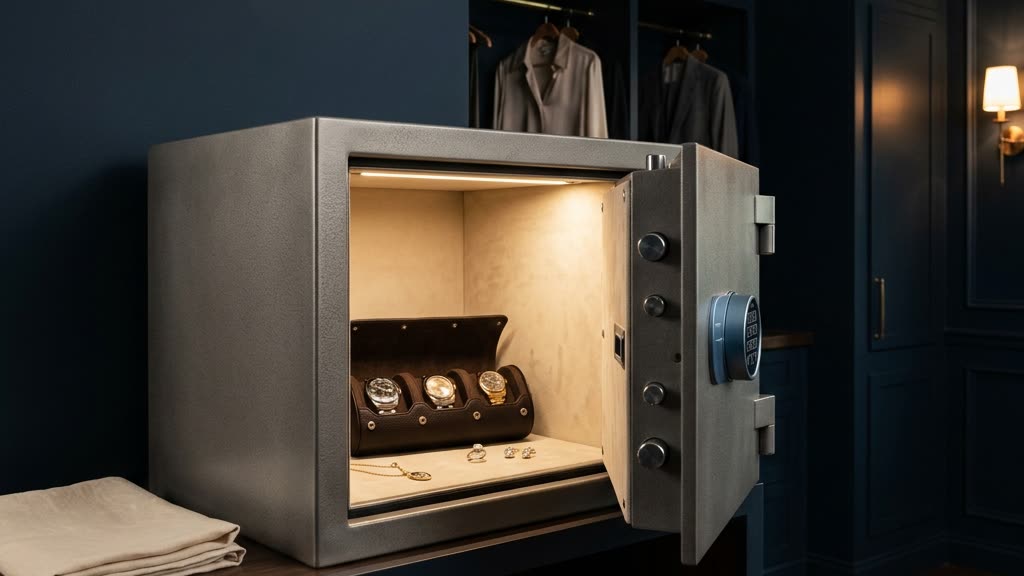
Most people think about a jewelry collection the way they think about a fire extinguisher. They buy the box, bolt it somewhere reasonable, and settle into a quiet confidence that the matter is handled. A jewelry safe home setup, in most of the estates I assess, looks exactly like that: a decent safe, a sensible closet, and an assumption that the hard part is over. The safe matters. It is not the whole answer, and in my experience it is rarely the part of the problem that actually gets people hurt.
I have spent my career on the operational side of protecting people and the things they value, from running a security firm in Brazil to building security programs for institutions that do not get second chances. What that work teaches you, over and over, is that a static object like a safe protects an asset only in one narrow moment: when the asset is inside it. The rest of the time, your jewelry and watches are exposed to a very different set of risks, and those risks travel with you.
The Safe Protects a Moment, Not a Lifestyle
A safe is a control for a specific scenario: an intruder is in your home, the pieces are locked away, and you want the barrier to buy time. That is a real and worthwhile function. The problem is that most theft of high-value jewelry and watches does not happen while the pieces sit in the box. It happens while they are being worn, transported, photographed, admired, and moved through the ordinary rhythm of an affluent life.
So the safe is the floor of your program, not the ceiling. When I walk an estate, I am less interested in the rating stamped on the door than in the vast majority of the time those pieces are somewhere else. If your security thinking begins and ends at the safe, you have protected the one moment that criminals are least likely to target.
Wear Patterns Are a Signal You Are Broadcasting
Every collector I have worked with has habits, and habits are patterns. The same watch on the same wrist every Thursday at the same club. The anniversary set that comes out for the same gala each year. The engagement ring photographed and posted the week it was resized. None of this feels like a security decision. All of it is.
Sophisticated theft crews do not start with a lock. They start with observation. They watch valet lines outside certain restaurants. They read social media geotags. They notice which guests at a charity event are wearing serious pieces, and which car those guests walk to afterward. The Justice Department (opens in a new tab) has prosecuted organized theft groups that operate exactly this way, treating affluent neighborhoods and luxury venues as hunting grounds and building target lists from public behavior.
The countermeasure is not paranoia. It is discretion as a practiced habit. Vary what you wear and when. Be deliberate about what gets photographed and posted, and when it posts relative to when you are actually somewhere. Treat the most recognizable pieces, the ones a knowledgeable eye can price from across a room, as items that draw attention rather than simply express taste. Discretion is not about hiding wealth. It is about not narrating it to strangers.
Follow-Home Robbery: The Threat That Ignores Your Safe
The risk I spend the most time on with jewelry-owning families is the follow-home robbery, because it renders the safe irrelevant by design. The crew identifies a target away from home, at a restaurant, a jewelry showroom, a valet stand, an airport, then follows the vehicle back and confronts the victim in the driveway or garage, before anyone is behind a locked door. The FBI (opens in a new tab) and local agencies across South Florida have documented this pattern in affluent communities, and it has become a defining concern for families in places like Boca Raton and the surrounding coastal enclaves.
What makes follow-home effective is that it attacks the seam between public and private space. Your safe is deep inside the private zone. The attack happens in the transition. That is why I treat the driveway, the garage, and the arrival sequence as their own security problem, closely related to how you protect the vehicle itself. The habits that reduce follow-home risk are unglamorous and effective: notice whether the same vehicle appears across separate legs of a trip, do not drive directly home when something feels wrong, arrive with your attention up rather than buried in a phone, and design the last hundred feet of your route so that the most vulnerable moment, stepping out of the car, is well lit, observed, and brief.
Safe Placement and Ratings, Done Properly
None of this means the safe does not matter. It means the safe has to be chosen and placed with the same seriousness as everything around it.
Ratings you should actually understand
Retail marketing blurs a distinction that matters: burglary resistance and fire resistance are two different tests, and a safe strong in one can be weak in the other. On the burglary side, a Residential Security Container is the entry-level Underwriters Laboratories rating, adequate for an opportunistic smash-and-grab but not for a determined attack. The tool-resistant ratings, such as TL-15 and TL-30, describe a safe built to resist common hand and power tools for a tested duration, and they are a different class of protection. For a serious collection, the honest question is not “is it a safe” but “how long does this actually delay a prepared thief, and does that exceed my alarm and response time.” Match the box to the threat and to how fast help arrives.
Placement is half the value
A high rating on a poorly placed safe is a wasted investment. I look for a few things. The safe should be anchored into structural concrete, not simply set on a closet floor, because an unanchored safe can be carried out and opened elsewhere at leisure. It should not live in the first place a thief looks, which is the primary bedroom closet, so a secondary or concealed location often serves better, sometimes paired with a modest decoy. It should sit inside a monitored zone, so that any attempt to attack it in place trips detection. And for watches specifically, the environment matters: mechanical timepieces do not love the humidity we live with in Florida, so climate and desiccation deserve a thought alongside security.
The Safe Is One Layer in a System
The estates that actually protect their valuables treat the safe as a single component inside a layered design, the same philosophy I bring to luxury home security across Florida. Detection has to see the attempt early. Monitoring has to route it to a real response. Barriers have to buy time that matches that response. The safe is the last barrier, and a last barrier only works when the earlier layers have done their job.
On the detection side, this is where modern tooling earns its place. As the exclusive reseller of GuardDog AI, an enterprise intrusion-detection platform, our team deploys and tunes it to watch the network and connected environment of a property, closing gaps that traditional alarm contacts never see. That belongs to a broader principle worth stating plainly: valuables are protected by the whole estate, not by any one box, which is the through-line in how we approach protecting valuables at home. The same logic extends to your other collections. A wine cellar and a watch collection are different assets with the same underlying exposure, and the way you protect a fine wine collection rhymes with the way you protect jewelry: control access, monitor the space, and document what you own.
Discipline Off the Shelf
The least expensive and most neglected layer is administrative. Keep a current, photographed inventory of every significant piece, stored securely and off-site. Keep appraisals current, because value drifts and a stale appraisal helps no one after a loss. And schedule your jewelry properly on your insurance rather than assuming a standard homeowners policy covers it; the Insurance Information Institute (opens in a new tab) is clear that high-value items generally need their own scheduled coverage to be made whole. None of this prevents a theft. All of it changes what happens to you afterward, and that difference is enormous.
Frequently Asked Questions
What safe rating do I need for a serious jewelry and watch collection?
There is no single answer, because the right rating depends on your response time. A Residential Security Container deters casual theft. For high-value pieces, a tool-resistant rating in the TL class buys meaningful delay against a prepared thief. The rating only matters relative to how quickly detection and response reach the safe, so specify them together.
Is a hidden safe better than a rated one?
They solve different problems, and the strongest setups use both. Concealment defeats the thief who never finds the box. A rating defeats the thief who does. Relying on concealment alone is fragile, because a crew that has studied you may already know where to look.
Does my homeowners insurance already cover my jewelry?
Usually not to the extent owners assume. Standard policies commonly cap payouts on jewelry well below the value of a real collection. Scheduling individual pieces, with current appraisals, is what actually protects you financially, and it is worth reviewing every year.
How do I lower my follow-home risk without living defensively?
Small habits carry most of the weight: vary your routines, stay aware in transitions between public and private space, protect the arrival sequence at your own driveway, and be disciplined about what your jewelry announces in public and online. The goal is a lower profile, not a smaller life.
Protecting a collection is ultimately about matching every layer to the way you actually live, and that assessment is different for every family and every property. If you would like a candid, discreet evaluation of how your jewelry, watches, and the rest of your estate are protected, our veteran-owned team is glad to help. You can request a private consultation or reach us directly at (239) 710-1772.