
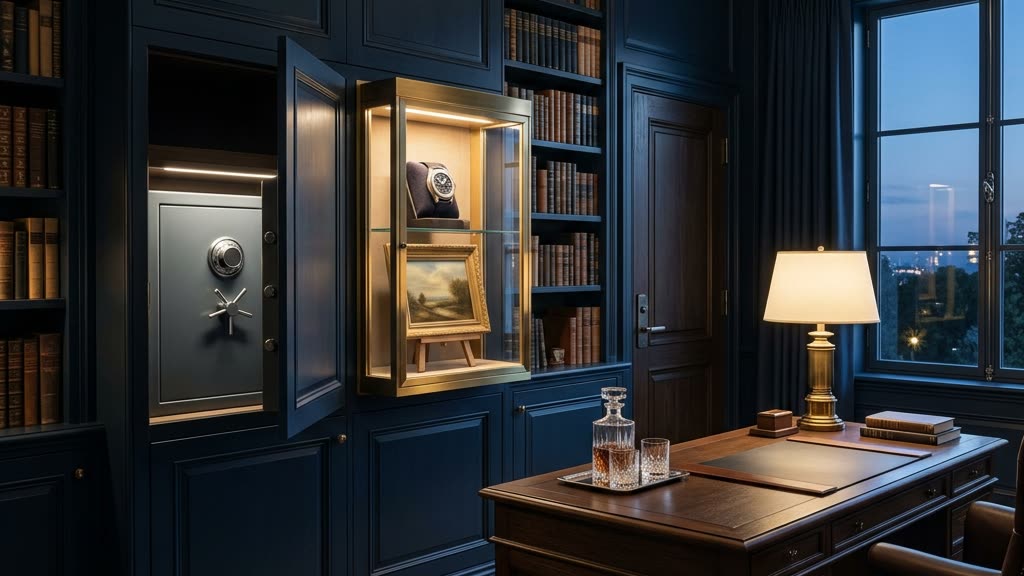
In more than two decades of assessing estates and running protective operations for high-net-worth families, I have found that home valuables security is rarely undone by a master thief. It is undone by ordinary assumptions: that a single alarm covers the whole property, that a wall safe is a vault, that a homeowner’s policy will simply make everything right after a loss. The families who protect what matters best are not the ones who spend the most. They are the ones who stop treating security as a product and start treating it as a system.
That system has four moving parts, and they work in sequence: document what you own, harden the ways in, insure intelligently, and rehearse your response before anything happens. Miss one, and the other three carry more weight than they were built to hold. This guide is the broad map. It is meant to orient you across the whole problem, from the front gate to the insurance rider, so you can see where your own protection is thin. Some categories, like fine art and high-value jewelry, deserve their own detailed treatment, and I will point you to those along the way.
Start With What You Actually Own
Most people cannot produce, on demand, an accurate account of what would be lost in a burglary or a fire. That gap is the single most expensive mistake I see, and it costs owners twice: first in recovery, because law enforcement cannot return what you cannot describe, and again in insurance, because carriers pay against proof, not against memory. Before you buy a single lock or camera, you build the record.
Build a real inventory
A working inventory is more than a spreadsheet. For each item of meaningful value, you want clear photographs, including any serial numbers, hallmarks, or maker’s marks, along with purchase records and provenance where it exists. Store that record somewhere it will survive the event you are protecting against, which means encrypted cloud storage and at least one copy held off the property. The FBI’s stolen property and recovery programs, documented at the FBI (opens in a new tab), depend on exactly this kind of detail. A watch with a recorded serial number can be flagged and returned. A watch described as “gold, expensive” is gone for good.
Get current appraisals
Values drift, and they rarely drift downward for the things worth stealing. Fine art, jewelry, rare timepieces, and collectibles should be appraised on a schedule your insurer will honor, typically every few years. An out-of-date appraisal is not a small problem. It is the difference between being made whole and absorbing a large uninsured gap after a loss you thought was covered.
Harden the Ways In
Once you know what you are protecting, you protect it in layers. No single measure should be load-bearing. The goal is to make each stage of an intrusion slower, louder, and more visible than the last, so that a determined person runs out of time and nerve before they reach anything that matters. I treat this the same way for a barrier-island residence as I do for the larger estates inland. If you want the full architecture of that layered approach in a Florida context, our overview of luxury home security in Florida walks through it property type by property type.
The perimeter is your cheapest layer
Protection begins well before the front door. Landscaping that eliminates concealment near windows and entries, lighting that removes shadow rather than merely decorating, and clear sightlines from the street all reduce a property’s appeal to someone surveying it. Perimeter awareness matters because the most dangerous moment is not the break-in. It is the reconnaissance beforehand, when someone is deciding whether your home is worth the risk. A property that signals attention and difficulty rarely makes the list.
Rate your safe honestly
A safe is only as good as its rating, its installation, and its concealment. A lightweight box that two people can carry out the door is a convenience, not a defense. For anything of real value, you want a unit rated for both burglary and fire, bolted into structure rather than resting on it, and sited where it is not the first thing a searcher finds. Different valuables call for different storage, and the specifics matter enough that jewelry, watches, and small high-value items get their own detailed treatment in our guide to jewelry and watch security and safes. Read it before you assume the safe you inherited with the house is adequate.
Add a Detection Layer That Reacts
Hardening buys you time. Detection is what turns that time into a response. The two only work together. A vault that no one is watching is a delay, not a defense, and a camera that no one acts on is a recording of your loss.
Modern detection has moved well beyond motion sensors and door contacts. On the estates we protect, we deploy and tune GuardDog AI, a third-party enterprise intrusion-detection platform for which our team serves as the exclusive reseller partner. It watches the network and connected environment rather than just the physical doors, which matters more every year as homes fill with connected devices, cameras, and access controls that each represent a way in. You can read how we integrate and tune it on our GuardDog page. The important point for an owner is this: detection has to see the whole surface, digital and physical, because a modern intruder will probe the softest one.
That softness is often the cameras themselves. Consumer cloud cameras are convenient and, too often, the weakest point in an otherwise serious system. I have written separately about why cloud cameras like Ring and Nest are the weak link, and I would urge any owner relying on them to understand where their footage actually lives and who can reach it.
Insure Like You Expect to Use It
Documentation and hardening reduce the odds of a loss. Insurance decides what happens on the day the odds do not hold. Most high-value households are underinsured for their contents without realizing it, because a standard homeowner’s policy caps categories like jewelry, art, and cash at limits that were never meant for a serious collection.
The instrument that closes that gap is scheduled personal property, sometimes called a floater or a rider, which insures named items individually at their appraised value. The Insurance Information Institute (opens in a new tab) explains the mechanics well, and it is worth understanding before you sit down with your broker rather than after a claim. Ask specifically how your policy treats theft versus mysterious disappearance, whether coverage follows an item off the premises, and what documentation the carrier will require to pay. The answers will send you straight back to the inventory and appraisals from the first section, which is exactly the point. The four parts of this system are not separate. They feed each other.
Rehearse the Response
The final layer is the one owners skip, and it is the one that saves lives rather than objects. Every capable household should know, without thinking, what happens when an alarm sounds at two in the morning. Where does the family gather. Which door do they not open. Who is called, and in what order. A protected interior space, sometimes a purpose-built safe room and sometimes simply a reinforced bedroom with a hard line of communication, buys the minutes that matter while help arrives.
This is preparedness, not paranoia, and it belongs in the same drawer as your fire plan and your storm plan. The general framework at Ready.gov (opens in a new tab) is a sound starting point for family emergency planning, and the discipline transfers directly. A plan that has been walked through once, calmly, in daylight, is worth more than the most expensive system left to improvise under stress. I tell every family the same thing: your alarm’s job is to buy time, and your plan’s job is to spend it wisely.
The Categories That Need Their Own Playbook
A hub guide can only go so deep, and two categories reward the extra attention because they concentrate enormous value into small, portable, and often displayed forms.
Fine art carries risks that jewelry does not: environmental damage, handling loss, and the reality that a piece is usually meant to be seen rather than hidden. Protecting it means balancing display against exposure, and it deserves its own approach, which I lay out in art collection security at home.
Jewelry and watches present the opposite problem. They are small, liquid, easy to carry, and frequently targeted by organized crews who study a household’s routine before they ever approach. The lessons from what a large burglary ring teaches us about estate security apply directly here, and the storage specifics live in the jewelry and safes guide linked earlier. Across Southwest Florida, from the barrier islands to the estates around Fort Myers, these are the categories that draw the most patient and professional attention, which is precisely why they need the most deliberate planning.
Frequently Asked Questions
Where should I start if I have done none of this?
Start with documentation. It is the least expensive step, it improves both recovery and insurance outcomes immediately, and it forces you to see what you are actually protecting. Everything else in home valuables security is easier to plan once you have an honest inventory in front of you.
Is a home safe enough on its own?
No. A safe is one layer, and a good one buys time, but time only matters if detection and a response plan turn it into action. Treat the safe as part of a system, correctly rated and properly installed, rather than as the whole answer.
Are professional monitoring and smart detection worth it for a private home?
For a household with meaningful value at stake, yes, provided the system watches the full surface rather than a few doors. The connected devices in a modern home are entry points, and detection that ignores them leaves the softest path open. That is why we deploy an enterprise-grade platform and tune it to the specific property.
How often should I revisit all of this?
At least once a year for the plan and the inventory, and on the schedule your insurer requires for appraisals, typically every few years. Values change, families change, and a system reviewed on a calendar stays current instead of quietly falling out of date.
Protecting what matters is not about buying the most equipment. It is about closing the gaps between the pieces you already have. If you would like a discreet, experienced assessment of where your own protection is thin, our veteran-owned team is glad to help. You can request a private consultation or reach us directly at (239) 710-1772, and we will treat your home, and your privacy, with the seriousness both deserve.