
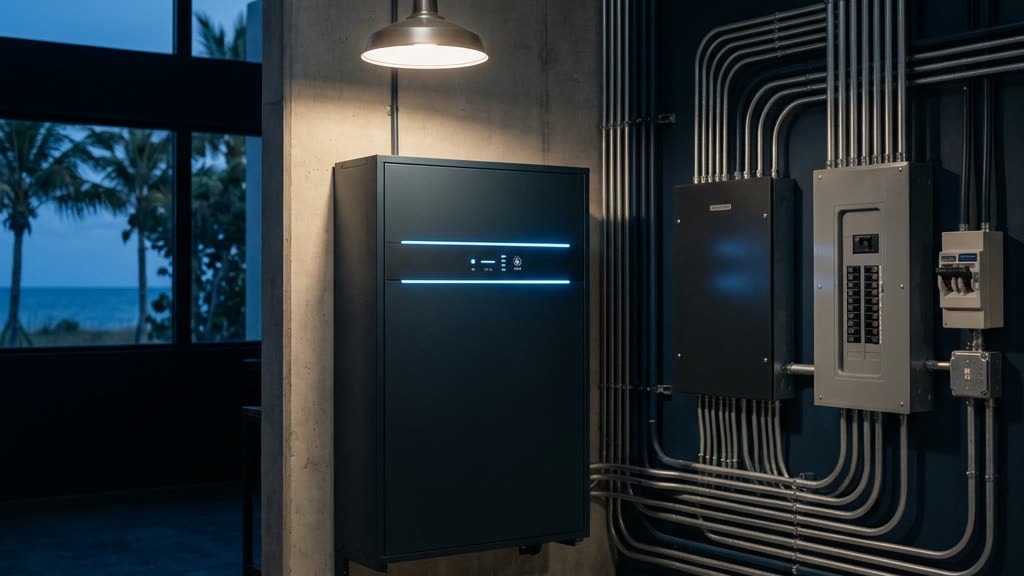
The first time I watched a Gulf-coast estate go completely dark during a summer storm, the owner’s first concern was the wine cellar. Mine was the front gate. Within a few minutes of the grid failing, the automated gate had lost its hold, the exterior cameras had gone black, the alarm panel was running down its small internal cell, and the cellular router that carried every notification to my team had already stopped answering. The house was, for practical purposes, blind and mute. That is the exact window a prepared adversary waits for, and it is the reason a serious conversation about protection has to start with power. A well-designed security system battery backup is not a convenience feature. It is the difference between a system that keeps watching when the lights go out and a very expensive collection of sensors that all switch off at the same moment.
Florida makes this concrete in a way few other places do. Between hurricane season, afternoon thunderstorms, grid strain, and the simple fact that many of the finest homes sit at the end of long coastal feeder lines, extended outages are a normal operating condition here, not a rare emergency. If your security posture assumes reliable utility power, it has a single point of failure baked into it. I want to walk through how I think about keeping detection and communications alive through an outage, how I size battery storage for a real estate rather than a marketing brochure, and where a generator fits alongside the batteries rather than instead of them.
An Outage Is a Security Event, Not Just an Inconvenience
It helps to reframe what an outage actually is. Most homeowners file it under “comfort,” alongside a warm refrigerator and a dark pool deck. I file it under “risk,” because losing power removes several of the layers a home relies on all at once. The cameras stop recording. The network video recorder shuts down and loses the very footage you would want afterward. The gate and garage default to a state someone has to manage manually. The alarm panel falls back to a battery that was sized for a short grid blip, not a two-day event, and its cellular link may have no independent power at all.
Law enforcement has long documented that opportunistic and organized burglars pay attention to conditions that reduce a home’s defenses, and a neighborhood-wide outage is about as clear a signal as they get. This is the same logic behind the professional’s interest in when a home is empty, which I have written about in the context of protecting an estate during long absences. An outage during an absence stacks two vulnerabilities on top of each other. Battery storage is how you refuse to hand over that advantage.
What Battery Backup Actually Has to Protect
When people hear “battery backup,” they often picture the whole house humming along as if nothing happened. That is a fine goal for comfort, but it is the wrong starting point for security. I begin with the smallest possible list of loads that absolutely must survive an outage, because those are the loads worth protecting first and protecting well.
Detection
Detection is the sensing layer: door and window contacts, motion and glass-break sensors, the alarm panel itself, and the cameras that give you eyes on the property. The panel usually carries a modest internal battery, but on a large property that battery was never intended to run the full sensor field and the camera system for a long event. Cameras and the recorder that stores their footage are power-hungry by comparison, and they are precisely what you lose first if backup is an afterthought. Keeping detection alive means putting the panel, the recorder, and the camera field on a power source that outlasts the outage, not one that expires an hour into it.
Communications
Detection with no way to report is a tree falling in an empty forest. The communications layer is the cellular or internet link that carries alarm signals, video, and alerts to a monitoring center and to my team. This is the most commonly overlooked load in the entire chain. I have inspected beautiful systems where the panel had backup and the router did not, so the moment utility power dropped, the house went silent to the outside world even though the sensors were still technically armed. Your battery plan has to explicitly include the router, the cellular gateway, and any hub the system depends on to reach a human being.
Access and Deterrence
A narrower tier covers the gate controller, a few strategic exterior lights, and the intercom. These do not always need to run for days, but they should not fail instantly either. A gate stuck open and a dark perimeter tell a watcher exactly what they need to know.
Sizing Battery Storage for a Real Estate
Sizing is where good intentions meet physics, and it is where I see the most money wasted in both directions. The honest method is not complicated. You add up the continuous power draw of the loads you decided you cannot lose, then you decide how many hours of autonomy you want, and the battery capacity follows from those two numbers. Detection and communications together tend to be a surprisingly small continuous load, which is good news: keeping the essential security spine alive for a long stretch often costs far less energy than people assume. Adding air conditioning, pool equipment, and a full kitchen to that same battery is what drives cost into another category entirely.
I encourage owners to think in tiers rather than all-or-nothing. A modest, dedicated battery can carry detection and comms for an extended outage on its own. A larger home battery system can then layer in comfort and convenience loads for a shorter window. When you separate these, you get resilience where it matters most for a fraction of what a whole-estate solution costs, and the security layer no longer competes with the refrigerator for the last of the stored energy.
Chemistry matters too, and I will keep this practical. Older sealed lead-acid batteries, the kind still tucked inside many alarm panels, are inexpensive but lose capacity as they age and often fail quietly right when you need them. Modern lithium iron phosphate storage holds up far better over years of Florida heat and deep cycling, which is why I lean toward it for the security-critical tier. Whatever the chemistry, the discipline is the same: size for the loads you defined, then test the runtime rather than trusting the label. The federal preparedness guidance at Ready.gov (opens in a new tab) is a sound, plain-language reference for building an outage plan around your actual needs, and it pairs well with the resilience thinking that CISA (opens in a new tab) publishes for protecting critical systems against disruption.
Battery and Generator Synergy
Owners often ask whether they should buy a generator or a battery, as though it were a choice between two answers to the same question. In an estate context, the two solve different problems, and the strongest designs use both. A whole-home standby generator is excellent at carrying large loads for a long time, but it has a cold-start delay, it depends on a fuel supply that can run out in a multi-day event, and it is a mechanical device that occasionally refuses to start on the one night you need it. Batteries have none of that latency. They carry the load instantly and silently, which is exactly the behavior you want for the security spine.
The pattern I favor is straightforward. Battery storage handles the seamless, instant, always-on protection of detection and communications, so there is never a gap, not even the few seconds a generator takes to spool up. The generator then handles the heavier comfort loads and, crucially, recharges the batteries during the outage so the security tier never runs dry. In that arrangement the battery covers the generator’s weaknesses and the generator extends the battery’s endurance. Neither one alone gives you both instant continuity and long duration. Together they do.
Where This Matters Most in Florida
Everything above applies anywhere, but the coastal estates I assess raise the stakes. A waterfront property may sit at the end of a vulnerable utility line, face longer restoration times after a storm, and combine an outage with the water-access exposure I have detailed in my notes on waterfront risk in Naples and Port Royal. When a home is also empty for part of the year, the outage risk and the absence risk compound, which is why battery resilience is a recurring theme in my broader Florida estate security guide and across our approach to luxury home security in Florida. Florida’s own emergency management resources at FloridaDisaster.org (opens in a new tab) reinforce how routine extended outages are here, and any protection plan for a home in and around Naples should treat them as an expected condition rather than a surprise.
On the detection side, keeping power to the sensing layer only matters if the sensing layer is worth keeping alive. This is where the intrusion-detection platform we deploy earns its place. Our veteran-owned team is the exclusive reseller partner for GuardDog AI, a third-party enterprise detection system that we install, integrate, and tune to a specific property. Battery storage keeps that detection watching through the outage; the platform is what makes the watching intelligent. The two are meant to work as one continuous layer, and neither is much use during an outage without the other.
Frequently Asked Questions
How long should my security battery backup last?
Long enough to outlast a realistic outage for your location, not just a brief flicker. On the coast, that means planning in terms of days rather than hours for the detection and communications tier. Because those loads are small, extended autonomy is achievable without an enormous battery, especially when a generator is present to recharge during the event.
Will a home battery like a wall-mounted storage unit cover my alarm system?
It can, but only if the alarm panel, the recorder, and the network equipment are actually wired to it. I frequently find home batteries that power the kitchen and the living room while the security router quietly runs on nothing. The fix is intentional design: put the security spine on protected circuits first, then add comfort loads.
Do I still need the small battery inside my alarm panel?
Yes, as a last-ditch layer. That internal battery is a short-duration safety net for the panel alone. It was never meant to carry cameras, recorders, and communications through a Florida outage, which is exactly why a properly sized storage system sits behind it.
Can batteries and a generator work together automatically?
They can, and that is the ideal. A well-integrated setup lets the battery carry the load instantly and silently while the generator starts, then uses the generator to recharge the batteries so the protected loads never lose ground during a long event.
Power resilience is one of those investments that is invisible until the night it saves you, and by then it is too late to add it. If you would like a clear-eyed assessment of how your detection and communications would hold up through an extended outage, I am glad to walk your property and show you exactly where the gaps are. You can request a private consultation or reach my team directly at (239) 710-1772.