
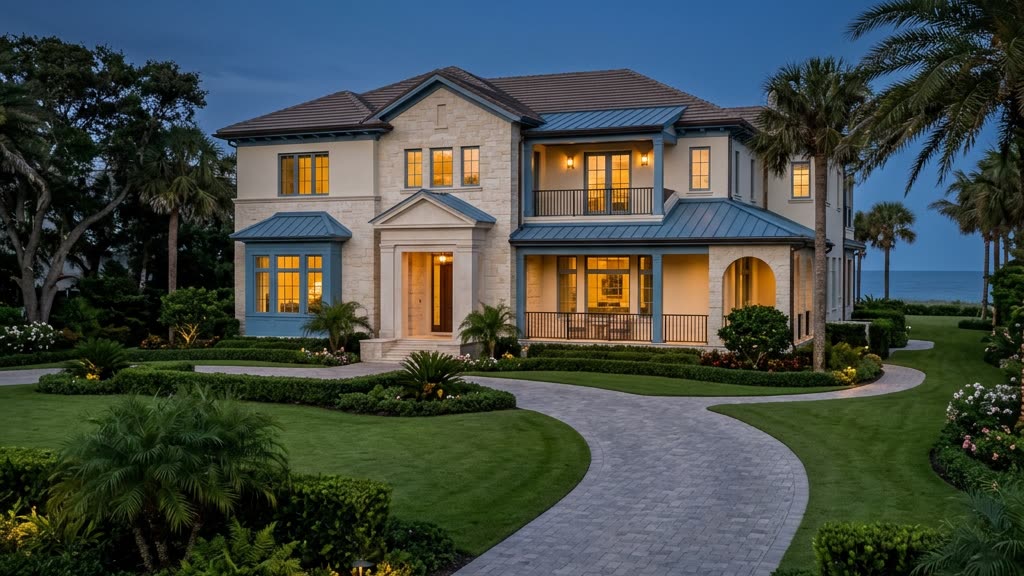
A house that empties out for the season sends a signal, whether or not anyone is standing on the street to read it. In the years I have spent assessing estates and running protective operations for families who split their year between Florida and somewhere colder, I have come to treat empty house security as a problem of appearances first and hardware second. The break-in, when it happens, is almost never the beginning of the story. It is the end of a quiet stretch during which the property advertised, in small and cumulative ways, that no one was coming home tonight, or this week, or this month.
Most residential burglaries, as law enforcement has long documented, happen in daylight hours when homes are unoccupied. The people who commit them are not master tacticians. They are opportunists who read tells, knock on doors to confirm a house is empty, and move on to the property that looks softest. A home left dark for a long absence is not inherently a target. A home that looks abandoned is. The distance between those two conditions is where the real work of protecting a vacant estate lives, and most of it can be managed before you ever lock the door behind you.
What an Empty House Quietly Announces
Before I recommend a single camera or sensor, I walk a property the way someone with bad intentions would. I stand at the curb, at the service gate, at the neighbor’s sightline, and I ask a simple question: what does this place tell me about who is home? On a well-run estate, the answer should be ambiguous. On most homes heading into a long absence, the answer becomes obvious within a week.
Mail, Packages, and Paper
The mailbox is the oldest tell in the book, and it remains the most reliable. Envelopes fanning out of a slot, a wad of circulars wedged behind the door, a stack of packages accumulating on a portico: each one is a timestamp announcing exactly how long the owners have been gone. Beyond signaling vacancy, that mail is a second liability. It carries names, account relationships, financial statements, and travel confirmations, the raw material that makes both a burglary and an identity theft easier to execute. The Federal Trade Commission has been clear for years about how much sensitive information moves through ordinary mail, and its guidance at ftc.gov (opens in a new tab) is worth reviewing before any extended trip.
The fix is unglamorous and effective. Place a formal hold on delivery for the length of the absence, or route everything to a monitored address that someone actually collects. Suspend the newspapers and the recurring subscription boxes. Do not let a single item sit where the street can see it accumulate. I ask clients to think of the mailbox as a public status board, because that is precisely how it functions.
The Landscaping Tells
Grounds age visibly when no one tends them, and they age on a schedule that anyone can read. An unmown lawn, a hedge that has lost its line, storm debris left where it fell, a pool surface going cloudy: these are calendar entries written in green. In Florida especially, where growth is aggressive and weather is not gentle, a landscape can look neglected in ten days. That neglect does more than signal absence. It compounds it, because a property that looks uncared for invites the assumption that it is also unwatched.
Keep the maintenance cadence exactly as it runs when the family is in residence. The crews should arrive on their normal days, the irrigation should cycle, the pool service should continue, the exterior should look tended by people who expect to see the owners at any moment. Consistency is the point. A groomed estate reads as a supervised one, and supervision is the single quality opportunists most want to avoid.
Staged Occupancy Without the Theater
The goal of staging is not to stage a play. It is to remove certainty. Someone studying the house should never be able to conclude, with confidence, that it is empty. That confidence is what converts a curious pass into an attempt.
Interior and exterior lighting on varied, randomized schedules does more here than any single device. A house where one lamp clicks on at exactly 7:00 every evening and off at exactly 11:00 is transparently automated. A house where lights move through rooms at plausible hours, where a television glow appears and fades, where the front and rear illuminate at different times, reads as occupied. Motion-responsive exterior lighting at entrances and dark approaches adds a second layer, denying the cover that people working a property depend on. Add the small human touches: a car that occasionally sits in the drive, shades at natural positions rather than uniformly sealed, a garbage bin that goes to the curb and comes back on collection day. These details cost little and carry disproportionate weight, because they are exactly the things a watcher expects an occupied home to produce.
Remote Checks That Actually Mean Something
Owners often ask me whether they can simply watch the house from their phone. They can, and they should, but a camera feed is a record, not a defense. A consumer camera pointed at a driveway tells you a burglary occurred. It rarely helps you prevent one, and when it depends entirely on a cloud account and home wifi, it introduces a fragile link that a prepared intruder can defeat before ever touching a window. I have written elsewhere about why cloud cameras like Ring and Nest are the weak link, and an empty house is exactly the scenario that exposes their limits.
Meaningful remote awareness means layered, monitored detection rather than passive recording. It means sensors on the true entry points, a network that resists tampering, and a monitoring relationship where a real person is positioned to act on an alert at two in the morning rather than a notification landing on a phone that is silenced across three time zones. For clients who want genuine visibility into an empty estate, we deploy and tune GuardDog AI, the enterprise intrusion-detection platform we serve as exclusive reseller partner. It watches the network and device layer that consumer cameras leave exposed, which matters precisely because so much of a modern home now depends on that layer holding. Because remote monitoring rests on the same connected infrastructure attackers probe, the baseline network-security guidance published at cisa.gov (opens in a new tab) is a sensible companion to any camera or sensor plan.
The Trusted-Person Protocol
Every long absence needs a human being with a defined role, and this is where I see the most avoidable mistakes. Owners hand a key to a neighbor or a housekeeper with a vague instruction to keep an eye on things, and then treat the matter as settled. Vagueness is the vulnerability. A trusted-person arrangement only protects an estate when it is specified.
Give one primary contact and one backup a written protocol: when they visit, what they check, how they enter and re-secure, whom they call and in what order if something is wrong. Vary their visits so the pattern itself does not become a tell. Make sure the monitoring provider knows exactly who is authorized to be on the property, so a legitimate check does not trigger a false alarm and a genuine intrusion is not waved off as the housekeeper. Limit the circle to people who genuinely need to know the house is empty, and resist the urge to broadcast the absence. A meaningful share of residential losses trace back not to strangers but to information that circulated too freely among people close to the household. Discretion is not paranoia here. It is basic operational hygiene, and it is the least expensive control on this entire list.
A Florida Layer: Season, Storm, and Access
Florida adds variables that a northern property never has to weather. A long absence here frequently overlaps with hurricane season, which means empty house security and storm readiness are the same conversation. An unoccupied estate needs a pre-agreed plan for shutters, for who secures loose exterior items on short notice, for how the property is checked after a system passes through, and for how access is granted to emergency or restoration crews without handing the keys to the wind. The state’s preparedness guidance at ready.gov (opens in a new tab) is a reasonable starting framework, though a staffed estate needs something more specific than a general checklist.
Waterfront properties carry their own exposure, with dock access, seawall lines, and approaches from the water that a landward assessment misses entirely, a theme I explore in detail regarding waterfront risk in Naples and Port Royal. Dense urban estates present a different profile again, where proximity and sightlines change the whole calculus, which I cover in my notes on Miami urban estate security. Families holding property in Port Royal and comparable enclaves tend to face both patterns at once. Wherever the home sits, these seasonal absence considerations fit inside a larger program, and I lay out that full picture in the Florida estate security guide and in our broader work on luxury home security in Florida. The through line is simple: an empty house is not a paused house. It is a live asset that happens to have no one standing in it, and it deserves to be treated that way for every week it stays that way.
Frequently Asked Questions
How long can a home sit empty before it needs active oversight?
Sooner than most owners assume. The tells that mark a house as vacant, accumulating mail and untended grounds, become legible within a week or two. Any absence longer than a few days benefits from a mail hold and continued landscaping, and anything measured in weeks or months warrants a staged-occupancy setup, monitored detection, and a named trusted person with a written protocol.
Should I tell people the house will be empty?
Only the people who genuinely need to know, and never publicly. Do not announce a departure or a return on social media, and keep travel dates off open channels. The circle should be limited to your monitoring provider, your maintenance crews, and your one or two designated contacts. Information that spreads beyond that group is itself a security exposure.
Are smart cameras enough to watch an empty house?
No. Consumer cameras are useful for after-the-fact record, but they depend on cloud accounts and home networks that a prepared intruder can defeat, and a notification is worthless if no one is positioned to act on it. Treat cameras as one layer inside a monitored, tamper-resistant system, not as the system itself.
What is the most common mistake you see with long absences?
Treating a trusted-person handoff as complete once a key changes hands. Without a specific protocol covering what to check, how to enter and re-secure, and whom to call in what order, that arrangement provides comfort rather than protection. The fix costs nothing but the discipline to write it down.
Securing an estate through a long absence is not about buying more equipment. It is about closing the gap between a house that is empty and a house that looks abandoned, and then making sure a capable person is ready to respond if something crosses the line. That is the work our veteran-owned team does every season for families who would rather not think about their homes while they are away. If you are planning an extended absence and want a candid assessment of how your property reads when no one is home, request a private consultation or call us directly at (239) 710-1772.