
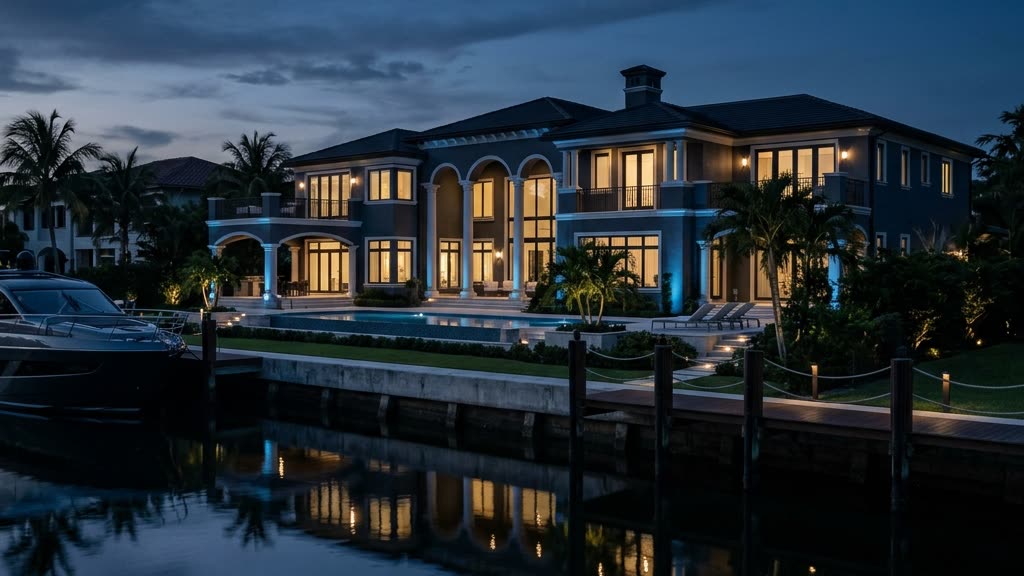
Florida home security is not the same problem it is anywhere else in the country, and most of the families I assess learn that only after something has gone wrong. A protection plan built for a primary residence up north can perform beautifully in Connecticut and still leave a Florida estate exposed, because the risk here does not arrive from a single direction. It comes from the water, from the calendar, from the storm season, and from crews who read all three better than the homeowner does.
Across a career running protective operations, first as chief executive of a security firm in Brazil and later assessing estates and standing up security infrastructure for institutions and private families, I have come to treat Florida as its own discipline. What follows is the complete picture as I see it: the four forces that make a Florida property distinct, and how the pieces of a serious plan fit together. If you want the broader framework, our overview of luxury home security in Florida sits alongside this piece. Consider this the map that shows how everything connects.
What Makes Florida Different
Every market has its own signature. In Florida, four characteristics stack on top of one another, and it is the stacking, not any single factor, that creates the exposure.
The waterfront changes your perimeter
A canal, an intracoastal frontage, or open Gulf or ocean access is the reason many of these homes exist. It is also a second front door that most security plans never account for. A dock is an approach route. A seawall is a boundary that no fence covers. On the barrier islands and canal communities of South Florida, from Naples to the estates around Palm Beach, the water side of the property is frequently the least monitored and the most inviting. I have walked grounds where the street elevation was hardened well, with cameras, gates, lighting, and signage, while the water elevation had a single motion light and an unlocked boathouse. An intruder arriving by small craft after dark bypasses every measure aimed at the driveway.
The calendar creates long, predictable vacancies
Florida is a seasonal state at the top of the market. Families arrive for the winter and leave for months, or they keep the estate as one of several homes and occupy it a few weeks a year. That rhythm is public knowledge. Staff know it, contractors know it, and anyone who watches the neighborhood knows it. An empty house is not the problem. A predictably empty house, on a schedule that strangers can infer, is the problem.
The storm season is a security event
Hurricane season reshapes the threat landscape in ways homeowners rarely plan for. Evacuations empty entire neighborhoods at once. Power and connectivity drop, which is precisely when many camera and alarm systems go blind. Boarded windows and shuttered doors read, to the wrong observer, as an announcement that no one is home. The days before and after a named storm are among the most operationally difficult of the year, and I treat them as a distinct planning problem.
The pool of offenders is mobile
Florida attracts organized, traveling property crews, not just local opportunists. The FBI (opens in a new tab) and local agencies have documented professional groups that move between affluent markets, surveil targets, and time entries to absences. These are not smash-and-grab teams. They are patient, they do reconnaissance, and they favor exactly the conditions Florida supplies in abundance: high-value homes, long vacancies, and water access.
The Empty-House Problem
The single most common failure I find in Florida is a plan designed for an occupied home applied to one that sits empty for months. Occupancy hides a multitude of weaknesses. Lights change, cars move, people come and go, and that ordinary activity does more deterrence work than most owners realize. Remove it, and every gap stands out.
Seasonal absence demands its own protocol. That means controlling who holds keys and codes, and revoking them the moment a relationship ends. It means giving the property signs of life rather than the flat, unchanging facade that signals vacancy. It means a named local responder who can reach the property quickly, not a call center three time zones away reading from a script. And it means treating your household staff, landscapers, pool crews, and trades as part of the security picture, because they are the people with lawful, recurring access during the exact window you are gone.
We keep a detailed snowbird home security checklist for families who close a Florida home for the season, and I would rather a client work through it a week before departure than call me a week after a loss. The difference between a hardened vacant estate and an easy target usually comes down to a dozen unglamorous decisions made before the family leaves.
Storm Season Demands Continuity, Not Just Shutters
Most storm preparation stops at the physical: shutters, generators, sandbags, a plan to get the family out. Those matter. But they are property preservation, not security, and the two are not the same.
Security continuity means your ability to see and respond to your property does not collapse when the grid does. It means battery and cellular fallback for detection systems, so a power cut does not blind you. It means knowing, in advance, who will lay eyes on the estate after the storm passes and before you can return, because the post-storm window, with roads closed, neighborhoods dark, and legitimate contractors swarming the area, is a genuine opportunity for theft. Federal preparedness guidance from Ready.gov (opens in a new tab) and the state resources at Florida’s emergency management division (opens in a new tab) cover the life-safety fundamentals well, and every family should follow them. My job is the layer they do not address: keeping your security posture intact while the environment around it is in chaos.
I have written separately on hurricane season security continuity, because it is involved enough to deserve its own treatment. The short version: decide how your property stays watched and defended through a storm before the storm has a name, not while it is churning in the Gulf.
How the Layers Fit Together
A serious Florida home security plan is not a product you buy. It is a set of layers that assume the earlier layers will sometimes fail.
Deter, then detect, then respond
Deterrence is the outer layer: lighting, sightlines, signage, and the visible impression that the property is watched and difficult. It turns away the majority of would-be intruders who are simply looking for an easier target. Detection is the layer that matters when deterrence does not, and it is where most residential systems are weakest. Consumer cameras and alarms generate noise, miss the approaches that matter, and depend on cloud services and home internet that fail at the worst possible moment.
This is where we deploy GuardDog AI, a third-party enterprise intrusion-detection platform we integrate and tune for the residential estate environment. It was built for demanding commercial and institutional networks, and as its exclusive reseller partner we adapt it to the realities of a large private property: multiple structures, waterfront approaches, and long stretches when no one is home. It is not a camera you check on your phone. It is a detection layer designed to catch the intrusion attempts consumer gear misses, and to keep working when the internet does not.
Response is the layer that closes the loop. Detection without a fast, competent response is just a recording of your loss. That means a defined, tested chain: who gets the alert, who verifies it, who arrives, and how quickly. For a vacant seasonal estate, this is the layer families most often skip and most often regret.
Why the cloud camera is the weak link
I want to be blunt about the equipment most homes rely on. Cloud-dependent consumer cameras are the single most overrated line item in residential security. They depend on home internet and a distant server, both of which fail exactly when you need them, and they are trivially defeated by anyone who cuts power or connectivity. I have detailed the reasons in a separate note on why cloud cameras are the weak link. For a Florida estate that sits empty and loses power in storm season, building your security on that foundation is a mistake.
Start With an Honest Assessment
Every property is its own puzzle. The waterfront exposure of a Naples canal home is a different problem from a beachfront estate or a gated inland compound. The right plan begins with someone walking the grounds, at the street and at the water, in daylight and after dark, mapping how the four Florida forces apply to that specific address.
That assessment is the work my team does, and it is what our veteran-owned firm was built to deliver. We do not sell a box. We build the picture, close the gaps in order of real risk, and make sure the plan holds when the family is a thousand miles away.
Frequently Asked Questions
Is Florida really different from other states for home security?
Yes, in specific and compounding ways. Waterfront access opens a second perimeter that street-focused systems ignore, long seasonal vacancies remove the deterrent effect of occupancy, storm season regularly knocks out power and connectivity, and the state draws mobile, organized theft crews. Any one of these is manageable. Together they demand a plan built for Florida, not adapted from a northern primary residence.
How do I protect an estate that sits empty for months?
Treat the vacancy as its own security problem. Control keys and codes tightly, give the property signs of life, and arrange a named local responder who can reach it fast. Detection has to keep working without home internet or grid power, and everyone with lawful access during your absence should be accounted for. A structured seasonal checklist, run before you leave, prevents most losses.
What happens to my security system during a hurricane?
That depends entirely on how it was designed. Systems that rely on grid power and home internet often go dark at the moment of highest risk. A continuity-minded plan uses battery and cellular fallback so detection survives an outage, and it names in advance who will check the property in the post-storm window, when neighborhoods are empty and contractors are everywhere.
Are cloud cameras enough to protect a high-value home?
No. Consumer cloud cameras are useful for casual monitoring, but they depend on connectivity and power that fail under exactly the conditions a Florida estate faces, and they are easily defeated. They belong at the edges of a plan, never at its center. Serious detection uses hardware and design that keep working when the network does not.
Every estate deserves a plan drawn from its own grounds and its own calendar, not a template. If you are ready to see how these layers apply to your property, request a private consultation or call our team directly at (239) 710-1772. We will walk the grounds, at the street and at the water, and give you an honest read on where you stand.