
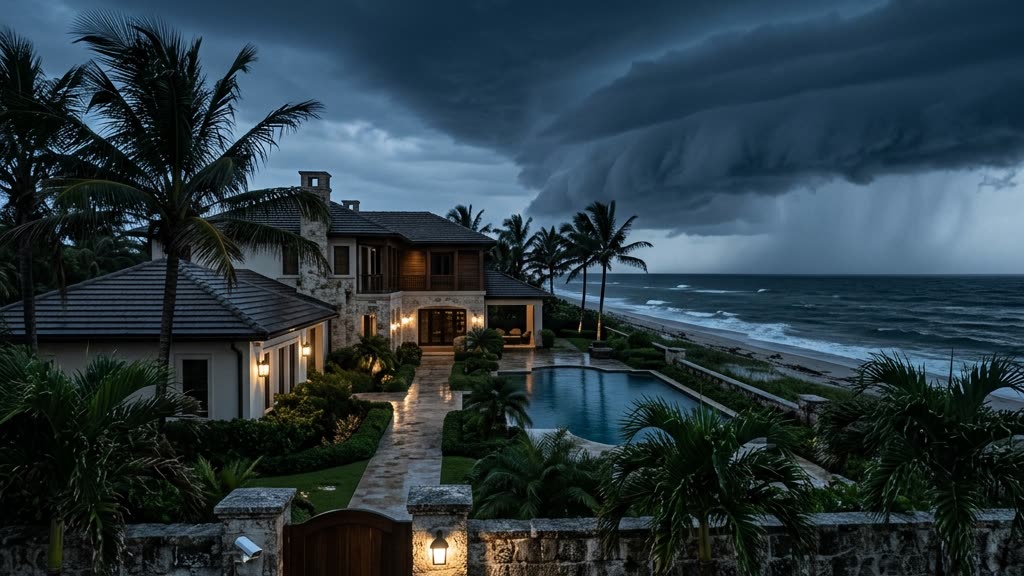
Hurricane season changes the arithmetic of protecting a home. For most of the year, estate security is about controlling access on ordinary days: who arrives at the gate, who holds a code, what the cameras record at two in the morning. A named storm collapses all of that into a handful of days when the power fails, communications fray, and the people who would normally respond are occupied protecting their own families. Hurricane home security is the discipline of keeping a property defended precisely when its everyday defenses are being stripped away, one layer at a time.
I have spent my career assessing residences and running protective operations for families who cannot afford to be casual about any of this. What I have learned is that a storm is not a single event. It is three distinct security problems stacked on top of each other: the days before, the hours during, and the window after, which is often the most exposed of all. Each phase asks something different of your systems, your plan, and the people you rely on. Treating them as one undifferentiated emergency is how well-protected homes end up vulnerable at the worst possible moment.
A storm is a security event, not only a weather event
When homeowners think about a hurricane, they picture wind and water. Those are the headline threats, and they are real. But from a protective standpoint, the more instructive question is what a storm does to your ability to see, decide, and respond. It severs power. It knocks down cellular and internet service. It scatters the neighbors and off-duty personnel who form the informal fabric of any secure neighborhood. It fills the roads with legitimate service traffic that makes an unfamiliar vehicle unremarkable.
Every one of those effects is an opening. Law enforcement across storm-prone regions has documented that property crime does not simply pause when a hurricane hits. In the disorder that follows, opportunists move through darkened neighborhoods knowing that alarms may be silent, cameras dark, and response times measured in hours rather than minutes. A hurricane, in other words, is a large-scale, region-wide degradation of exactly the infrastructure your security depends on. Planning for it as a security event, and not only a weather event, is what separates an estate that comes through intact from one that is quietly picked over while everyone’s attention is elsewhere.
Before the storm: harden while the systems still work
The most valuable work happens before the first outer band arrives, while power, connectivity, and daylight are all still on your side. This is the phase most people rush, and it is the one that pays the largest dividends.
Power is the foundation of everything else
Cameras, alarms, gate controllers, network equipment, and door hardware all run on electricity. When the grid goes down, so does the majority of a modern security stack unless you have planned otherwise. A whole-property generator is the traditional answer, and it has its place, but generators fail in exactly the conditions that matter most: they run out of fuel, they trip, or they simply do not start after months of sitting idle. I treat a generator as one layer, never the only one.
The more resilient approach pairs generation with battery storage sized to carry the critical security load through an extended outage, so the transition from grid to backup is silent and automatic rather than a gap during which everything goes dark. I have written more about designing that kind of continuity in a dedicated field note on outage-proof security backed by battery storage, and it is worth reading before the season starts rather than during it. The principle is simple: identify the handful of devices that must never lose power, and build a tiered backup that keeps them alive when the neighborhood goes dark.
Communications need a second path
Your cameras and sensors are only useful if their signal can reach you. Most residential systems depend on a single internet connection, and that connection is one of the first casualties of a serious storm. Before the season, establish a redundant path: a cellular failover for your network, a backup for critical alarm signaling, and a clear understanding of which of your systems will keep talking to the outside world when the primary line is cut. Test it. A failover you have never exercised is a theory, not a safeguard.
Physical hardening and a documented baseline
The pre-storm days are also when you secure the tangible. Store or anchor anything on the grounds that a high wind could turn into a projectile or that a person could later use for concealment or access. Just as importantly, document the estate’s baseline before the storm: current photographs of the property, the vehicles, the valuables, and the condition of every structure. If you later need to substantiate a loss, that record is far more persuasive than memory. The federal consumer protection guidance at Ready.gov (opens in a new tab) offers a sound general framework for household preparation, and it pairs well with the more security-specific measures I am describing here.
If the family is leaving
Many principals evacuate, which introduces a distinct problem: an unoccupied estate during and after a major storm is a soft target. A vacant high-value home signals opportunity, and a storm removes most of the deterrents that normally protect it. The considerations for a residence left empty through a crisis overlap heavily with those for any extended absence, which I cover in detail in a note on securing an empty home during long absences. The essentials: maintain the appearance and reality of an active, monitored property, arrange for trusted eyes on the ground, and make certain your remote verification works before you need it, not after.
During the storm: hold the line and watch remotely
Once the storm arrives, the objective shifts from prevention to endurance and observation. You are no longer trying to stop things from happening; you are trying to keep your systems alive and your situational awareness intact through the worst of it.
This is where the pre-storm investments prove themselves. If your critical devices are on battery-backed power and your network has a cellular failover, you retain the ability to see your property when it matters most. Remote verification during a storm is not about dispatching anyone into dangerous conditions. It is about knowing, with your own eyes, whether a perimeter has been breached, whether water is entering a structure, or whether the property is simply weathering the event as designed. That knowledge changes the decisions you make in the hours afterward.
I counsel families to resist the urge to act on every camera alert during the height of a storm. Wind moves foliage, debris, and shadows; motion analytics generate noise in exactly these conditions. The discipline is to distinguish genuine anomalies from storm artifacts, which is one reason properly tuned detection matters so much. A system that cries wolf through a hurricane trains its owner to ignore it, and an ignored alert is worse than none at all.
After the storm: the most dangerous window
If I could impress one idea on every homeowner, it would be this: the hours and days after a hurricane passes are frequently more dangerous, from a security standpoint, than the storm itself. The wind is gone, but power is still out, alarms may still be down, streetlights are dark, and the roads are full of unfamiliar vehicles that now look entirely ordinary: contractors, adjusters, tree crews, utility trucks, and, mixed among them, people who are none of those things.
This is the post-storm window, and it is when opportunistic theft and fraud spike. It is also when a specific category of predator appears: the fraudulent contractor. In the chaos after a major storm, individuals go door to door offering immediate repairs, demanding cash up front, and disappearing without performing the work. The FBI and other agencies have repeatedly warned about disaster-related fraud that follows precisely this pattern. The federal guidance at FBI.gov (opens in a new tab) on avoiding charity and repair scams is worth reviewing, because the person offering to fix your roof at a moment of vulnerability may be assessing far more than the shingles.
Two safeguards matter most in this window. The first is verified, restored surveillance: bringing your monitoring back online quickly so the property is watched again while the neighborhood is still dark and disordered. The second is disciplined access control. No one enters the grounds who has not been verified. Legitimate contractors will show credentials, provide written estimates, and never pressure you into an immediate cash decision. Anyone who does the opposite is telling you something.
Where continuous detection earns its place
Restoring visibility fast is where enterprise-grade detection proves its worth. As the exclusive reseller partner for GuardDog AI, our veteran-owned team deploys, integrates, and tunes that intrusion-detection platform on the estates we protect, and the post-storm window is exactly the scenario it is built for: identifying anomalous activity on a network and property when the ordinary defenses are still coming back online and human attention is stretched thin. The value is not the gadget. It is having a system that keeps watching, intelligently, during the precise hours when a determined intruder is counting on no one paying attention.
Building a plan that holds under pressure
None of these measures works in isolation. The homes that come through a hurricane season intact are the ones with a layered, tested plan that accounts for all three phases and does not assume the grid, the network, or the neighbors will be there to help. That is the philosophy behind our broader approach to luxury home security in Florida, and it is worth building deliberately rather than assembling piecemeal after the first warning.
For families weighing the full picture of coastal risk, I would also point to our Florida estate security guide, which sets hurricane readiness in the context of the year-round threats specific to the region. For those with residences in the most storm-exposed corridors, including the properties we assess across Miami, the calculus is the same but the margins are thinner: the density of high-value homes and the frequency of severe weather leave less room for improvisation. Florida’s own emergency management resources at FloridaDisaster.org (opens in a new tab) are a useful complement to a professional assessment, particularly for evacuation planning and regional alerts.
The through-line across every phase is preparation done in calm conditions. You cannot harden an estate in the hours before landfall, and you cannot restore visibility in the chaos afterward if the systems were never built to survive the outage in the first place. Hurricane home security is not something you buy in June and forget. It is a posture you maintain, test, and refine, so that when a storm does come, the plan simply executes.
Frequently Asked Questions
What is the single most important upgrade for hurricane home security?
Resilient power for the critical security load. Cameras, alarms, and network equipment are only as reliable as their electricity supply, and the grid is among the first things a storm takes. Pairing generation with properly sized battery storage keeps the systems that matter alive through an extended outage, which in turn preserves everything else: monitoring, remote verification, and access control.
Should I leave my security system armed if I evacuate?
Yes, and you should also confirm before you leave that it will keep functioning without you. Verify battery backup, confirm your network has a cellular failover, and test remote access so you can actually see the property from wherever you evacuate to. An armed system that goes dark the moment the power fails offers false comfort. The goal is a property that stays monitored and defended in your absence, not one that merely looks that way.
Why is the period after a hurricane considered high risk?
Because the ordinary deterrents are still down while the disorder is at its peak. Power outages, disabled alarms, dark streets, and a flood of unfamiliar service vehicles create ideal conditions for both opportunistic theft and repair fraud. Restoring surveillance quickly and refusing to admit anyone to the property who has not been verified are the two most effective countermeasures during that window.
How do I avoid contractor fraud after a storm?
Never pay in full up front, never make a decision under pressure, and always verify credentials and written estimates before anyone sets foot on the grounds. Legitimate professionals will not object to any of that. High-pressure demands for immediate cash are the clearest warning sign, and the disaster-fraud guidance published by federal law enforcement echoes exactly this pattern.
If you own a coastal or high-value residence and want an honest assessment of how it would hold up through a full storm cycle, I would welcome the conversation. Every property has different vulnerabilities, and the right plan is the one built specifically for yours. You can request a private consultation or reach our team directly at (239) 710-1772, and we will walk the estate with you well before the next system forms.