
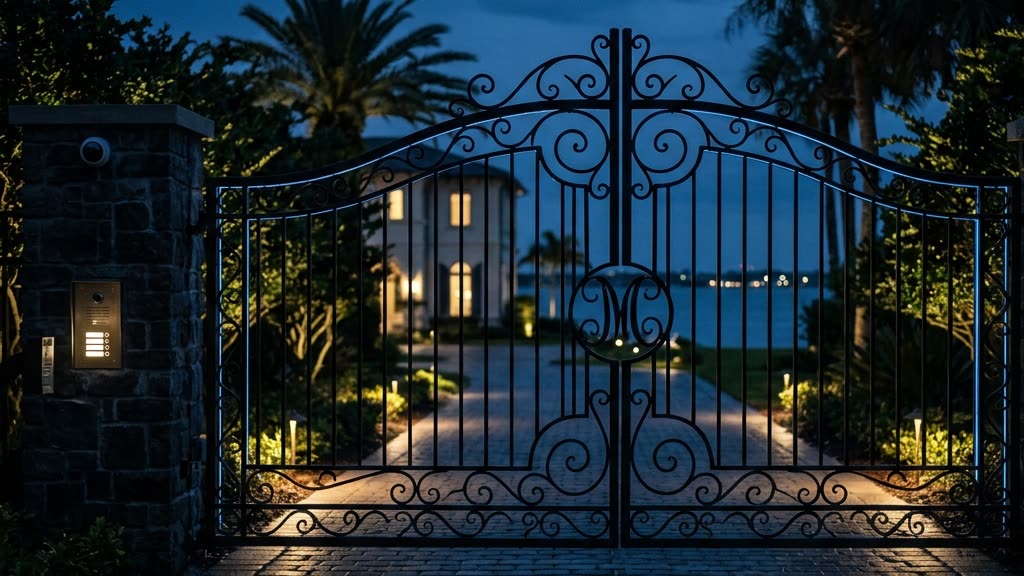
A driveway gate is the most visible security decision a family makes, and one of the least understood. It sits at the entrance announcing that the home behind it is worth protecting, and yet in my assessments I find that most gates are decorative first and functional a distant second. Residential gate security has very little to do with the height of the ironwork or the sophistication of the automation. It has everything to do with whether the gate controls who reaches your front door, and whether it does that without becoming a daily nuisance to the people who live there. After years of assessing estates and running protective operations for high-net-worth families, I can tell you plainly that a gate either buys you time and information, or it hands you a comfortable illusion of both.
The good news is that the fixes are rarely exotic. Most of what separates a gate that works from one that merely looks the part comes down to a handful of decisions about type, verification, tailgating, and the quiet vulnerabilities buried inside the opener itself. What follows is a practitioner’s walk through those decisions.
A Gate Is a System, Not a Barrier
When a family tells me they want a stronger gate, they are usually picturing a taller, heavier one. That instinct is understandable and mostly wrong. A determined intruder is not stopped by a gate. A high wall with no gate at all can be scaled in well under a minute by someone who has practiced. What a good gate actually does is slow, filter, and record. It forces an approach to happen on your terms, in a location you have chosen, under lighting and cameras you control, with a delay long enough that a bad actor has to decide whether the effort is worth it.
That reframing matters because it changes what you invest in. The gate leaf is the least important part of the system. The access control, the verification method, the sensors watching the approach, and the way the gate ties into the rest of the perimeter are what determine whether it protects anyone. I encourage every client to think of the entrance the way the Cybersecurity and Infrastructure Security Agency frames physical access control: a layered set of measures that manage entry, not a single locked door. The federal guidance published by CISA (opens in a new tab) gives a good sense of how seriously that layering is taken in high-value environments.
Choosing the Right Gate Type
Swing Gates
Swing gates are the classic estate choice, and for good reason. They are quieter, they carry ornamental designs beautifully, and a well-built swing gate on heavy hinges reads as permanent and serious. Their weakness is the swing arc itself. They need clear space to open, they move slowly on wind-loaded panels, and a long single leaf puts enormous strain on the operator and hinges over time. On a sloped or short driveway, a swing gate can also force a visitor to wait in the road while it clears, which becomes its own safety problem.
Slide Gates
Slide gates, particularly cantilever designs that never touch the ground, solve most of the swing gate’s problems. They open fast, they tolerate wind, and they work where there is no room to swing. On the barrier-island estates I assess around Marco Island, where salt air and storm wind punish hardware relentlessly, a cantilever slide gate on stainless rollers often outlasts and outperforms a swing setup. The trade-off is the side-run space the gate needs to retract into, and a slightly more industrial look that thoughtful planting can soften.
Bollards and Secondary Control
For families with a genuinely elevated risk profile, the gate is only the visible layer. Retractable bollards, a secondary inner gate, or a simple offset in the drive that prevents a straight high-speed run at the house are all worth discussing. These are not paranoid measures. Vehicle-borne approaches, whether reckless or deliberate, are a documented concern, and a gate alone does nothing to stop a vehicle that simply drives through it.
Intercoms and the Art of Visitor Verification
Video Intercoms, Done Properly
An intercom is where most residential gate security quietly fails. A voice-only callbox tells you someone is there. It does not tell you who, or who else is standing just out of earshot. A proper video intercom shows the whole approach in usable resolution, day and night, and reaches the family wherever they are rather than ringing a panel in the kitchen that nobody hears. The camera should capture the driver and the vehicle, and ideally a second view of the area behind the lead visitor, because the person at the callbox is rarely the whole story.
A Verification Protocol Anyone in the House Will Follow
Technology fails at the human layer. The most common breach I see is not a defeated lock. It is a household member buzzing open the gate because a van looked like a delivery, or because someone in a uniform waved a clipboard. Impersonation of delivery and service personnel is one of the oldest and most reliable tactics in property crime, and the public reporting on burglary and property offenses maintained by the FBI (opens in a new tab) underscores how often intruders rely on a plausible pretext rather than force.
A verification protocol does not need to be elaborate. Confirm the appointment, confirm the name, and if anything feels off, keep the gate closed and make the caller wait while you check. A thirty-second delay costs a legitimate visitor nothing and costs a fraudulent one their entire plan.
Tailgating: The Gap Most Gates Never Close
Tailgating is the vulnerability almost every homeowner overlooks. Your gate opens for you, and in the seconds it takes to close, a following vehicle or a person on foot slips through behind you. Automated gates are slow by design, and that closing interval is a standing invitation. During assessments I have watched how easy it is to walk in behind a resident who is focused on the road ahead and never checks the mirror.
Closing this gap is a matter of design and habit. Faster, well-maintained operators shorten the window. A safety-loop and photo-eye configuration tuned for security, not only for convenience, helps. Cameras positioned to watch the gate as it closes, ideally with analytics that flag a person or a second vehicle entering during the cycle, turn a blind interval into a monitored one. And the simplest measure of all is behavioral: wait, watch the gate close fully in your mirror, and never assume the interval is empty.
Hardening the Cheap Opener
Here is the uncomfortable truth about a great many expensive gates: the beautiful, costly ironwork is controlled by an inexpensive radio. Fixed-code and older rolling-code remotes can be captured or replayed, and a gate that opens to a cloned fob is no gate at all. This is the same weak link I write about with consumer cloud cameras, where impressive-looking hardware hides a soft digital underbelly.
Hardening the opener is unglamorous and high value. Move to a modern encrypted rolling-code or credential-based system. Retire old remotes that leave the property, especially with departing staff or contractors, and keep an actual list of who holds credentials. Put the operator’s control board and the manual release inside a locked, tamper-sensed enclosure, because a manual release reachable from outside the gate defeats everything upstream of it. Segregate any network-connected gate controller from the family’s main network. In the estates where we deploy GuardDog AI, the enterprise intrusion-detection platform we integrate and tune as its exclusive reseller partner, that gate controller becomes one more device the system watches for anomalous behavior, so a compromised opener cannot sit silently on the network.
The Gate Belongs to the Whole Perimeter
A gate examined in isolation will always disappoint. It earns its cost only as part of a coordinated perimeter. The approach should be lit so that faces and plates are legible without glare, which is a discipline in itself and one I cover in depth in our work on security lighting design. The planting around the entrance should channel movement and eliminate hiding spots rather than provide them, the core idea behind landscaping and CPTED. And the gate should be the outermost of several layers, each buying time and information, an approach I lay out fully in our guide to estate perimeter security layers.
Seen that way, the gate is the first sentence of a longer statement about how the property is protected. Families who want the whole picture can start with our overview of luxury home security in Florida, which places the entrance in the context of everything standing behind it.
Frequently Asked Questions
How tall should a residential security gate be?
Tall enough to discourage a casual climb and to match the surrounding wall or fence, but height is not where security lives. A gate that is six inches taller yet opens to a cloned remote or a plausible clipboard is not more secure. Spend on verification, access control, and integration before you spend on height.
Are wireless gate remotes safe from hacking?
Older fixed-code and early rolling-code remotes can be captured and replayed with inexpensive equipment. Modern encrypted rolling-code and credential-based systems are far more resistant. If you do not know which type your opener uses, treat that as the first question to answer, and retire any remote that has left your control.
Should the gate stay open during the day for deliveries?
I advise against it. A gate propped open for convenience is simply no gate for those hours, and deliveries are the exact pretext intruders use most often. A good video intercom lets you admit legitimate visitors in seconds without ever leaving the entrance standing open.
Does a gate actually deter a determined intruder?
A gate rarely stops a determined, well-prepared intruder on its own. What it does is filter the far larger population of opportunists, buy time, and generate the information your cameras and sensors need. That covers a meaningful share of the real threat, and it is exactly why the gate belongs to a layered system rather than standing alone.
The families I work with rarely need a taller gate. They need one that thinks, verifies, and connects to everything behind it. If you would like a candid assessment of how your entrance actually performs, our veteran-owned team is glad to walk the property with you. You can request a private consultation or call us directly at (239) 710-1772.