
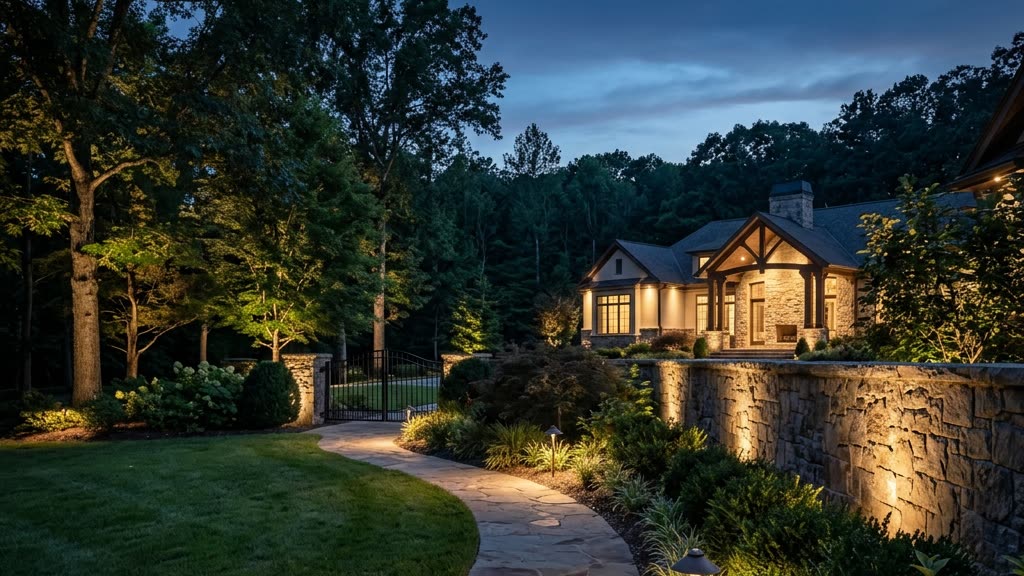
Most of the estates I assess are not underlit. They are overlit, and lit in the wrong places. When a family first calls me about security lighting home upgrades, they almost always picture the same thing: more fixtures, brighter bulbs, a wash of white across the grounds. The instinct is understandable. It is also wrong. After two decades of protective work, from residences in Brazil to institutional campuses, the lesson I keep returning to is that lighting is a design discipline, not a wattage contest. A floodlight that blinds your own camera and throws a hard-edged shadow for someone to stand inside is worse than a modest fixture placed with intent.
Good security lighting does not announce itself. It shapes how a property is read at night, by a camera, by a patrol, by a person on the street deciding whether your home is worth the risk. Done well, it looks like nothing more than a beautifully lit garden. That restraint is precisely what makes it effective.
Brightness Is Not the Objective
The reflex to flood a property with light comes from a reasonable place. Darkness feels like exposure. But the human eye and a camera sensor both work on contrast, not raw intensity. Point a 5,000-lumen floodlight at your driveway and you have not eliminated the dark. You have created a searing bright zone surrounded by a wall of black that the eye and the lens can no longer penetrate. Anyone standing three feet outside that cone is now more concealed than they would have been under a quarter moon.
I ask clients to stop thinking about coverage and start thinking about legibility. The question is never “how bright is the yard.” The question is “can I clearly read a face, a gait, a vehicle plate, a hand carrying something it should not be carrying, at the distances that matter.” A property that answers yes to that is often using far less total light than the one next door that looks like a stadium.
Layered Lighting: The Three Tiers
The estates that perform best at night use light in layers, the same way a lighting designer approaches an interior. Each layer does a distinct job, and no single layer tries to do everything.
Ambient Baseline
This is the low, even wash that keeps the grounds from falling into pockets of total black. It is soft, warm, and continuous. Path lights, downlit soffits, and gently grazed walls sit here. The goal is to eliminate the deep shadows an intruder relies on, not to light the property like noon. When the baseline is right, someone crossing the lawn is always partially visible from somewhere, and there is no comfortable dark corner to wait in.
Task and Transition
The second tier lights the places where people actually move and decide: entries, gates, the transition from driveway to walk, stairs, dock approaches. These are the pinch points where you want genuine clarity. This layer works hand in glove with how you shape the landscape itself, which is why I treat lighting and planting as one plan rather than two. I have written before about landscaping as a security tool through CPTED principles, and lighting is the layer that makes those sightlines usable after dark. A well-lit approach with a clean, unobstructed line of sight tells an outsider they will be seen the moment they commit.
Contrast and Accent
The third tier is the one most homeowners skip, and it is the one that does quiet heavy lifting. Grazing a stone wall, uplighting a specimen tree, or backlighting a hedge creates depth and gives the eye reference planes. A figure moving in front of a softly lit wall reads instantly. The same figure against a flat black void does not. Accent light is where security and beauty stop being a tradeoff and start being the same decision.
The Glare Trap
If there is one mistake I correct on nearly every property, it is glare. A fixture aimed outward, or a bare bright source in the visual field, does not protect a boundary. It disables the very people and cameras meant to watch it. Glare draws the iris down, floods the sensor, and manufactures shadow. It is the lighting equivalent of shouting so loudly you cannot hear anyone approach.
The fix is disciplined and almost always improves the aesthetic at the same time. Shield the source so you see the effect of the light, not the bulb. Aim downward and inward. Use fixtures with proper cutoff so the beam lands where you intend and nowhere else. A shielded, well-aimed fixture at a fraction of the output will outperform a raw floodlight every time, because it preserves the contrast your eyes and cameras need to actually resolve detail.
Motion-triggered floods deserve a specific warning. A light that snaps from off to blinding is a gift to an intruder and a nuisance to you. It signals exactly where the sensor’s edge is, it trains the household to ignore the constant false triggers from cats and palm fronds, and in the second your eyes need to adjust, someone has already moved through. I favor a lit baseline with motion used to lift levels smoothly, not to shock the whole yard awake.
Dark-Sky Compliance and the Look of Restraint
Across much of Florida, and increasingly as a matter of good neighborly practice, dark-sky principles are becoming the standard for high-end properties. Fully shielded fixtures, warm color temperature, and light kept on the property rather than spilling into the sky or a neighbor’s bedroom. Some coastal municipalities also enforce lighting rules tied to sea-turtle nesting seasons, and I always confirm local ordinances before finalizing a plan.
Here is the part clients are surprised by: dark-sky compliance and serious security point in the same direction. Both demand shielded, downward, purposeful light. Both reject the wasteful upward and outward spill that creates glare and washes out the night sky. A property lit to dark-sky standards reads as considered, expensive, and calm, which is exactly the signal a well-defended estate should send. The organizations that publish physical-security guidance, including CISA (opens in a new tab), consistently emphasize lighting that supports observation rather than lighting for its own sake. Restraint is not a compromise here. It is the higher standard.
Lighting That Serves Your Cameras
Cameras are the most common reason lighting fails, because the two systems are usually specified by different people who never speak. A camera has a limited dynamic range. Put a bright source in its frame and everything else crushes to black. Backlight a subject and you get a silhouette with no usable detail. I have reviewed countless clips where the homeowner had excellent hardware and still could not identify anyone, purely because the lighting fought the lens.
Design the two together. Keep bright sources out of camera frames. Light faces and approaches from the front or side, never from directly behind the subject. Match color temperature so skin tones and vehicle colors render true. And be honest about the limits of consumer gear, which is one reason I have written about why cloud cameras like Ring and Nest are the weak link on serious properties. Lighting is also where a professionally integrated detection layer earns its keep. On estates where we deploy and tune GuardDog AI, the third-party intrusion-detection platform we integrate as its exclusive reseller partner, well-designed lighting is what turns an alert into a clear, actionable image instead of a vague blur at the edge of the lawn.
Controls, Zones, and an Occupied Look
Static lighting is a missed opportunity. The most capable systems are zoned and scheduled so the property presents differently through the night and, critically, looks lived-in when the family is away. Astronomical timers, gentle scene transitions, and the ability to lift a specific zone in response to a sensor give you a property that behaves intelligently rather than blazing at full output from dusk to dawn.
Zoning also lets you tie lighting to the parts of the estate that carry unique risk. A waterfront home is a different problem after dark than an inland one, and the approach from the water needs its own deliberate treatment, which I cover in depth in my notes on waterfront and dock security. The dock, the seawall, and the water approach should be lit so that anything arriving by boat is legible well before it reaches the house.
Power and Resilience: The Florida Factor
None of this matters if it goes dark in a storm. In Southwest Florida, lighting has to be planned around outages and salt air. That means marine-grade fixtures, corrosion-resistant hardware, and critical zones on backup power or independent low-voltage circuits so the perimeter stays legible when the grid does not. I encourage every client to think through outage readiness the way emergency-management resources at Ready.gov (opens in a new tab) recommend, and to treat resilient lighting as part of that plan rather than an afterthought.
Lighting is only one tier of a complete perimeter, and it is at its best when it is designed alongside the others. It sits inside the broader framework I lay out in estate perimeter security layers, and within the full approach to luxury home security in Florida that our veteran-owned team brings to each property. For families in the region, we handle these assessments personally across Fort Myers and the surrounding communities.
Frequently Asked Questions
Does brighter lighting really deter intruders?
Not on its own. Law enforcement and physical-security bodies have long documented that lighting deters when it supports clear observation and the sense of being watched. Raw brightness that creates glare and hard shadow can actually help an intruder. The deterrent value comes from legibility and design, not lumens.
Will dark-sky compliant lighting leave my property too dark?
No. Dark-sky simply means shielded, warm, downward light kept on your property. It eliminates waste and glare, which improves what you can actually see. Well-designed compliant lighting is typically more effective for security than the floodlit alternative, not less.
How do lighting and cameras work together?
They have to be designed as one system. Bright sources stay out of camera frames, subjects are lit from the front or side rather than backlit, and color temperature is matched so faces and vehicles render accurately. Poor lighting is the most common reason good cameras still fail to identify anyone.
What about outages and salt air near the coast?
Both are planned for from the start. Critical perimeter zones should sit on backup power or independent low-voltage circuits, and every fixture near the water should be marine-grade and corrosion-resistant. Resilience is part of the security value, not a separate concern.
Lighting is one of the few upgrades that improves how an estate looks and how safe it truly is at the same time, provided it is designed rather than simply installed. If you would like a considered assessment of how your grounds read after dark, request a private consultation or call our team directly at (239) 710-1772.