
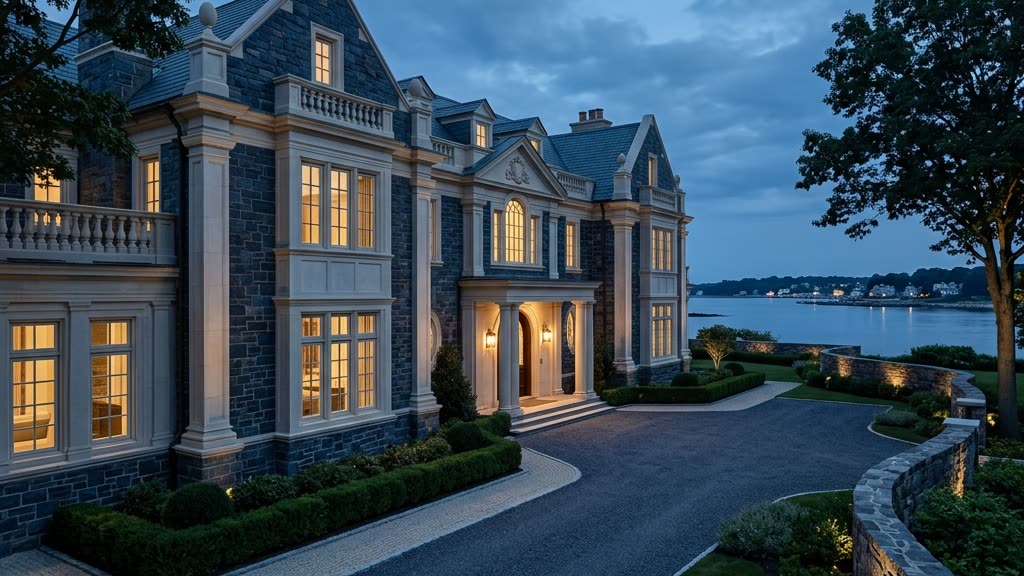
A landscape does two jobs at once. It welcomes the people you want on your property, and it quietly discourages the people you do not. In my years assessing estates for high-net-worth families, I have found that most homes get the first job right and the second one by accident. CPTED landscaping, the deliberate application of Crime Prevention Through Environmental Design to your grounds, is how you make that second job intentional. Done well, it does not turn a beautiful home into a compound. It uses the plants, the grade, and the stone you were going to install anyway, and arranges them so the property defends itself before anyone touches a camera or a lock.
I want to be clear about the frame here, because it matters. Landscaping is not a security system. It is the outermost, most passive layer of one, and it is the layer a determined person meets first. A garden designed with intent buys you two things that money cannot otherwise buy: time and visibility. Both of those decide how an incident ends.
What CPTED Landscaping Actually Means
CPTED is a discipline that has been used by planners, architects, and law enforcement for decades. The U.S. Cybersecurity and Infrastructure Security Agency and other public bodies treat it as a foundational approach to protecting physical spaces. You can read more about the broader framework through CISA (opens in a new tab). On an estate, four ideas carry most of the weight.
The first is natural surveillance. You want sightlines that let residents, staff, and cameras see approaches and entries without obstruction. The second is natural access control. You use planting, grade changes, and hardscape to guide legitimate visitors along an obvious path and to make every other route awkward, noisy, or thorny. The third is territorial reinforcement. Clear transitions between public, semi-private, and private ground tell an outsider, without a single sign, that this space is owned and watched. The fourth, and the one people forget, is maintenance. A cared-for landscape signals occupancy and attention. An overgrown one signals the opposite.
None of this requires ugliness. Some of the most secure estates I have worked on read, to a guest, as simply immaculate. That is the point. Beauty and defense are not in tension. They are the same set of decisions made with a second purpose in mind.
Sightlines: The Three-Foot, Eight-Foot Discipline
If you take one rule from this piece, take this one. Keep shrubs and bed planting low, generally below the sill line of your ground-floor windows, and keep tree canopies limbed up high, generally above head height, so that a person cannot stand concealed between the two. Practitioners sometimes call it the three and eight rule: nothing solid between roughly three feet and eight feet along the zones you need to watch.
The reason is simple. A burglar’s best friend is a place to wait unseen. Dense foundation shrubs under a window, an overgrown corner beside a gate, a hedge that has crept up to eye level next to the front door: each of these is a hiding place you planted and paid to maintain. Law enforcement has long documented that most residential intrusions favor concealment and quick, unobserved entry. Take the concealment away and you remove the intruder’s advantage before he uses it.
Apply the discipline where it counts, which is not everywhere. You want it hardest at entries, along the driveway approach, under ground-floor and accessible windows, and near any gate or service door. A screening hedge for privacy at the road is fine. A screening hedge that hides your own front door from your own cameras is a liability wearing the costume of a nice plant.
Living Barriers: Put the Thorns Where They Matter
There is a category of plant that is genuinely unpleasant to push through, and it belongs directly beneath and around your vulnerable openings. Bougainvillea, pyracantha, holly, agave, Spanish bayonet, crown of thorns, and certain climbing roses form a living barrier that is beautiful from the terrace and miserable to climb over. Planted in the bed under a ground-floor window, a mass of bougainvillea does something no camera does: it makes the easy target physically hostile.
I treat defensive planting as a partner to the glass itself, not a replacement for it. A thorny bed slows and discourages; it does not stop a person who has decided to break in. That is why, on the windows and doors that a barrier protects, I want the opening hardened too. Laminated glass and professionally applied security film keep a pane together under impact and turn a five-second smash into a loud, sustained struggle in the open. If you have not looked at that layer, my colleague’s notes on security glazing and window film are worth your time. The thorns and the film work as a pair: one says do not come here, the other says even if you try, you will not be quick or quiet about it.
Gravel and the Sound of Approach
Silence is a tool intruders rely on. Take it away. A band of loose, angular gravel under windows, along side yards, and across the routes a person would use to skirt the house makes silent movement nearly impossible. You cannot cross a proper gravel bed without announcing yourself, and at night that sound carries.
I like gravel because it is honest and cheap and it pulls double duty. It reads as a clean, deliberate design detail during the day, it improves drainage against the foundation, and it converts every off-path approach into an audible one at night. Pair those gravel zones with your detection layer and the effect compounds. A motion light or an acoustic sensor over a gravel bed is watching a place where a person cannot help but make noise and cannot help but be exposed.
Tree Discipline Near Walls and Windows
A mature tree is a ladder. I have stood at the base of more than one perimeter wall that was rendered decorative by a beautiful oak planted three feet away from it, its lower limbs an open invitation to the second story. When you plant near a wall, a fence, or beneath an upper-floor window, you have to think about what that plant will become in ten years, not what it is on planting day.
Keep climbable trees set well back from perimeter walls and from any balcony, trellis, or roofline that offers a way up. Limb up the trees you keep so the lowest branch is out of reach. And on the Gulf Coast this discipline earns its keep twice, because a tree too close to the house is not only a ladder, it is a projectile and a debris path in a storm. The state’s preparedness guidance at Ready.gov (opens in a new tab) reinforces the same instinct from the hurricane side: manage the trees near your structure before the season, not during it. Landscaping choices that reduce a burglar’s access and reduce your storm exposure are the kind of decisions I like, because they pay for themselves along more than one axis. Tree discipline is one strand of a fully layered estate perimeter, where the planting, the wall, the lighting, and the sensors are designed to reinforce one another rather than compete.
Territorial Reinforcement: Make Ownership Obvious
An intruder reads a property the way a guest does, mostly unconsciously, in the first few seconds. Your job is to make the reading unambiguous. Use grade changes, a shift in paving material, a defined hedge line, a formal gate, or a change in lighting to mark where public ground ends and private ground begins. These transitions do not need to be fortifications. They need to be clear.
When the boundary between “anyone may be here” and “you are now on watched, owned ground” is vague, you invite testing. When it is obvious, the casual opportunist self-selects out and keeps walking, and the person who crosses it anyway has told you something useful about their intent. That is territorial reinforcement, and on estates it is often the most elegant layer, because it is expressed in stone, hedge, and light rather than in anything that looks defensive.
Where the Waterfront Changes the Math
Many of the Florida estates I assess do not have four walls of dry approach. They have three, and the fourth is water. On a canal, an intracoastal lot, or an open-water parcel, your CPTED landscaping has to account for the fact that the most exposed approach may arrive by boat, at night, from the one direction your street-facing design ignores. The planting, lighting, and sightline logic that governs your entrance has to be carried around to the dock line, where it is easy to leave a dark, unwatched gap. If your property touches water, read the specific thinking on waterfront and dock security before you finalize the grounds, because the vegetation choices along a seawall are different from those along a driveway.
This is also where local context matters. In a community like Palm Beach, where lots are deep, mature, and heavily planted, the temptation is to let decades of growth stand untouched because it is lovely. Lovely and secure are not automatically the same thing. The audit is worth doing.
Technology Belongs in the Garden Too
The passive landscape earns its value when it feeds an active layer. A sightline is only as good as the camera or the resident that uses it. A gravel bed is only as good as the sensor listening over it. This is where the grounds and the detection system stop being separate projects.
We deploy and tune GuardDog AI, a third-party enterprise intrusion-detection platform for which our team serves as the exclusive reseller partner, precisely so that the exposure your landscaping creates gets converted into an alert. The garden strips away the intruder’s cover; the detection layer we integrate makes sure that being uncovered actually means something. Neither half is complete alone. If you want to see how all of these layers fit together into one coherent posture, our overview of luxury home security in Florida walks through the full stack, from the plants at the property line to the response plan.
Maintenance: The Layer That Fails Quietly
Every principle above degrades on a schedule. Shrubs grow back into hiding places. Canopies drop back to eye level. Gravel gets colonized by groundcover and goes silent. The most common failure I find on established estates is not a bad original design; it is a good design that has not been maintained to its intent for several seasons.
Build the security logic into the landscape maintenance brief so the crew knows the sill line is a rule, not a suggestion, and that the gravel bands stay clear. A maintained property also does the quiet work of signaling occupancy and attention, which is its own deterrent. For the broader habits that keep a home from looking like an easy, unattended target, the FBI’s public safety resources at the FBI (opens in a new tab) are a sound, non-alarmist starting point.
Frequently Asked Questions
Does thorny landscaping really deter intruders?
On its own, no barrier planting is a guarantee, and I would never sell it as one. What it does reliably is raise the cost of the easy approach. A dense, thorny bed under a window turns a quick, quiet target into a slow, painful, exposed one, and most opportunistic intruders choose the path of least resistance. The value comes from pairing the thorns with hardened glass and a detection layer, so that a person who pushes through anyway is already loud, slow, and on camera.
Will low shrubs and high canopies make my estate look exposed?
Handled by an experienced landscape designer, no. The three and eight discipline applies to the zones you need to watch, not to the entire property. You can keep tall screening at the road for privacy, mature specimen trees for character, and formal beds throughout, while keeping the specific sightlines to your doors, windows, and driveway clean. The result usually reads as more manicured, not more exposed.
How does CPTED landscaping work with cameras and sensors?
They are designed as one system. Landscaping removes concealment and forces movement into audible, visible zones; the electronic layer watches those zones. A camera aimed at an overgrown corner is nearly useless, while the same camera over a clear sightline and a gravel band is highly effective. We tune the GuardDog AI platform we resell against the physical layout so that the exposure the garden creates actually generates a meaningful alert.
Is defensive planting practical in Florida’s climate?
Very. Many of the best barrier and low-maintenance choices, including bougainvillea, agave, Spanish bayonet, and native hollies, are well suited to the heat, sun, and coastal soils here. The one added discipline is storm season: keep trees managed and set back from the structure, which serves both security and hurricane resilience at the same time.
Your grounds are already an expression of how you live. With a modest shift in intent, they become the first, quietest, and most gracious layer of how you are protected. If you would like a veteran-owned assessment of how your landscape is helping or hurting your security posture, I would welcome the conversation. You can request a private consultation or reach our team directly at (239) 710-1772.