
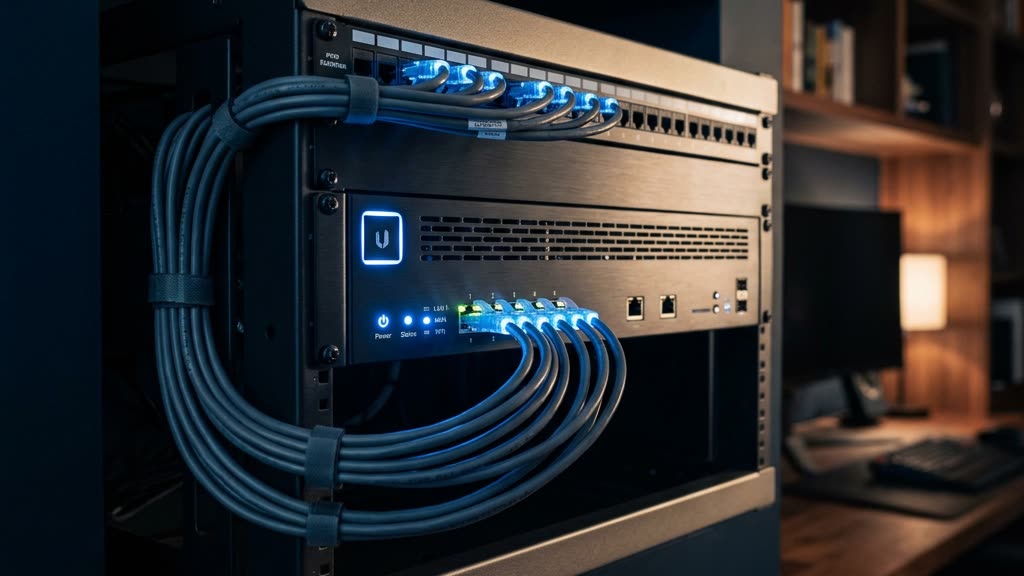
In 2011 I deployed to Afghanistan as an Electronic Warfare Officer attached to a Counter-IED team. My job, reduced to a single sentence, was deciding which signals moved through our slice of the electromagnetic spectrum and which did not. Years later, when a client asks me to recommend the best home firewall, I recognize the same problem wearing civilian clothes. A firewall is not really a product. It is a policy about what enters and leaves your home, enforced at a chokepoint, and maintained by someone who knows what normal looks like. The hardware matters, but far less than the discipline behind it. Most residences, including some remarkably expensive ones, still run on the router the internet provider shipped, configured the way the installer left it years ago. That is not a firewall strategy. It is an unlocked door with an impressive handle. What follows is what actually matters when you evaluate firewalls for a serious home: inspection, rules, outbound control, and an honest answer to the question of when enterprise-grade equipment belongs in a residence.
The Router Your Provider Shipped Is Not a Security Device
The typical carrier gateway performs three jobs. It translates addresses between your home and the internet, it assigns addresses to your devices, and it broadcasts Wi-Fi. Address translation produces a side effect that people mistake for security: unsolicited connections from the outside have nowhere obvious to land. That incidental protection is real, but it is shallow. It says nothing about what leaves your network. It offers no meaningful logging. And it cannot express any policy more sophisticated than “every device inside may talk to anything, anywhere, at any time.”
The structural problems run deeper. Carrier equipment often ships with remote management enabled so the provider can push changes without a service call, which means your security perimeter has a second administrator you have never met. Firmware updates arrive on the carrier’s schedule, not yours. And the administrative interfaces of consumer gateways have a long, well-documented history of default credentials and slow patching. The Cybersecurity and Infrastructure Security Agency (opens in a new tab) publishes practical guidance on securing home networks, and the consistent theme is that consumer defaults are a starting point, never a destination.
For a household with meaningful assets, staff and vendors moving through the property, or a public profile, the provider’s gateway should be demoted to a simple modem. The security decisions belong on equipment you own, control, and monitor.
What Separates a Real Firewall From a Router
When I evaluate a firewall for a residence, I ignore the marketing page. I ask three questions. What can this device actually see? What policies can it express? And will anyone competent look at what it records?
Stateful Inspection Is Table Stakes
Every serious firewall tracks the state of connections, meaning it knows the difference between a reply your laptop requested and a stranger knocking uninvited. This is the baseline, and it is roughly where consumer equipment stops. It is necessary. It is nowhere near sufficient.
Deep Packet Inspection, Described Honestly
Deep packet inspection examines the content and character of traffic rather than just its source and destination. Vendors promote it aggressively, so here is the honest residential version. The majority of modern traffic is encrypted, and inspecting inside that encryption requires intercepting it, which introduces real risks of its own and breaks some applications outright. In home deployments I usually get more value from what inspection can read without breaking anything: which applications are running, which domains are being resolved, and which cloud endpoints a device contacts at three in the morning. That metadata layer is where unusual behavior shows first, and it requires no compromise of your encrypted sessions.
Rules That Reflect How Your Household Actually Lives
A firewall ruleset is a written model of your life, and most rulesets model a life nobody lives. Your televisions have no business reaching your document archive. The pool controller does not need to talk to the family laptops. Staff and guest devices need a path to the internet, not a path into the estate’s internal systems. Expressing any of this requires the network to be divided into zones first, which is why I wrote a full walkthrough of VLAN segmentation for smart homes. Firewall rules are only as strong as the boundaries they stand between.
Egress Control: The Discipline Almost Everyone Skips
In counter-IED work, we paid close attention to what transmitted out of an area, because an outbound signal is evidence of intent. The same logic applies to your home network. Inbound attacks get the headlines, but the traffic that should concern you most flows outward. A compromised device rarely announces itself. It calls out quietly: to command infrastructure, to a staging server, to whoever is waiting on the other end.
Egress control means your firewall applies policy to what leaves, not just what arrives. In practice, that looks like a few disciplined measures. Filter DNS so lookups to known-hostile infrastructure simply fail. Deny outbound connections to regions no device in your home has any business contacting. Alert when a device opens a category of outbound connection it has never made before, because an appliance that suddenly behaves like a file server is telling you something.
Cloud cameras deserve special mention here. They are engineered to push video offsite continuously, which makes their traffic an ideal place for problems to hide and makes the vendor’s cloud part of your attack surface. I have written separately about why cloud cameras are the weak link. More broadly, the FBI’s Internet Crime Complaint Center (opens in a new tab) has documented sustained growth in cyber-enabled crime against individuals, and affluent households draw patient, quiet adversaries precisely because the payoff justifies the patience. Quiet is exactly what egress monitoring exists to catch.
When Enterprise Equipment Belongs at Home
Not every residence needs an enterprise firewall, and I have talked clients out of them. The honest criteria look like this.
Signs You Have Outgrown Consumer Gear
You conduct significant financial or business activity from a home office. The property itself runs on connected infrastructure: gates, elevators, lighting, climate, audiovisual, irrigation. Staff, contractors, and vendors are regularly on the network. Your name, searched publicly, connects readily to your net worth. Or you maintain multiple properties that should enforce one consistent policy. If two or more of those describe your situation, the consumer tier is no longer built for your risk profile.
What Enterprise-Class Actually Buys You
Not prestige, and not raw speed: capabilities. Intrusion detection and prevention signatures updated continuously. Logging with enough retention to reconstruct events weeks later. Support contracts with real engineers behind them. Policy expressed cleanly across zones. Hardware that does not buckle when inspection features are enabled. The National Institute of Standards and Technology (opens in a new tab) maintains the security frameworks that enterprises build against, and the disciplines inside them scale down to a residence far better than most people expect.
One warning from experience. An unmanaged enterprise firewall becomes expensive shelfware within a year. The best home firewall is not the one with the longest feature list. It is the one whose logs a competent person actually reads, whose rules change when the household changes, and whose firmware stays current. Capability without management is decoration.
The Detection Layer Behind the Firewall
A firewall enforces the policy you wrote, which means it is only as imaginative as you were on configuration day. Detection is the complementary layer: watching behavior inside the network for the things no rule anticipated. For estates that warrant it, we deploy GuardDog AI, a third-party enterprise intrusion detection platform that our team integrates and tunes for residential environments as its exclusive reseller partner. It observes the segments the firewall creates and flags what does not belong. You can read more about how we pair perimeter policy with GuardDog.
Where the Firewall Fits in the Larger Design
A firewall is one layer of a design, never the design itself. The wireless side of the house needs the same discipline as the wired side, which is why WPA3 and protected management frames matter. Segmentation gives the firewall boundaries worth enforcing. Monitoring gives its logs meaning. I have laid out the full architecture in my home network security guide for high-net-worth households, and I would start there if you are assessing your whole posture rather than a single device.
Geography changes the calculus too. For clients in Naples and along the Gulf coast, seasonal occupancy is the complicating factor: a connected home sits unattended for months at a time. Egress monitoring and remotely manageable policy are what let you know the house is quiet because nothing is happening, not because nobody is listening.
Frequently Asked Questions
Is the firewall built into my ISP router good enough?
It is better than nothing, and that is the most that can be said for it. Address translation blocks casual inbound noise, but there is no egress policy, minimal logging, and a second administrator in the form of your provider. For a household with real assets, treat it as a modem and put the security decisions on equipment you control.
Do I need deep packet inspection at home?
You need visibility more than you need inspection in the strictest sense. Full decryption of your own traffic is rarely worth the tradeoffs in a residence. Application and domain-level visibility, which does not break encryption, catches most of what matters: unknown devices, odd destinations, and traffic at hours when the house should be asleep.
Will an enterprise firewall slow down my internet?
Properly sized, no. Undersized, yes, and that is the most common specification mistake I see. Inspection features consume processing power, so the appliance must be rated for your actual connection speed with those features enabled, not the bare throughput number printed on the box.
How often should firewall rules be reviewed?
Whenever the household changes, and on a calendar schedule regardless. New staff, new devices, a renovation, a new vendor with remote access: each one is a policy event. Between those, a periodic review catches the drift that accumulates silently in every ruleset.
If you are weighing an upgrade, or you suspect the router in the closet has been making your security decisions for too long, our veteran-owned team is glad to walk the property, map what is actually on your network, and give you a straight answer about what belongs there. Request a private consultation or call (239) 710-1772, and we will keep the conversation as discreet as the work itself.