
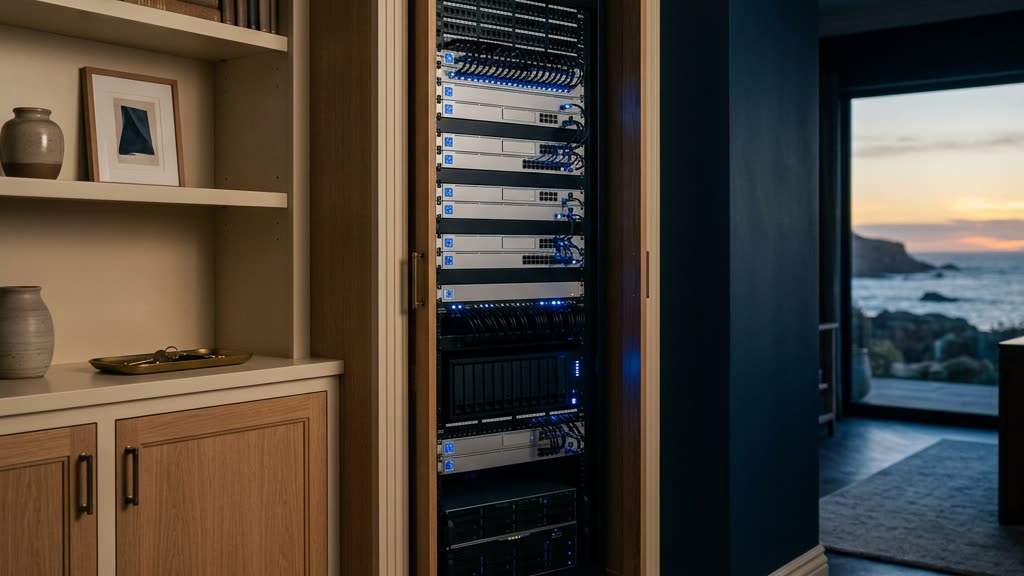
In the Army, I listened to the invisible battlefield for a living. As an Electronic Warfare Officer supporting counter-IED operations in Afghanistan, my work rested on one premise: every signal is a doorway, and whoever understands the doorways controls the ground. I carry that premise into every estate I assess today, because the modern luxury home broadcasts more signals than some forward operating bases I supported. Home network security is no longer an IT afterthought for high-net-worth families. It is the foundation everything else stands on: your cameras, your locks, your alarm signaling, your family office traffic, your privacy. And in a meaningful share of the estates I walk, it is the weakest structural element on the property.
That is rarely the homeowner’s fault. These networks were never designed. They accreted, one integrator and one device at a time, across a decade of renovations, upgrades, and staff changes. This piece is the full picture: how the estate network became an attack surface, and the architecture that turns it back into a defensive asset.
Why the Estate Network Became the Primary Attack Surface
Twenty years ago, targeting a wealthy household meant physical reconnaissance: watching the driveway, learning the schedule, testing the fence line. Today, a serious adversary starts with your network, because your network now touches everything that matters. Gate controllers, door locks, camera systems, alarm panels, lighting scenes that reveal occupancy, thermostats that reveal travel, and the laptops where wires get approved and trusts get administered. All of it rides the same infrastructure that streams cartoons in the guest wing.
Law enforcement has documented organized crews conducting digital and signals reconnaissance on affluent targets before ever touching the property. That tracks with everything I learned overseas: sophisticated adversaries prefer to understand a target completely before they act, and a poorly secured home network hands them that understanding for free. Occupancy patterns, device inventories, camera placement, even the make and model of your alarm system can be inferred from network behavior.
There is a second dynamic that makes this different from ordinary consumer cybersecurity. Most cybercrime is opportunistic, sprayed across millions of households. High-net-worth families face that background noise plus something rarer and more dangerous: targeted interest. When the adversary has chosen you specifically, the question is no longer whether your equipment is average. It is whether your architecture can withstand deliberate, patient attention.
Mapping the Attack Surface
Before any family can defend an estate network, someone has to actually map it. In my experience that map surprises nearly every owner.
Every device is a doorway
Run a census on a large residence and the count climbs fast: televisions, voice assistants, wine cellar sensors, pool and spa controllers, irrigation systems, AV processors, printers, solar inverters, EV chargers, exercise equipment, pet feeders, and the phones and tablets of everyone who lives or works there. Each of those devices runs software. Much of that software will never receive another update from its manufacturer. On a flat, unsegmented network, any one of them can serve as a beachhead: compromise the cheapest gadget in the pool house and you are standing, digitally speaking, next to the computer that manages the family’s finances.
The human layer
Networks are used by people, and people are the most reliably exploited component of any system. Household staff click links. Contractors bring their own laptops. Children install whatever their friends install. A house manager who shares one password across systems creates a single point of failure no firewall can compensate for. None of this calls for suspicion of the people around you. It calls for an architecture that assumes ordinary human behavior and stays defensible anyway.
The vendor problem
This is the one I see most often. AV integrators, smart-home installers, pool companies, and alarm dealers each configure their own slice of the network, and each tends to leave behind remote access for future service calls: port forwards, default credentials, cloud accounts nobody remembers. Individually, each decision was reasonable. Collectively, they mean a dozen outside organizations hold standing access to your home, and no single party owns the network as a system. Ownership is the first thing a proper assessment restores.
The Architecture of a Defensible Home Network
The good news: none of this requires exotic technology. It requires the same discipline enterprises and government facilities apply, scaled and tuned for a residence. Four layers matter most.
Segmentation before anything else
Segmentation means dividing one physical network into isolated zones, so that devices which have no business talking to each other simply cannot. Family computers live in one zone. Guests in another. Staff devices in a third. Cameras and physical security in their own protected enclave. The smart-home gadgetry, the least trustworthy population on the property, gets quarantined where a compromise cannot spread. Federal guidance from CISA (opens in a new tab) has long treated segmentation as one of the most effective controls available, and everything I saw in military networks confirms it: containment is what turns an incident into an inconvenience instead of a catastrophe. I have written a full walkthrough of VLAN segmentation for the smart home for families who want the deeper mechanics.
A firewall that enforces policy, not a box that blinks
The router your internet provider supplied is built for cost, not for defense. A defensible estate runs a proper firewall that enforces written policy: which zones may reach which, what traffic may leave the network, which countries and services your devices are permitted to contact, and what gets logged. Egress filtering deserves special emphasis. Most homeowners think about keeping attackers out, but a compromised device has to phone home, and a firewall that scrutinizes outbound traffic catches what inbound defenses miss. I cover the selection criteria in detail in what actually matters in a home firewall, because the honest answer is that the brand matters far less than the configuration.
Monitoring, the layer almost everyone skips
Here is an uncomfortable truth from both battlefields and boardrooms: prevention eventually fails, and it fails silently. The families who come through incidents well are the ones who detect intrusion early, while the adversary is still exploring rather than acting. That requires continuous monitoring of the network itself: watching for new devices, anomalous traffic, and behavior that does not match the household’s normal pattern.
This is where enterprise capability has finally become practical at the residential level. GuardDog AI is a third-party enterprise intrusion-detection platform originally built for commercial and critical environments. Our team serves as its exclusive reseller partner, and we deploy, integrate, and tune it for private estates: mapping every device on the property, establishing a behavioral baseline, and flagging anomalies in real time. I have written at length about how we deploy GuardDog on residential networks, but the principle stands regardless of platform: a network nobody watches is a network someone else can study at leisure.
Remote access without exposure
Every port forward an installer opened for convenience is a standing invitation. Modern architecture eliminates them entirely. Remote access to cameras, controls, and files should flow through authenticated, encrypted tunnels with multi-factor authentication, so the estate presents no open doors to the internet at all. Done properly, the family notices no loss of convenience. The internet simply stops being able to see in.
Cameras, the Cloud, and the Convenience Trap
Consumer cloud cameras deserve their own mention because they sit at the intersection of network security and physical security. Systems that route your footage through a third party’s servers make your home’s imagery dependent on someone else’s infrastructure, someone else’s employees, and someone else’s breach history. They also announce themselves on the network in ways a knowledgeable adversary can exploit. I laid out the full argument in why cloud cameras are the weak link; the short version is that serious surveillance belongs on local, professionally managed recording inside its own protected network zone, with remote viewing provided through the secure access layer described above rather than a consumer cloud account.
Where the Digital Perimeter Meets the Physical One
My counter-IED work taught me that adversaries attack the seam between systems, and the seam between your digital and physical security is exactly where sophisticated residential crime now operates. Law enforcement agencies, including the FBI (opens in a new tab), have documented burglary crews using inexpensive radio-frequency tools to disrupt wireless cameras and sensors during entries. As someone who spent years in electronic warfare, I can tell you the technical bar for that kind of interference is low, which is precisely why estates should wire their critical sensors and cameras wherever possible and monitor the wireless environment for the anomalies that jamming and deauthentication attacks create.
The organized crews targeting affluent neighborhoods illustrate the same lesson from another angle. When we studied what a sophisticated burglary ring teaches us about estate security, the pattern was consistent: reconnaissance first, technology defeated second, entry last. A hardened network denies them the first step, and the rest of the plan degrades from there.
What a Professional Deployment Actually Looks Like
For families ready to treat this seriously, the work follows four phases. First, discovery: a complete audit of every device, connection, vendor account, and remote access path on the property. Second, architecture: a written design covering segmentation, firewall policy, secure access, and camera infrastructure. Third, implementation, staged so the household never loses function. Fourth, ongoing monitoring and maintenance, because a network is a living system and last year’s configuration will not answer next year’s threats.
Discretion shapes all of it. The veteran-owned team at SDVOSB.services builds these deployments quietly, working around household routines and holding client details to a standard we carried from military service. For the coastal markets we serve, including our clients in Miami, the density of high-value targets makes disciplined network architecture less a luxury than a baseline.
Frequently Asked Questions
Isn’t my alarm company already handling this?
Almost certainly not. Alarm companies monitor alarm signals. They do not audit your network, segment your devices, watch your traffic, or manage the remote access your other vendors left behind. In many homes, the alarm system itself depends on a network nobody is defending, which makes it only as strong as the weakest gadget sharing that network.
Do I really need enterprise equipment in a residence?
You need enterprise discipline more than any particular badge on the hardware. Segmentation, policy-based firewalls, authenticated remote access, and continuous monitoring are enterprise concepts, and consumer gear generally cannot express them. The right equipment is whatever implements that architecture reliably and can be maintained for years.
What should I do if I suspect my network is already compromised?
Do not start unplugging things, because that destroys the evidence a professional needs to determine what happened. Limit sensitive activity on the network, engage a qualified team to investigate, and report confirmed incidents to the FBI’s Internet Crime Complaint Center at IC3 (opens in a new tab). Early, quiet investigation preserves both your security and your options.
Will segmentation break the convenience of my smart home?
Not when it is engineered properly. Devices that legitimately need to communicate are given explicit, controlled paths. The family experience stays seamless. What changes is invisible: the compromised gadget that once could roam the entire network now finds itself alone in a locked room.
Every estate I have assessed taught me the same thing the spectrum taught me overseas: the doorways you have not mapped are the ones that get used. If you would like a discreet, professional evaluation of your own home network security, you can request a private consultation or reach us directly at (239) 710-1772. The conversation is confidential, and the map alone is worth having.